

If you picture Shanxi as coal country, loess terraces and empty temple courtyards, the southern edge of the Taihang Mountains will change your mind. In Huangcheng Village, Beiliu Town, Yangcheng County, roughly forty road kilometres north of Jincheng, sits Huangcheng Xiangfu: a castle-shaped mansion town where a Qing dynasty grand secretary kept his household, his library and his own defensive tower. This Huangcheng Xiangfu guide covers what you will actually see, ticket prices and opening hours, how to reach the site from Jincheng and Taiyuan, a realistic walking route, how it compares with the merchant courtyards of the province, and the best time to visit Huangcheng Xiangfu.
What Huangcheng Xiangfu is
The house belongs to Chen Tingjing (1638-1712), a scholar who rose to Grand Secretary of the Wenyuange and Minister of Personnel and served as compiler-in-chief of the Kangxi Dictionary, the 47,000-character lexicon still quoted by linguists today. Emperor Kangxi stayed here twice and inscribed the plaque “Wuting Shan Village”, which is why the hamlet became Huangcheng, the imperial city, and the Chen family home became Huangcheng Xiangfu, the mansion of the grand secretary.
Physically it is a double fortress. The inner city, called Douzhuju, was raised in 1633 by Chen Tingjing’s uncle Chen Changyan as a refuge during the bandit warfare of the late Ming. It is an irregular rectangle with five gates, eight large courtyards – including the ancestral shrine, the Qilin courtyard and Shideyuan, the room in which Chen Tingjing was born – and a ring of hidden soldier tunnels cut into the walls across five levels. The outer city, Zhongdao Zhuang, was finished in 1703 after Chen entered the Grand Council, and it holds the formal residence, the imperial calligraphy tower, the garden, the family school and the bachelor’s quarters. Between them the complex counts sixteen courtyards and more than 600 rooms, wrapped by close to 780 metres of wall standing about twelve metres high with seven gates. Look down from the wall and the whole plan reads as a turtle, an old geomantic joke about lasting for a thousand years.
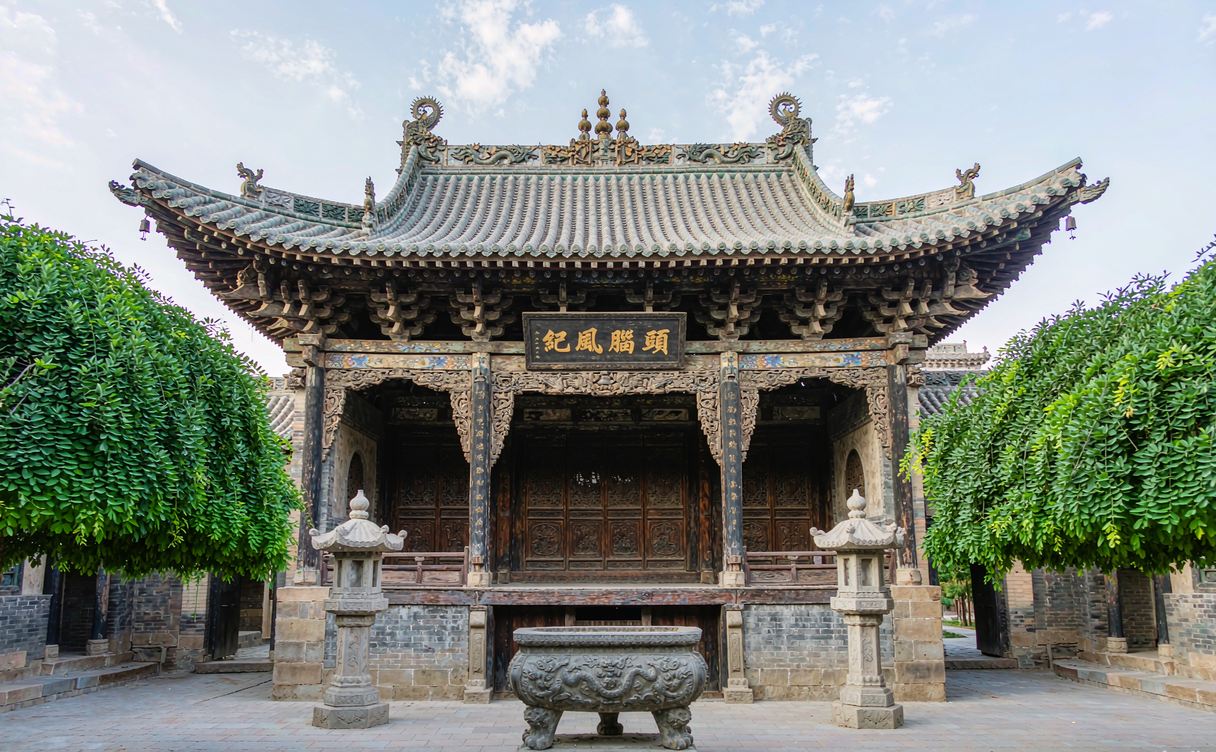
Huangcheng Xiangfu tickets hours
Admission runs on a single combined ticket rather than a string of separate ones, so one price covers the mansions, the Chen Tingjing exhibition halls and the agricultural park below the wall. Expect to pay on the order of 100 to 120 RMB for an adult, with small discounts for students and seniors and free entry for very young children; the exact figure drifts a little each year, so treat it as a budget guideline rather than a quote. The gate office accepts card and mobile payment, but keep some cash for the tea stalls and snack shops in the village. Opening hours are roughly 8:00 to 18:00 through summer and 8:00 to 17:00 in winter, with last admission an hour before closing. Because the ticket is valid for a full day and the site is walkable, the practical tip is simply to arrive at opening.
How to get to Huangcheng Xiangfu from Jincheng
The common question is how to get to Huangcheng Xiangfu from Jincheng, and the answer is easier than the map suggests. Take a high-speed train to Jincheng East station from Taiyuan South (about two and a half to three hours) or from Xi’an, then pick up the direct tourist shuttle or a long-distance bus bound for Yangcheng; the run is around forty kilometres and takes forty-five minutes to an hour on the Jinyang expressway. Frequent buses also connect Jincheng with Yangcheng county town, from where a twenty-minute taxi or shared ride finishes the trip. Driving gives you the same road and roughly a one-hour transfer from Jincheng, and the last stretch exits at Beiliu and is well signed. Our Jincheng travel guide covers the city-side buses, the station layouts and where to stay if you would rather sleep in the old city than in the village.
The Huangcheng Xiangfu walking route
A well-planned Huangcheng Xiangfu walking route takes about three to four hours and works best clockwise from the main gate. Cross the small stone paifang first: the four-pillar, three-gate archway of 1704 records the clan’s record of nine jinshi degree holders and six Hanlin academicians across three generations. Turn inward into the outer city and walk the axial sequence – the imperial calligraphy tower with Kangxi’s own characters, the residence hall known as Dianhan Tang, the steward’s quarters, the young ladies’ courtyard, the western garden and the family school – then cut through the north gate into the inner city. Climb Heshang Tower, the great defensive keep of 1632, whose seven storeys (the lowest sunk below ground) rise about twenty-three metres without a single timber beam; its lower floors once held a well and a mill for a thousand refugees, and a secret passage ran out of the compound. Finish along the wall through the soldier tunnels and the shrine courtyards before the midday tour buses arrive.
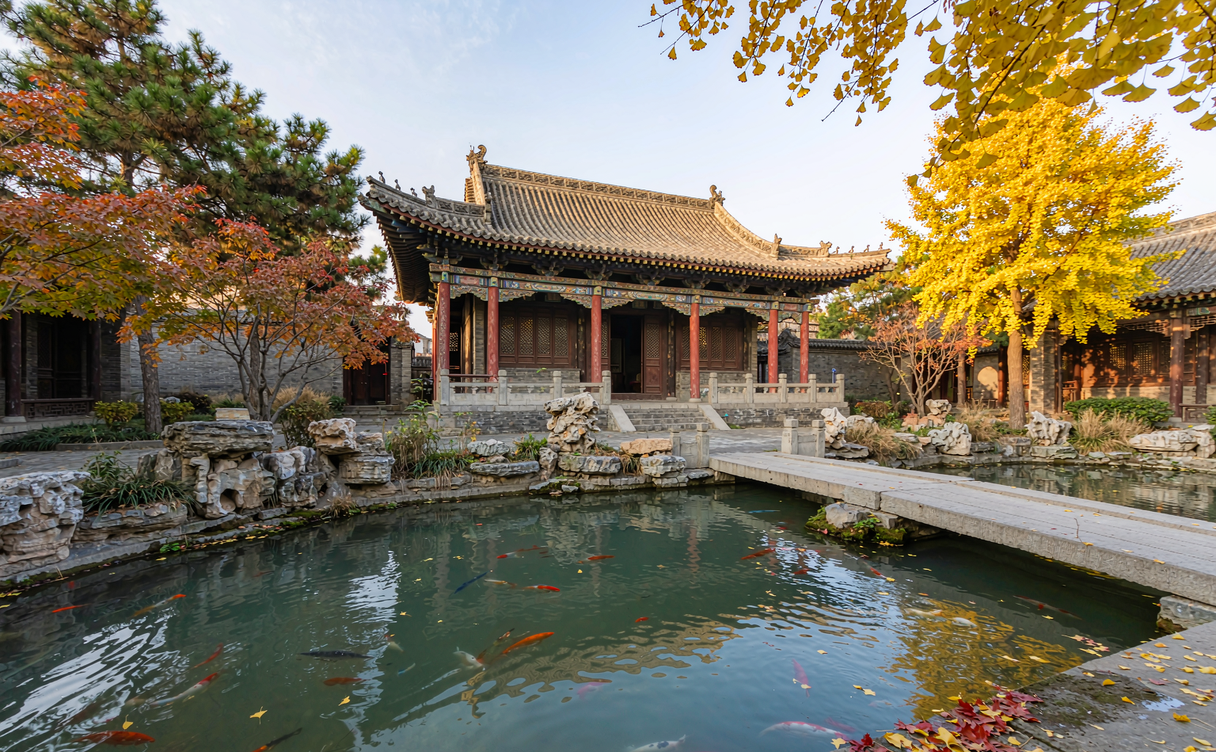
Huangcheng Xiangfu versus Wang family courtyard
The pairing visitors ask about most is Huangcheng Xiangfu versus Wang family courtyard, and the short answer is merchant money against official rank. The Wang Family Courtyard in Lingshi County was built by a trading clan over more than a century: a hillside swarm of grey-brick courtyards, steep alleys and watchtowers, raw and theatrical, best seen with a guide and good shoes. Huangcheng Xiangfu is the house of a man who was, in effect, the emperor’s civil servant and literary editor, so the detail is finer – carved screens, painted beams, imperial plaques – while the fortification is genuinely military. If your taste is for scale and drama on a hillside, our Wang Family Courtyard guide explains that site in depth; if you want the compact, film-famous version, compare it with the Qiao Family Compound near Qi County, which you can see in an hour.
Best time to visit Huangcheng Xiangfu
The best time to visit Huangcheng Xiangfu is late spring and autumn: April to June, and September to October, when the mountain air is clean, the light is strong on the carved stone and the village is not yet hot. The site sits a few hundred metres above the plains, so summer afternoon heat here is gentler than in Taiyuan, though the crowd peaks in July and August. Winter brings hard frost and near-empty courtyards, which is the most atmospheric way to photograph the grey brick. Whatever the month, come in the morning: from opening until about 10:30 you get the walls almost to yourself. Avoid the National Day holiday in early October and the Spring Festival week if you dislike queues.
Building a longer trip around this? Our round-up of the best things to do in China shows how a Jincheng day trip slots in beside the bigger set pieces of the country.
Practical tips for foreign visitors
Three things make the visit smoother. First, this is a living village, not a museum set: families still live inside and around the outer city, so keep your voice down in the residential lanes and ask before photographing doorways and people. Second, signage is mostly Chinese with a scattering of English, and the story you need – Chen Tingjing’s long service, the Kangxi dictionary, the two imperial visits – is rarely explained in English at the right moment. Hire a guide at the entrance for an hour or two, or buy the handset audio story; the difference between a walk and an understanding is large here. Third, wear real shoes: the route climbs stone steps, steep ramps and a tower with narrow ladders, and it is exposed to sun for much of the way. Bring water in summer and a layer in autumn, since the elevation takes the wind off the plain but not off your neck.
Nearby to add to the day
The main ticket already reaches further than the mansion. Two kilometres east lies Guoyu Ancient City, a compact Ming and Qing walled village with its own watchtowers and ramparts, easy to combine on the same morning. North of Yangcheng, Tian Guan Wangfu is another peaks and courtyard compound built by a different official family, and the Nine Girls Lake reservoir offers a cooler boat trip if the heat arrives. Foodwise, look for Yangcheng roast liver and the clay-pot meat stew of the county, both of which turn up in small shops along the approach road.
Two fortresses in one afternoon is realistic, and the village makes a quiet overnight base. Our Taiyuan travel guide helps you line up the capital with the courtyards before you fly home.
Where to go next in Shanxi
Shanxi rewards a slow pace, and Jincheng is an unusually good entry point: the high-speed line puts you within reach of the capital, the Pingyao merchant towns and the temple hills further north. For background on the whole region, Lonely Planet’s Shanxi destination guide is a useful first read if this is your first stop in the province, and it pairs neatly with the material above.
Save this page before you book, and pair the fortress with a Pingyao or Taiyuan leg on the same trip.