

Most visitors to the Yangtze delta never hear the river before they see it. I mean that literally: the Qiantang River tidal bore arrives as a wall of white water and a low freight-train rumble that you feel in your chest before it crests the bank. Haining, a county-level city tucked between Hangzhou and Jiaxing, is the single best place in China to watch this happen, and I’ve stood on its seawall with travelers who planned a half-day and stayed for two. This Haining travel guide is the briefing I give them: when the water comes, how to read the timetable, where to stand, and what the old salt town of Yanguan offers once the tide has gone.
Haining sits about 60 km east of Hangzhou and 100 km southwest of Shanghai, in flat northeastern Zhejiang where the Qiantang estuary funnels the East China Sea into a narrowing funnel. That geography is the whole show. As the tide pushes up the widening-then-narrowing mouth, the water stacks into a single wave that can run 1–3 m high and travel at 30–40 km/h. Locals call it the “tide of the world” (天下第一潮), and on a good day it earns the name. Background on the river itself is well covered on Wikipedia’s Qiantang River page if you want the hydrology before you go.
Qiantang River Tidal Bore Viewing: The Main Event
For Qiantang River tidal bore viewing, the classic seat is Yanguan (盐官), the ancient town on the north bank where a purpose-built tide park and a long seawall give you an uninterrupted front-row line. The bore sweeps past here roughly head-on, which is the most theatrical angle — you see the line of foam appear far downriver, grow, and slam into the wall in a single move. Arrive at least 90 minutes early: the park fills, and the best railing spots go to the first arrivals. A second, free and stranger viewpoint is Laoyancang (老盐仓), a few km east, where the wave hits a spur dike and “returns” in a second crest — the locals’ favourite trick of the river.
Practicalities: the Yanguan tidal park ticket runs about ¥70–100 depending on season, and it includes the riverside walk and the viewing terraces. Bring nothing you’re not willing to get wet — on a big tide the spray jumps the wall. Keep children and cameras well back until you’ve judged the height; the bore’s timing and size vary more than the timetable suggests.
A Haining Tide Timetable for Visitors
A Haining tide timetable for visitors is published daily, and you should treat it as a forecast, not a promise. The bore follows the moon: it’s largest around the 18th day of the eighth lunar month (the “birthday of the tide god”) and at each new and full moon, then tapers between. The actual arrival time shifts roughly 15–40 minutes later each day, so the printed time for the 18th is useless a week later. I tell clients to check the current-day timetable on the county tourism board’s notice or at the hotel desk the morning of their visit, then aim to be in position an hour before the listed time.
The season runs year-round, but the window from mid-September to mid-October is when the bore is reliably at its tallest and the crowds are part of the spectacle. If you’re building a wider trip around festivals, our China festivals calendar guide marks the lunar dates so you can line this up with other regional events.
Yanguan Ancient Town Haining: Salt, Sea Gods and Scholars
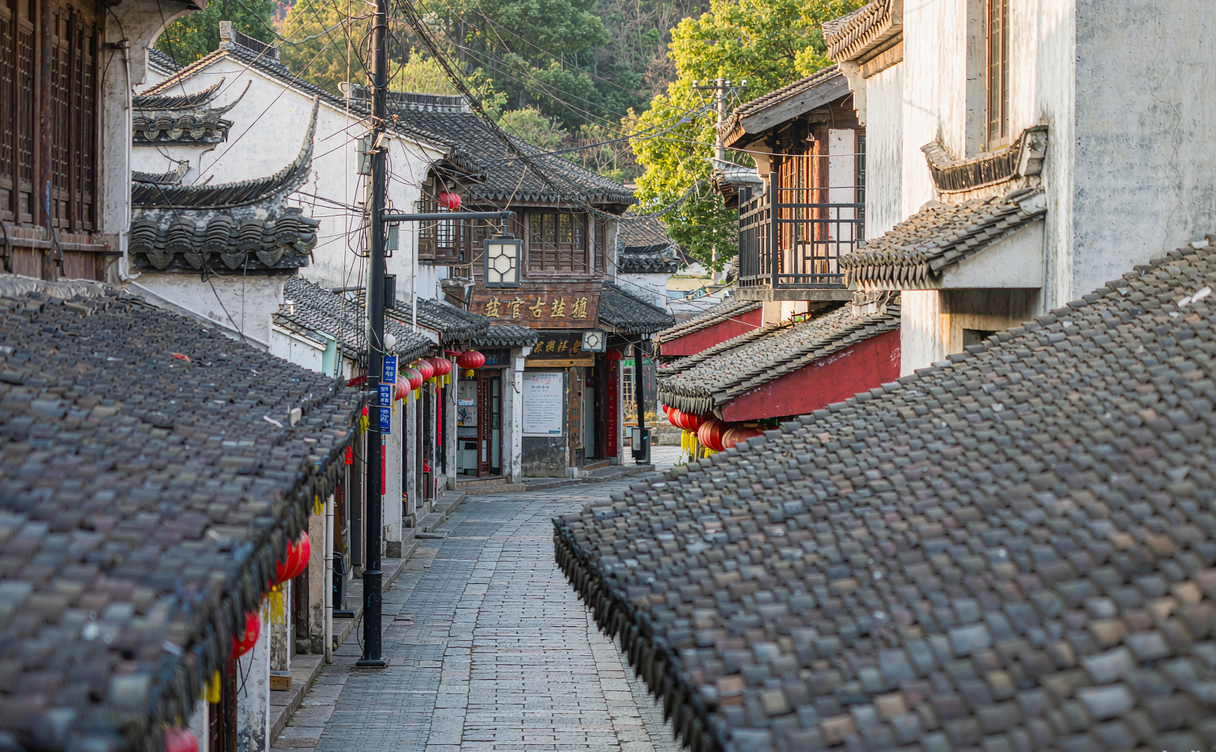
Yanguan ancient town Haining is the reason to stay overnight rather than bolt back to Hangzhou. This was a salt-administration town for a thousand years, and its grid of canals, gates and official courtyards still reads as a small walled city. The standout buildings are the Sea God Temple (海神庙), a ponderous Qing-era complex of stone columns and a nine-room hall built to propitiate the tide, and the former residence of Chen Yuanlong (陈阁老宅), a scholar’s courtyard with fine carved beams. A combined heritage ticket covering the temple, the residence and the tide park runs roughly ¥120–150; individual halls are ¥20–40.
The town is also the hometown of the poet Xu Zhimo, and his former residence in the Xiashi district of Haining draws literary pilgrims. After dark the canals quiet down and the lanterns come on, which is the moment the place stops feeling like a sight and starts feeling like a town. For a slower alternative to the big cities, the Jiaxing travel guide pairs well here, since Jiaxing’s canal core is only a short hop north.
How to Get to Haining from Hangzhou
The practical answer to how to get to Haining from Hangzhou is high-speed rail. Trains run from Hangzhou East to Haining West (海宁西站) in about 20–30 minutes for ¥20–35, and to Haining station nearer the old town in similar time. From Haining West, a bus or taxi covers the 25 km to Yanguan in 30–40 minutes for ¥50–80. If you’re coming from Shanghai, the Shanghai first-time travel guide explains the hub; allow 1–1.5 hours by train to Haining, making this an easy long day trip from either metropolis.
Within Haining, local buses to Yanguan leave from the county bus hub for ¥5–8, but they stop constantly — fine if you’re in no hurry, frustrating on tide day when you want to be early. A ride-hail or private car is the calmer choice. Parking at the tide park is ¥10–15.
Best Time to Visit Haining
The best time to visit Haining is mid-September to mid-October for the tallest bore and the tide festival, with the lunar 18th of the eighth month as the headline date. Spring (April–May) and autumn (October–November) are also pleasant for walking Yanguan’s streets without the crowds. Avoid the plum-rain weeks of June, when drizzle flattens the river light, and July–August, when heat and humidity sit at 33–37°C and the seawall offers no shade. For wider planning, our best time to visit China guide lays out the regional climate so you can stack Haining onto a delta route.

Food, Stay and a One-Day Tide Plan
Haining eats from the river and the field. Try the qiantang river shrimp, simply steamed, and the local “haine” rice cakes; the West Lake Hangzhou guide is a good companion read for the wider Zhejiang table. A riverside dinner for two runs ¥140–240. Lodging ranges from Yanguan guesthouses (¥250–450) to county-town business hotels (¥300–600); on festival nights book early or sleep in Hangzhou and train in.
A workable plan: arrive Yanguan the afternoon before, walk the Sea God Temple and canals at dusk, sleep in town, then be on the seawall 90 minutes before the next morning’s bore, watch it twice if you can (Yanguan then Laoyancang), and train back to Hangzhou by early afternoon. Realistic spend for two: ¥140–200 transport, ¥300–600 lodging, ¥250–400 tickets and food. The bore is free to watch from the public seawall outside the paid park, but the park’s terraces are worth it for the sightlines.