

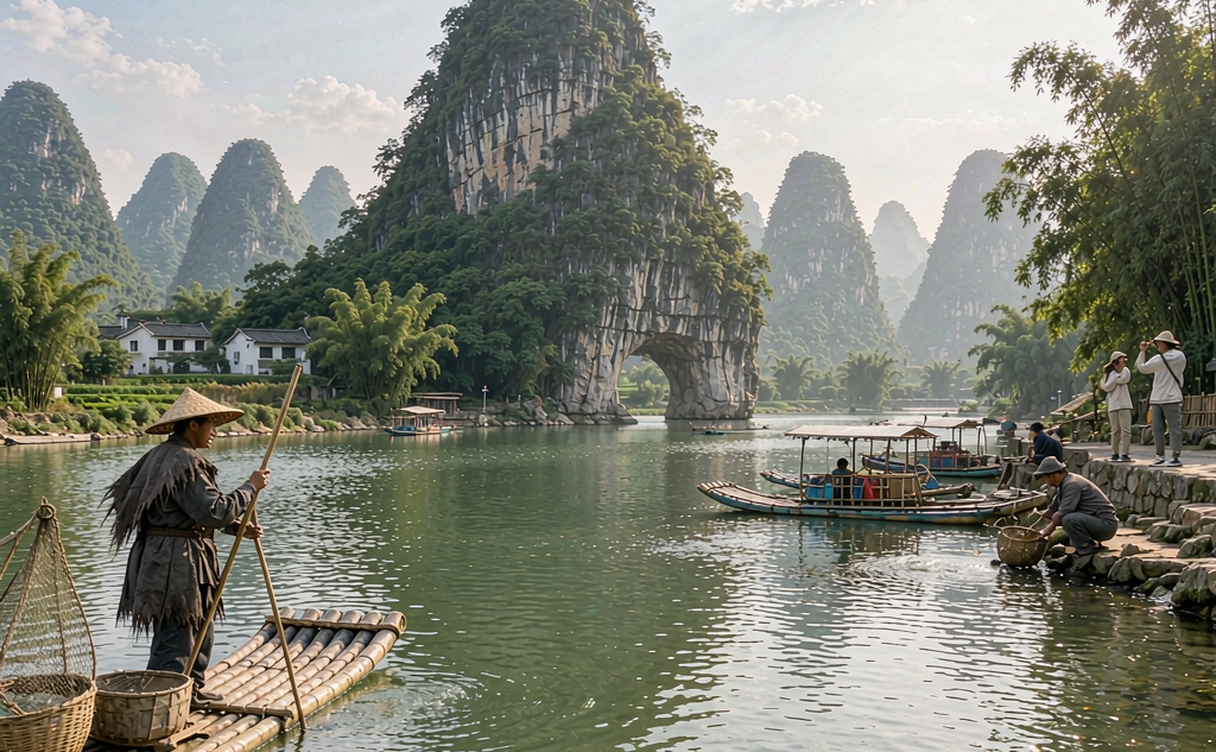
Guilin sits in a corner of Guangxi where limestone karst hills rise straight out of the river like ink-brush paintings, and for good reason the old saying goes “Guilin’s scenery is the best under heaven.” A Guilin travel guide needs to do more than list viewpoints — the magic is in the slow mornings on the Li River, the mist over terraced rice fields, and the bike rides between villages that most day-trippers never reach. This is how to plan it properly.
Best time to visit Guilin
The two standout windows are April to June and September to early November. Spring brings regular rain, which sounds bad but actually creates the low clouds and mist that make the karst peaks photogenic — book a Li River cruise on a misty morning and you’ll understand the paintings. Autumn is drier, cooler, and the Longji rice terraces turn golden for the harvest (late September–October), the single best time to pair Guilin with the terraces.
Avoid the July–August heat (35°C+, humid) and the Golden Week holiday in early October, when Yangshuo’s West Street is shoulder-to-shoulder. For Guilin specifically, spring mist and autumn gold are the targets — and if your dates are fixed, the terraces and the river each have their own best windows worth checking before you book transport.
How to get to Guilin
Guilin Liangjiang International Airport has direct flights from major Chinese cities (Beijing, Shanghai, Guangzhou, Chengdu, Xi’an) for roughly RMB 600–1,500 one-way depending on season, plus a few regional international routes. Far easier for most is the high-speed rail: Guangzhou to Guilin is about 3 hours (RMB 165–315), Shenzhen about 3.5 hours, Changsha around 2.5 hours, and Guilin is now on the main south–north line so connections from further afield are simple. The train station is in the city center, 20 minutes by taxi to most hotels (RMB 25–40).
Things to do in Guilin city
You don’t need many days in the city itself; the surrounding scenery is the point. Key stops:
- Elephant Trunk Hill: The symbol of Guilin, a rock arch that looks like an elephant drinking from the river. Small but iconic; go at opening (7am) to avoid tour buses. Detail in our [Guilin Elephant Trunk Hill guide](https://www.chinatravelplaces.com/guilin-elephant-trunk-hill/).
- Reed Flute Cave: A lit limestone cave 6km northwest of town with stalactite formations and a sound-and-light show. Cool escape in summer; entry about RMB 90. More in our [Reed Flute Cave guide](https://www.chinatravelplaces.com/guilin-reed-flute-cave/).
- Sun and Moon Pagodas: Twin pagodas on Shanhu Lake in the city center, beautiful lit up at night. Free to view from the shore; our [Sun and Moon Pagodas guide](https://www.chinatravelplaces.com/guilin-sun-moon-pagodas-guide/) covers the best angles.
- Two Rivers and Four Lakes: An evening walk or boat ride (RMB 210) linking the city’s waterways with floodlit hills.
The Li River cruise: Guilin to Yangshuo
The signature experience is the Guilin to Yangshuo cruise — about 83km of river threading between peaks, fishing cormorants, and villages. The classic government-operated boat departs Mopanshan Pier (near Guilin) and takes 4–5 hours, disembarking at Yangshuo (ticket RMB 210–360 depending on deck/class, book 3–7 days ahead in peak season). Smaller private bamboo rafts run shorter stretches from Yangdi to Xingping and are cheaper (RMB 100–200) but less comfortable in rain. Our full Li River Guilin cruise guide explains which option fits your budget and dates.
For background on the river itself, the Li River page on Wikipedia has useful geography and history.
Yangshuo and the countryside
Most travelers end the cruise and stay in Yangshuo, a town wrapped in peaks with a lively West Street (Xi Jie) of cafés and bars. The real prize is the countryside: rent an e-bike (RMB 40–80/day) and ride the paths between Yulong River, Moon Hill, and the villages of Gaotian. Rock climbing around Karst crags, kayaking the Yulong, and Impression Liu Sanjie — a light show directed by Zhang Yimou on a natural river stage (tickets RMB 320–680) — round it out. Our Yangshuo countryside guide maps the best rides and climbs.

Want the postcard view without the crowds? Book a misty-morning Li River cruise and a sunrise slot at the terraces before they sell out.
Guilin itinerary 3 days
- Day 1 — City and river: Morning at Elephant Trunk Hill and Reed Flute Cave, afternoon stroll around Sun and Moon Pagodas and Shanhu Lake, evening riverside dinner.
- Day 2 — Li River to Yangshuo: Early cruise to Yangshuo, check in, then e-bike the Yulong River loop and Moon Hill; catch the Impression show at night.
- Day 3 — Longji terraces (or a second Yangshuo day): If terraces are in season, take a 2.5-hour bus from Yangshuo/Guilin up to Longji for the day; otherwise spend Day 3 climbing and kayaking around Yangshuo before your evening train out.
If you have a fourth day, Longji easily justifies an overnight in a Zhuang or Yao village guesthouse (RMB 120–250/night including meals).
Food and local flavors
Guilin’s cooking leans into the region’s rice, river fish, and preserved vegetables. Don’t leave without trying Guilin rice noodles (mifen) — a breakfast bowl of thin rice noodles in a savory broth with pickled long beans, peanuts, and chili oil, eaten standing at a corner shop for RMB 8–15. In Yangshuo, beer fish (pijiu yu) is the signature: local river fish braised with tomatoes and beer, sour-sweet and rich, around RMB 60–90 for a plate to share. Street barbecue, stuffed tofu, and osmanthus-scented sweets round it out. A full dinner for two with beer runs RMB 100–200 at a local spot, three times that at a West Street tourist restaurant.
Getting to Longji from Guilin
The terraces deserve their own logistics note. Buses leave Guilin’s North Station or Yangshuo for Longsheng (RMB 45–65, 2.5–3 hours), then a shuttle climbs another 30–40 minutes to the Jinkeng or Ping’an terrace areas. The last shuttle down leaves mid-afternoon, so an overnight stay beats a rushed day trip — guesthouses in the villages cost RMB 120–250 including a home-cooked dinner. The climb to the best sunrise viewpoint (Golden Buddha Peak) is a 20-minute cable car (RMB 60) or a stiff walk; be at the rail by 5:30am in autumn. The village-by-village breakdown is in the dedicated Longji terraces guide.
Practical costs and booking
Daily budget runs roughly RMB 350–600 per person backpacker-style (hostel RMB 80–150, local meals RMB 25–50, transport RMB 50–100), or RMB 800–1,500 mid-range with a 4-star hotel and cruise. Book the Li River cruise and Impression show ahead; everything else can be arranged on arrival. The cruise in particular sells out on weekends and holidays, so treat it as the one fixed anchor of your plan and build the other days around it. If you’re combining Guilin with Yangshuo and Longji, a pre-booked private driver for the Longji leg saves the hassle of piecemeal bus transfers. Carry some cash for village vendors, though Alipay works almost everywhere else.
Three days is enough to fall for Guilin — build your 3-day itinerary now and lock in the cruise and show before peak season closes the window.
Getting around and staying safe
Within Guilin city, buses and Didi (ride app) are easy; in Yangshuo, e-bikes and rented bikes rule. The river cruise is the main long-distance hop. Weather shifts fast in the hills, so pack a light rain shell even in spring. Standard city precautions apply — watch bags on crowded West Street at night.
From misty peaks to golden terraces, Guilin rewards travelers who slow down — start planning your karst-country trip today.
Guilin isn’t a place to rush. Give it the misty morning and the open road, and it returns the kind of view you’ll describe for years.