

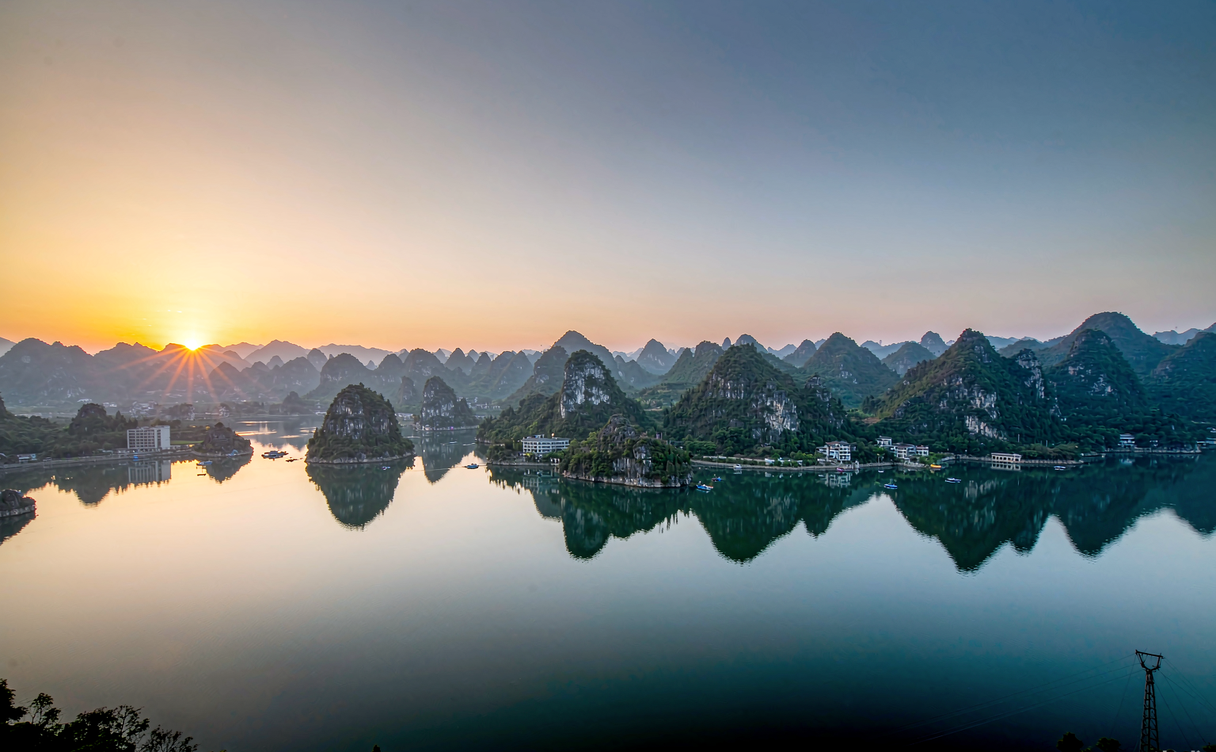
There are few places in China where the hour of the day changes the view more completely than Dongjiang Lake. At midday it is a deep blue reservoir ringed by karst peaks. At six in the morning, for a couple of hours, it becomes a lake inside a cloud: a flat ribbon of white mist on the water between the far shore and the near bank. This Dongjiang Lake guide is about that window, and about arranging a trip so you are standing on the shore when it opens.
Dongjiang Lake sits in Zixing, a county-level city under Chenzhou in the south of Hunan, China, roughly 200 kilometres south of Changsha. The water is not a natural lake but the reservoir behind the Dongjiang Dam, built to generate power from the upper Dong River, and when the valley flooded it drowned a stretch of river towns and left a shoreline of steep green hills.
Reserve a lakeside room before you do anything else, because the mist photo happens before breakfast and you do not want to spend that hour in a car.
What the Blue Water Actually Is
The colour people come for is real, and it comes from depth rather than filters. Dongjiang Lake holds water to more than a hundred metres in its deepest troughs, and the watershed above the dam is forested and free of heavy industry, so the load of suspended sediment is very low. Light comes back up off the lakebed almost without turning brown, and the water reads as a blue-green that photographs as turquoise in bright sun and near-black in shadow.
The dam is also part of the attraction, and most visitors never get closer to it than the road, which is a mistake: the viewpoint is a short walk from the parking area and puts the whole system in one frame.
Where the Morning Mist Comes From
The famous sight is not weather in the ordinary sense; it comes from the way the reservoir is operated. Water released for power and for the ecological supply of the cities downstream leaves from the bottom of the reservoir, where it has been sitting in the cold deep, and enters the upper river several degrees colder than the surface water of the same channel. When that cold inflow meets warm, humid air on a still morning, the air cools to its dew point and condenses into a low, flat cloud that hugs the surface and refuses to rise.
That is why the effect is so consistent. It is not luck on one morning a year, but a regular product of a hydropower and water-transfer system, and it appears most often when the air is damp and the night calm. Locals will tell you the mist is thickest in the warm months, roughly April through October, after a rainy night, and thinnest in winter, when the water and the air sit at the same temperature and there is no contrast to condense.
So a bright, windy morning can disappoint you and a grey, damp morning can give you the shot of your life. Do not reschedule around a clear blue forecast, because the lake on a hard bright morning is worth an hour on its own.
Best Time to Visit Dongjiang Lake
The short answer is that the best time to visit Dongjiang Lake is the hour after sunrise, and the best month is one with rain in it.
Six to eight in the morning. The window. The mist is densest just after the first light, thins as the sun lifts, and is gone before ten. Plan to be at the shore by half past five in summer and closer to six in winter, when sunrise is later.
April to October. The season with the highest probability of a good morning. Warm, damp air plus a cold released inflow is the recipe, and the warm months supply the first ingredient for free.
Late autumn and winter. Fewer mist mornings, far fewer visitors, water at its clearest. If you want empty boardwalks and hard blue reflections, this is the better choice; if you want the fog, come in a wet spring.
Public holidays. Chinese New Year and the May and October holiday weeks bring heavy crowds to the shore road, so choose a weekday inside any of them.
Dongjiang Lake Boat Cruise Tickets and the Boat Choices
The boat is the second half of the visit. From the main pier near the dam you can take a large sightseeing cruise that circles the middle of the lake, a smaller cabin boat on a shorter route, or a speedboat up into the narrow upper channel where the fog sits in the coves. Prices sit budget-friendly to mid-range depending on the class of boat and the season, and they are posted at the ticket office; there is no need for a private charter unless you are photographing with a group.
Tickets for the whole scenic area bundle the shore shuttle, the pier access and the cruise, with separate tickets for the boardwalk sections. The shuttle buses loop between the visitor centre, the dam viewpoint and the pier, and they are the only practical way to move inside the park, so budget fifty minutes from the entrance to the water. Bring a soft bag rather than a hard suitcase if you are staying inside the area, and a windproof layer even in August: standing still on an open deck before dawn on this lake is colder than summer visitors expect.
How to Get to Dongjiang Lake from Chenzhou
Chenzhou is the gateway, and this is the honest answer to how to get to Dongjiang Lake from Chenzhou: take a train to Chenzhou, then go overland for about an hour.
By high-speed rail. Chenzhou West is on the Beijing-Guangzhou high-speed line, with frequent services from Changsha and Zhuzhou in the north and Guangzhou and Shenzhen in the south. From there take a taxi or the coach toward Zixing and ask for the Dongjiang scenic area; the run is roughly an hour on the road depending on which gate you are heading for.
By conventional train or air. Chenzhou station serves the slower Beijing-Guangzhou line and sits closer to the old bus station, which makes it the simpler arrival point if you want a coach straight away. Chenzhou Beihu Airport handles a modest set of domestic connections and saves a train ride only if you are already flying into the city.
By car. A private car with a driver for two days is easiest if you want Gaoyiling, Yangtianhu or Mangshan in the same trip. The roads are good and the distances short.
Visitors from Hong Kong, China or Macao, China will find the high-speed link into Chenzhou makes this a natural add-on to a southern China itinerary rather than a dedicated flight.
Where to Stay: Dongjiang Bay and the Lakeside Road
Stay on the water. The lake area has hotels and guesthouses along the shore between the dam and the town, and the point of paying for one is the five-minute walk to the boardwalk before sunrise. Rooms a few hundred metres back are cheaper but add twenty minutes to a pre-dawn walk in the dark, which is not the trade you want. Zixing city is ten to twenty minutes inland by car and offers the widest hotel choice and the best dinners.
Ask when you book whether the room faces the water and whether the window opens. Both matter more than the star rating here, and neither is guaranteed by a booking app list.
Combining the Lake with the Hills Around It
Dongjiang Lake rewards a slow pace; the region around it rewards a slightly wider one. Three neighbours make a good four-day loop.
Mangshan. A national forest park to the south, on the border with Guangdong. Old rhododendron forest, waterfalls, a cable car up to the Wuzhi Peak ridgeline, and hot springs at the base. Cooler than the lake by several degrees.
Yangtianhu Grassland. Rolling high-altitude pasture in the north of Chenzhou with wind turbines across the skyline and wild horses in summer.
Gaoyiling. A red danxia ridge near Chenzhou city with a boardwalk along the crest. It pairs badly with a misty morning and well with a clear afternoon.
Give the lake two mornings, not one, and put the second on a day the forecast looks worse than the first.
Photographing the Mist
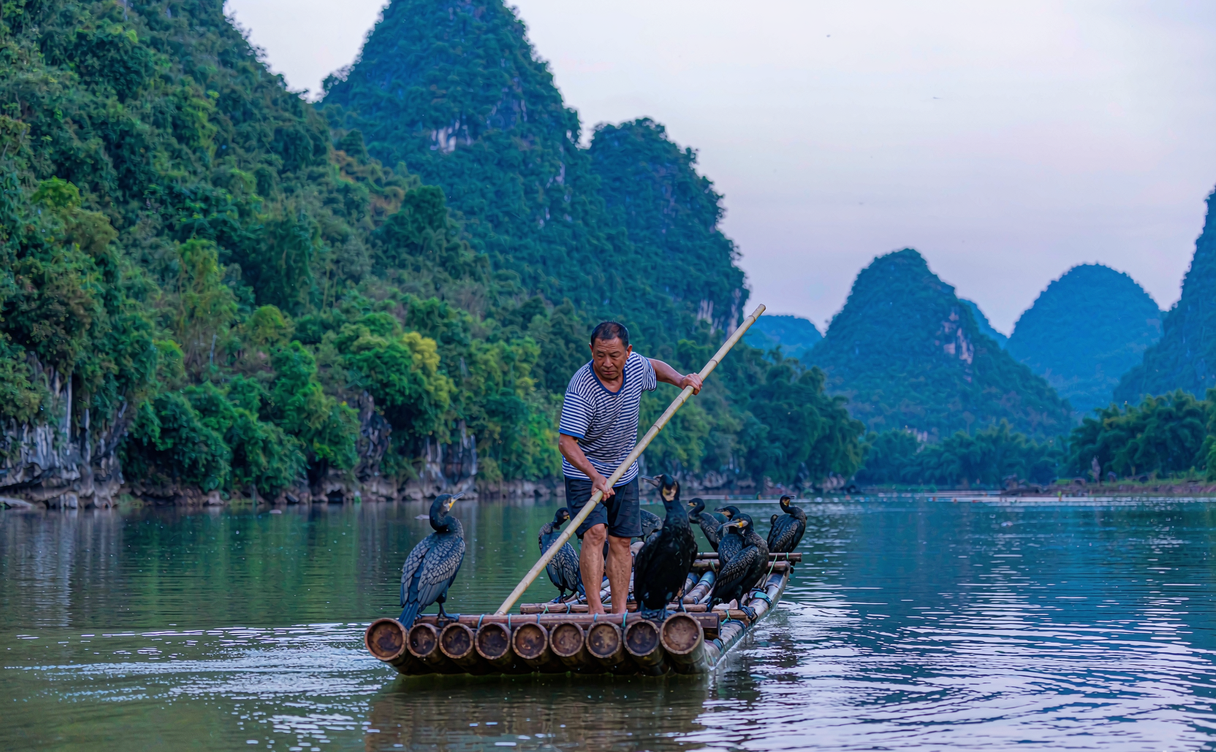
The mist photographs badly from a hotel window and well from a low platform. Get to the boardwalk before the light, use a wide lens for the ribbon of fog against the far hills, and expose for the water rather than the sky or you will blow the highlights out of the white. A polariser deepens the blue-green by a stop and is the most useful filter to carry. Shoot low and close to the surface and you keep the mist as a band rather than a blanket. Long exposures on the boardwalk are usually a mistake, because the rafts move.
If the fog is the whole purpose of the trip, the China photography tour guide covers the wider mechanics of shooting in Hunan in the warm wet season, including the same conditions on the rivers and terraces further north.
Mistakes to Avoid
Do not arrive at eight. The boardwalk opens early and the mist leaves early, and every guide you read, including this one, is telling you the same thing.
Do not buy the first boat ticket offered without checking whether the route enters the upper channel: the short loop stays in the open middle of the lake, blue and beautiful and with no fog on it.
Do not judge the morning by the day’s forecast. Call your hotel in the evening and ask whether the locals are talking about fog; the owners know better than any app.
A Hunan Loop That Fits
It helps that Dongjiang Lake sits midway through a province with three other heavyweight attractions, so one trip can give you a reservoir, a mountain and a river gorge without backtracking. A workable five days: two on the lake including Mangshan, a day at Gaoyiling and Yangtianhu, then north to Hengshan Mountain in Hunan and the temple town at its foot, and a final night or two in Changsha for the food and the river.
Push the trip longer and the obvious extension is west, where the Zhangjiajie travel guide covers the sandstone pillars and the boardwalk above the clouds. The full Chenzhou travel guide lists the city’s own markets, hot springs and day trips if you would rather stay local.
Before you book, the best things to do in China puts Dongjiang Lake in the context of a first visit, and the Hunan Provincial Department of Culture and Tourism publishes official listings and seasonal notices for the province.
Pick one morning, set an alarm for it, and build the whole trip around being on that boardwalk before the sun is up.
Dongjiang Lake needs no special equipment, no big budget and no long stay. It needs you there early, on a damp night, with a warm layer in the bag.