

Most foreign visitors to Sichuan fly into Chengdu and never look beyond the city limits. That is a mistake. A 30 minute high speed train ride north brings you to Deyang, a slow paced prefecture level city that sits at the crossroads of some of Sichuan’s oldest stories. If you are building a Deyang travel guide into your wider Sichuan plans, you get Bronze Age archaeology, quiet Confucian courtyards, Three Kingdoms battle passes and easy access to some of the province’s best panda country, all without the crowds of the provincial capital.
Deyang is often described as a Chengdu satellite, but it deserves its own day or two. The city proper is compact and walkable, the food is hearty Sichuanese without the tourist markup, and the surrounding county towns hold surprises that most guidebooks skip entirely. This Deyang travel guide covers how to get there, what to see, where to eat and how to build a relaxed itinerary that actually fits a real trip.
Getting to Deyang and getting around
The simplest way to arrive is by train. Chengdu East or Chengdu North stations run frequent high speed services to Deyang, and the trip takes between 20 and 40 minutes depending on the stop pattern. Tickets cost a fraction of what a private car would, and the station sits close enough to the old city that a short taxi gets you to your hotel. Many travelers use Deyang as a base for a Deyang to Chengdu day trip in reverse, sleeping here cheaply and commuting into the capital for sights they cannot miss.
If pandas are your priority, the obvious pairing is the Chengdu panda and city guide on our site, which explains the Chengdu Research Base and how to time your visit before the midday heat. Deyang itself is a sensible place to stay if you want to beat the Chengdu morning rush at the panda base, since you can catch an early train and still arrive before the gates open. For a fuller Sichuan overview, the Chengdu travel guide on our site walks through transport passes, the metro and day trip logistics that also apply to Deyang. The two cities share the same rail network, so a China Railway account set up for Chengdu works seamlessly here.
Sanxingdui and the Bronze Age
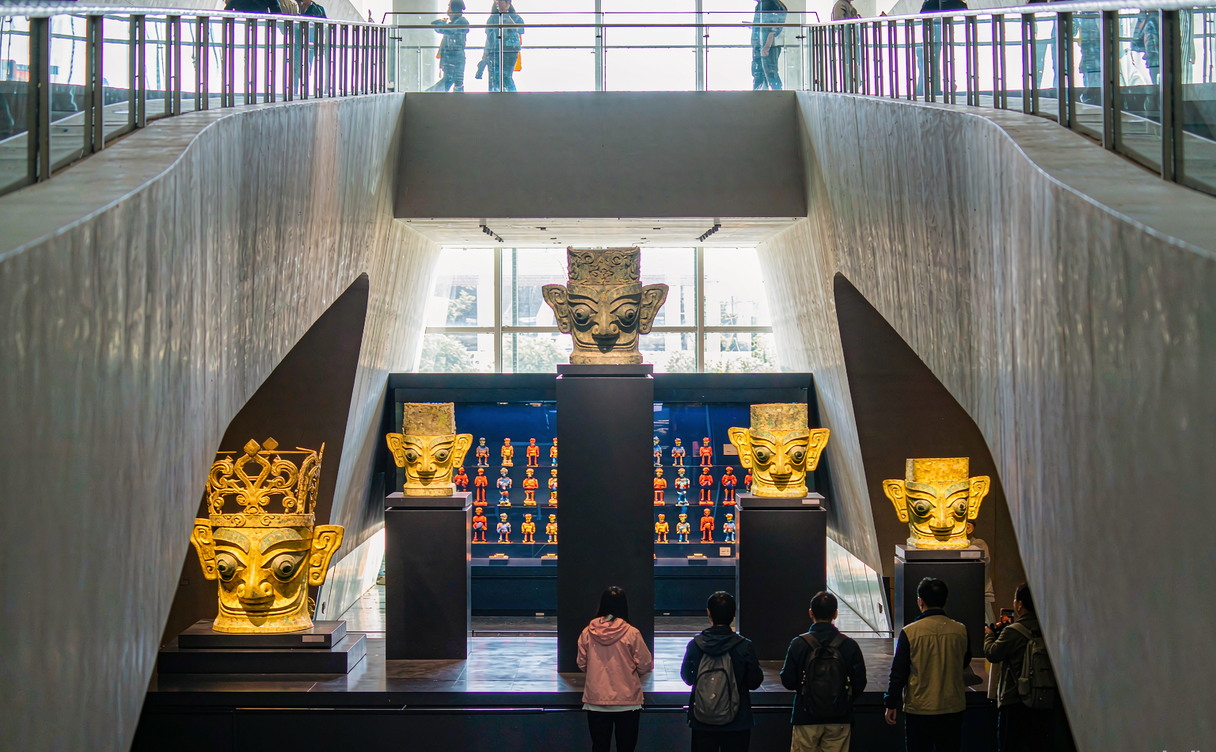
The headline reason many visitors come is the chance to see Sanxingdui. The Sanxingdui Museum sits in Guanghan, a county administered under Deyang, roughly 40 minutes from the city center. The collection of bronze masks, towering figures and gold artifacts dates back more than three thousand years and belongs to a civilization that left almost no written record. Standing in front of the 2.6 meter bronze standing figure is the kind of moment that reframes what you thought you knew about early China, and the famous eyes protruding mask is even stranger in person than in photographs.
Because the finds are so closely tied to the region, we cover the museum in detail in our Sanxingdui museum Chengdu guide, including how to buy timed tickets and why a weekday morning beats a weekend. If you want to connect the dots between sites, the Jinsha site Chengdu guide explains the later culture that appears to have inherited the Sanxingdui tradition after the city was abandoned. Together they tell a story you can follow across the northern Chengdu plain without hiring a private historian.
The Sichuan Giant Panda Sanctuary, a UNESCO World Heritage property, protects panda habitat across several reserves in the broader region, and you can read about its conservation value on the UNESCO listing. While the famous breeding base is in Chengdu, the forested hills around Deyang feed into the same ecological corridor, which is why the air here feels cleaner and the hiking greener than the flat city center suggests.
Ancient towns and Three Kingdoms passes
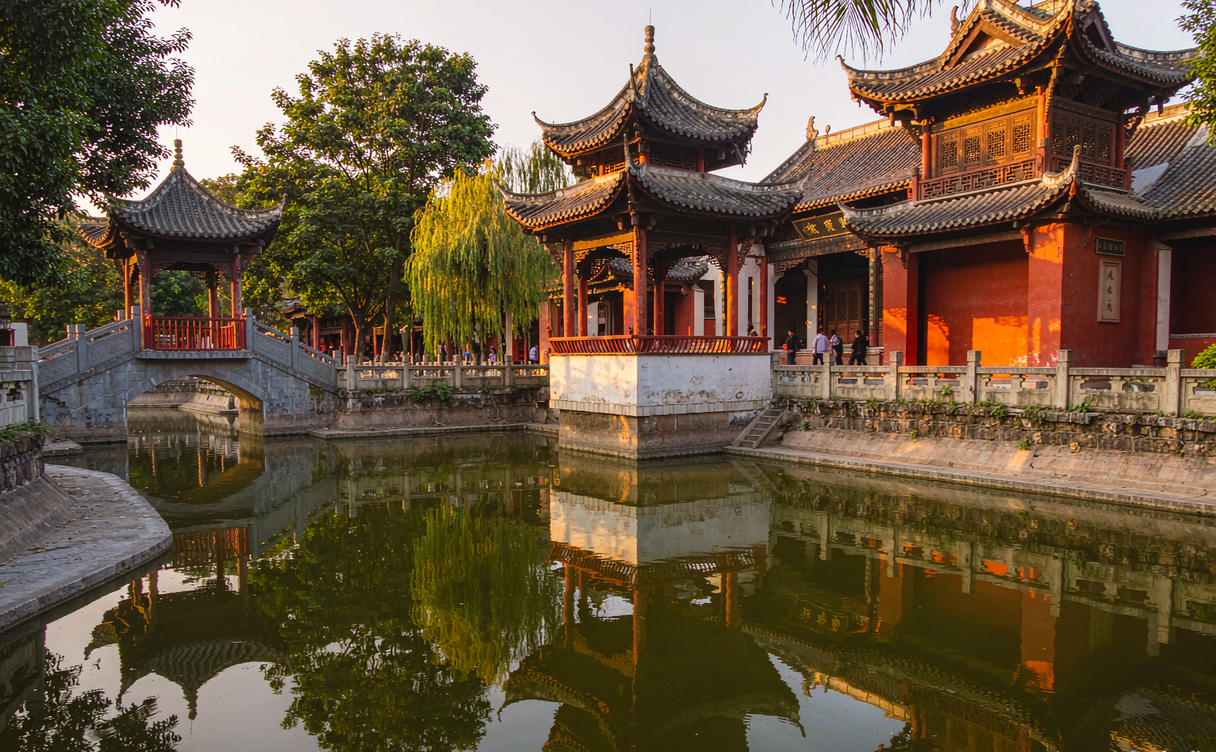
Back in Deyang city, the Confucian Temple, or Wenmiao, is the largest of its kind in Sichuan and one of the best preserved outside the Confucian heartland. The stone archways, the quiet courtyard ponds and the long red wall along the main street make for an easy half morning. Climb the small hill behind it for a view over the rooftops and a sense of how the old walled town was laid out.
Luojiang county, a short bus or taxi ride west, holds Baima Pass, a narrow defile where armies of the Three Kingdoms period are said to have clashed. The reconstructed gates and the riverside trail are more atmospheric than scholarly, but they make a pleasant walk and a good photo stop. Mianzhu, to the northwest, is famous for its New Year woodblock prints, a folk art still practiced in family workshops you can sometimes watch as the carvers pull proofs off rice paper. This is the Deyang ancient town angle most travelers miss: not one walled town but a scatter of craft and history across the prefecture, each reachable on a half day loop.
Food, stay and a simple itinerary
Deyang eats like the rest of Sichuan, with a few local twists worth seeking out. Cold noodles dressed in chili oil, tofu pudding served with pickles, and the salty sweet Mianzhu version of cured sausage are all worth a try, best eaten at a plastic stool joint where the regulars already know the owner by name. Night markets along the river light up after dark with skewer stalls and cheap beer, and the lack of English menus is balanced by the low prices and the friendly curiosity of people who rarely see foreign visitors.
Hotels range from international chains near the station to family run inns in the old town; either way rates run well below Chengdu, and a comfortable double rarely costs more than a budget room in the capital. The best time to visit Deyang is spring, from March to May, and autumn, from September to November. Summer is hot and humid, though the rain clears the air, and winter is cold but rarely freezing. Cherry blossoms line parts of the city in early April, and the autumn light on the temple roofs is the best you will get all year.
A realistic Deyang travel itinerary looks like this. Day one: arrive by mid morning train, drop bags, walk the Confucian Temple and old streets, eat noodles, then train to Chengdu for the panda base the next dawn. Day two: Sanxingdui in Guanghan, back to Deyang for dinner. Day three: Luojiang and Baima Pass, or a loop toward the hills if you want forest air. If you have a fourth day, the Dujiangyan irrigation system guide and the Mount Qingcheng guide describe two nearby escapes that pair naturally with a Deyang base, since both sit on the same rail line heading west from Chengdu.
Deyang suits travelers who like to wander without a rigid schedule. The city is safe, flat and easy to read on foot, and the county trips are short enough that a missed bus is never a disaster. Pack light, keep a translation app handy for the menus, and remember that the relaxed pace is the point rather than a problem to solve.
Deyang will not shout for your attention the way Beijing or Shanghai do. It is a place you choose because you want the texture of real Sichuan life, because Bronze Age mystery interests you more than another shopping street, and because a slow train north of Chengdu turns out to be the most interesting turn your trip takes. Build a loose plan, leave room for a random noodle stall, and let the city unfold at its own pace. The ancient sites, the pandas and the quiet courtyards will still be there tomorrow.