

I arrived at the foot of Mount Qingcheng before the tour buses did, and the mist was still sliding off the cypress trees like smoke off a boiling kettle. There’s a moment, just after you pass the stone archway and the only sound is cicadas, when you finally get it — why this green peak has drawn Taoist hermits, emperors, and wandering poets up its slopes for nearly two thousand years. Mount Qingcheng is one of China’s most sacred Taoist mountains, and standing there in the damp, fragrant hush, it’s easy to believe the legend that Laozi’s disciple Zhang Daoling founded the Taoist school right on this very mountain. If you’re basing yourself in Chengdu and want a day that mixes ancient religion, forest air, and a UNESCO irrigation marvel, this is the trip to make.
Mount Qingcheng (locals say Qingchengshan, a name you’ll see on every train sign) sits about 70 kilometers northwest of Chengdu in Dujiangyan City. It isn’t a single dramatic summit like Huangshan; it’s a cluster of lush, rounded peaks draped in evergreen forest, with temples tucked into the gullies and ridgelines. The whole place feels softer and greener than most Chinese sacred mountains — which is exactly the point. Taoism loves quiet, water, and wood, and qingcheng mountain delivers all three in abundance.
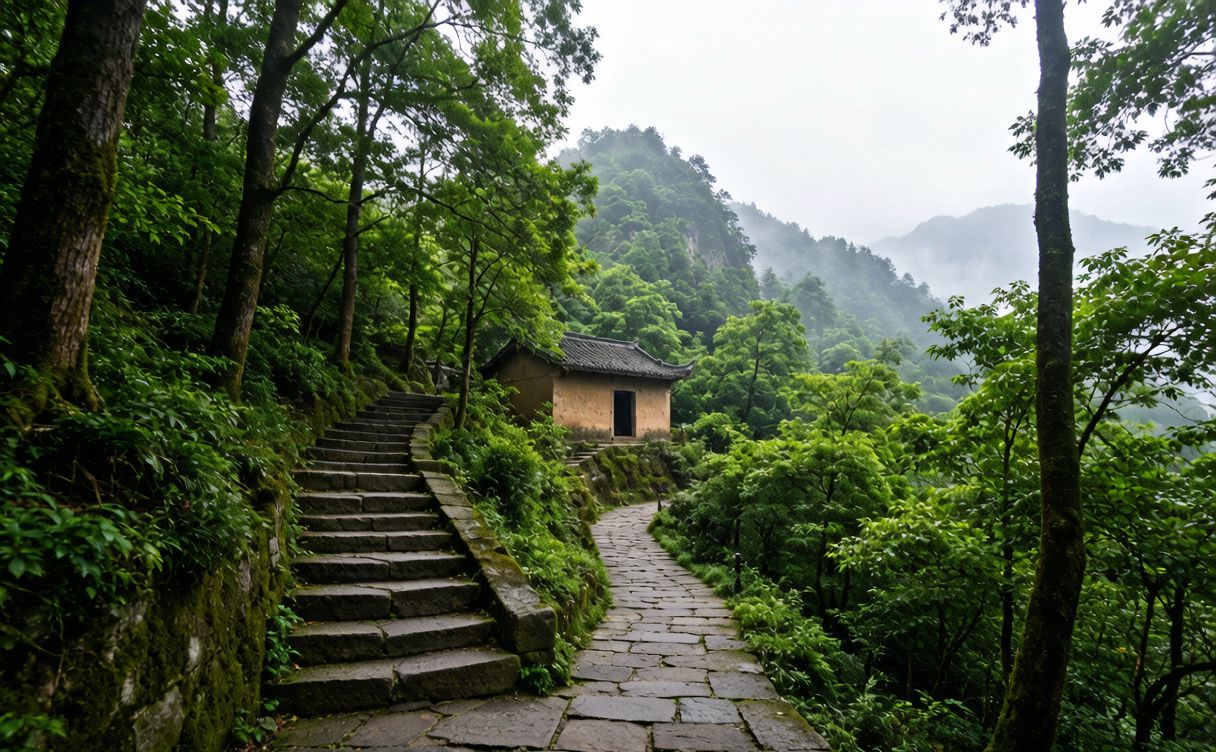
Why Mount Qingcheng Matters
The mountain is the birthplace of the Zhengyi (Orthodox Unity) school of Taoism, founded by Zhang Daoling in the second century AD. For a traveler, you don’t need to care about sect history to feel the weight of it: the mountain is dotted with dozens of temples and shrines, some rebuilt after earthquakes, some astonishingly old, all threaded together by stone paths that smell of moss and incense. UNESCO agrees on its significance — Mount Qingcheng and the nearby Dujiangyan irrigation system were together inscribed as a World Heritage Site in 2000 (you can read the official listing on the UNESCO World Heritage Centre).
When I climbed the stone path past the Jianfu Palace before eight in the morning, I had the forest almost to myself. A caretaker was sweeping fallen leaves into neat piles, and when I asked how many times he walks this route a day, he laughed and said, “Enough to know every stone by name.” That small, unhurried warmth is the real Mount Qingcheng — not the cable-car selfies, but the slow rhythm of a living holy mountain.
Front Mountain vs Back Mountain
This is the single most important thing to understand before you go, because the two halves of the mountain are completely different experiences, and you can’t do both well in one day.
The Front Mountain (Qianshan) is the classic, temple-heavy route. It’s where the headline sights sit: Jianfu Palace, the Shangqing Palace at the summit, the Chalou Pavilion, and the Yuecheng Lake. The paths are paved and well maintained, there’s a cable car for the lazy or the pressed-for-time, and signage is decent. If your interest is Taoist culture and you only have half a day, do the Front Mountain and stop there.
The Back Mountain (Houshan) is wilder and emptier — a hiker’s mountain. The trails are longer, steeper, and far less developed; you’ll cross wooden footbridges, follow a mountain stream, and meet more butterflies than people. I spent an afternoon on the Back Mountain once and saw maybe a dozen other visitors the entire time. A Taoist monk told me, as we rested at a tea stall near the Wulong Gully, that “the front teaches you the rituals, the back teaches you to be quiet” — which is as good a summary as any.
Most first-time visitors from Chengdu do the Front Mountain as a half-day, then pair the other half with Dujiangyan. If you’re a serious trekker, the Back Mountain pairs better with our wider roundup of trails in the China hiking and treks guide.
The Temples and the Climb
The climb from the entrance to the Shangqing Palace at the top is roughly 10 kilometers round trip if you walk both ways, but most people take the cable car up or down to spare their knees. I’d recommend walking up slowly and riding down — walking up means you control the pace and actually notice the small roadside shrines that most bus-tour groups blow past.
The Jianfu Palace at the base is a calm, photogenic complex shaded by ancient trees. Higher up, the Tianshi Cave (Celestial Master Cave) is the spiritual heart of mount qingcheng taoist worship — this is where Zhang Daoling is said to have practiced. It’s a cool, dim warren of halls built into the rock, and even on a busy weekend it keeps a hushed, reverent feel. At the very top, the Shangqing Palace offers the best view: on a clear day you can see the plains rolling toward Chengdu and the Minjiang River cutting through them.
One practical note: the steps are real. Qingchengshan is nicknamed “the most secluded mountain under heaven” (Qingcheng Tianxia You), and “secluded” here means lots of stone staircases. Wear proper shoes, and don’t underestimate the Front Mountain just because it’s the “easy” side.
Mount Qingcheng as a Day Trip from Chengdu
Mount Qingcheng is the perfect half of a Dujiangyan day trip, and almost everyone does them together. The logic is simple: take the high-speed train from Chengdu’s Xipu Station to Dujiangyan (about 30–40 minutes), spend the morning at the 2,300-year-old Dujiangyan irrigation system — still working, still brilliant — then hop the local commuter train one stop to the Mount Qingcheng station and climb the Front Mountain in the afternoon. You’ll be back in Chengdu for a late hotpot, legs pleasantly tired.
If you’d rather not self-navigate the trains, the mountain also fits neatly into a bigger Sichuan itinerary. Many travelers combine it with the giant pandas or push on to Emei. See our Chengdu and Mount Emei guide for a multi-day route that links both sacred mountains without backtracking.
Best Season to Visit
Spring (April–May) and autumn (September–November) are the sweet spots. In spring the mountain is loud with new green and wildflowers; in autumn the cypresses stay green but the maples and ginkgos turn, and the air is crisp. Summer is lush and cool — a genuine escape from Chengdu’s furnace humidity — but it’s also the domestic-tourist peak and the rainiest season, so expect crowds and slippery stone. Winter is quiet and occasionally dusted with snow, which looks magical in photos but means cold, damp climbing.
I went in late October and it was close to perfect: cool enough to climb in a t-shirt by midday, empty enough to hear the stream, clear enough to see the plains from the top. If you’re planning around weather more broadly, our best time to visit China guide maps the seasons across the whole country, and it ranks autumn in Sichuan among the very best windows.
What to Bring
- Sturdy walking shoes with grip. The stone steps get slick after rain, and there are a lot of them.
- A light rain jacket, even in “dry” months. Mountain weather turns fast and without warning.
- Water and a snack. There are stalls, but they thin out fast once you leave the Front Mountain’s main drag.
- Cash or a working Alipay/WeChat Pay setup. Small temple donations and the tea stalls often prefer cash.
- A modest outfit if you’ll enter the active temples — shoulders covered, no shorts inside the halls.
Getting There and Tickets
From Chengdu, the cleanest route is the high-speed train to Mount Qingcheng Station (Qingchengshan Zhan), then a short shuttle bus or taxi to the entrance. Buy tickets in advance where you can, especially on weekends and public holidays. Entry to the Front Mountain runs around 90 RMB, with the cable car extra. The Back Mountain has its own, cheaper entrance on the far side if you’re hiking only.
Mount Qingcheng rewards the traveler who slows down. Skip the rush, take the stairs one breath at a time, and let the green silence do its work. It’s an easy, rewarding day trip from Chengdu, and paired with Dujiangyan it’s one of the best single days you can spend in Sichuan.