

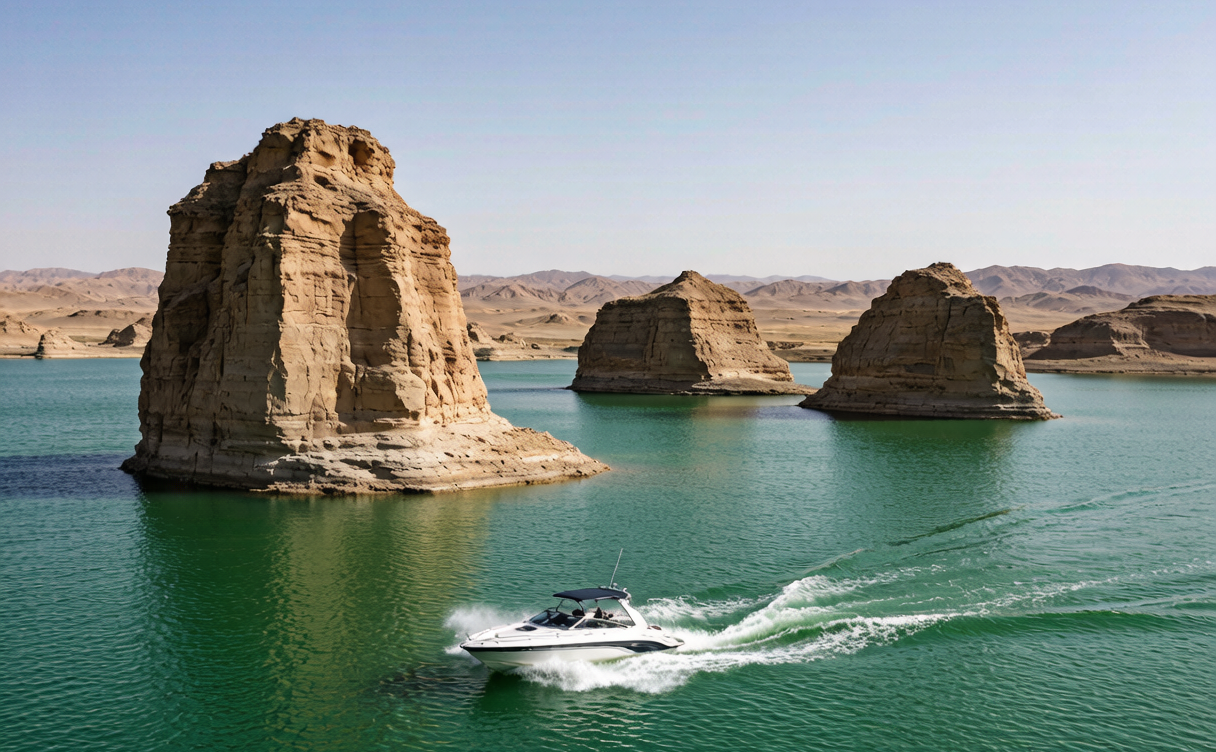
You cannot drive to the best part of this. The boat leaves a jetty on the Liujiaxia Reservoir, ninety minutes southwest of Lanzhou, and for an hour it runs between eroded rock towers with the dammed Yellow River underneath, jade-green and improbably calm. Then the gorge opens and a 27-metre Buddha carved into a red cliff appears above the waterline, flanked by hundreds of niches cut over 1,400 years. This Bingling Temple grottoes guide covers how to organise the day.
Why Visit Bingling Temple
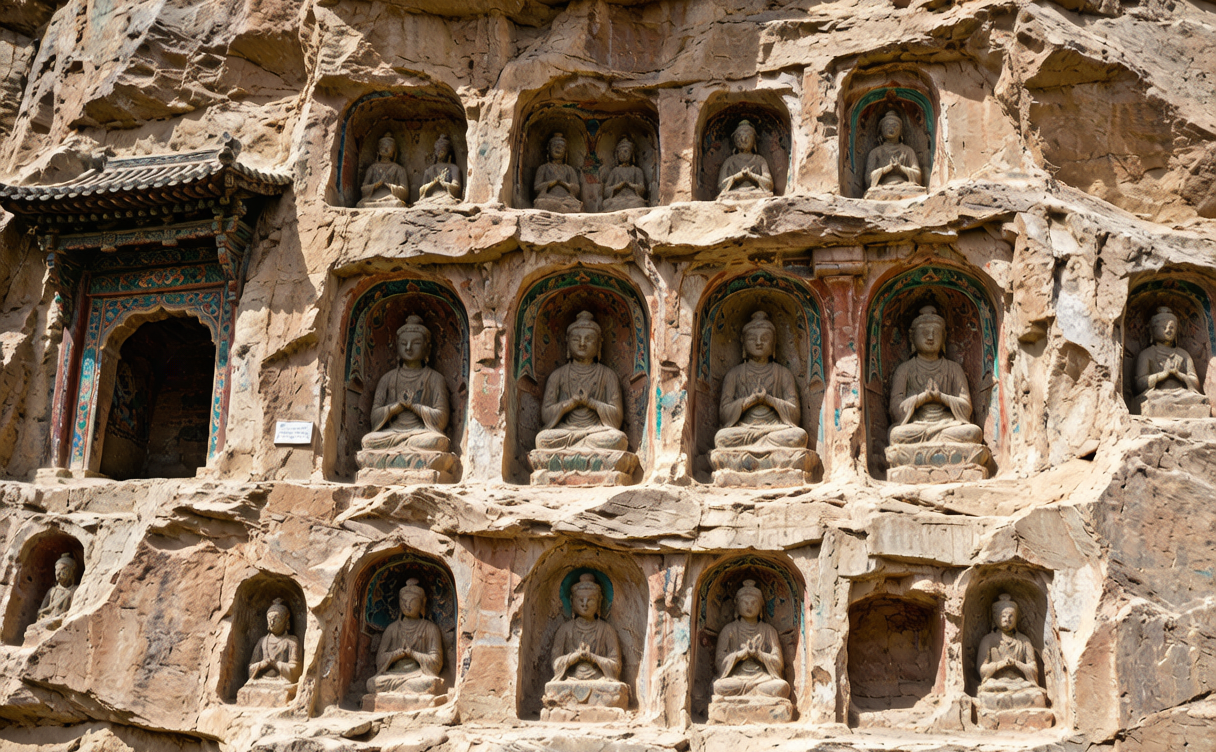
Bingling Si sits in Yongjing County, Linxia Hui Autonomous Prefecture, about 80 kilometres from Lanzhou, in a side canyon of the Yellow River. The complex holds roughly 183 caves and niches containing around 800 statues in stone and clay and something close to 900 square metres of wall painting, carved and repainted continuously from the fifth century through the Tang, Song, Ming and Qing periods.
Its art-historical importance is hard to overstate. Cave 169 carries a dated inscription from 420 CE, one of the earliest securely dated Buddhist cave inscriptions in China, and its Western Qin wall paintings show a style still visibly connected to Central Asian models. Cave 171, the great seated Maitreya, is Tang and dominates the site. The complex is inscribed as part of the UNESCO Silk Roads: Chang’an–Tianshan Corridor World Heritage Site, listed in 2014.
Compared with Dunhuang, Bingling is smaller, rougher and far less visited — and the boat gives it an atmosphere no coach park can. Our Lanzhou travel guide is the logical base; the Mogao Caves guide covers the other end of the comparison.
Best Time to Visit Bingling Temple
May to October — the operating season. Boats run reliably, the reservoir is at workable levels, and the canyon is warm. This is essentially the only window most travellers should consider.
September and early October — the pick. The best time to visit Bingling Temple. Dry, clear, 15–25°C, the reservoir still high after the summer, and the low autumn sun raking across the cliff face in the afternoon. Avoid the 1–7 October holiday.
June to August. Hot in the canyon, 25–34°C, with no shade on the cliff boardwalk. Reservoir levels are usually good. Go early and carry water.
April and November. Shoulder season: cold mornings, thinner boat schedules, and lower water.
December to March. Boat services are largely suspended. Low water and ice make the crossing unreliable. Do not plan a winter visit without confirming first.
Water level is the variable that catches people out. In a dry spring the reservoir drops, the run takes longer, and boats may dock further from the site.
How to Get to Bingling Temple
Every route starts at Lanzhou, which is on the Xi’an–Lanzhou and Lanzhou–Urumqi high-speed lines and has an international airport.
| From | Mode | Typical duration | Approx. cost |
|—|—|—|—|
| Xi’an North → Lanzhou West | High-speed rail | 3 hr – 3 hr 30 min | ¥175–280 (US$25–39) |
| Lanzhou West Bus Station → Liujiaxia town | Public coach | 1 hr 30 min – 2 hr | ¥25–35 (US$3.50–5) |
| Lanzhou → Liujiaxia dam jetty | Private car | around 1 hr 30 min | ¥600–900 return (US$85–126) |
| Liujiaxia town → jetty | Taxi | 10–15 min | ¥20–30 (US$3–4) |
| Jetty → Bingling Temple | Speedboat | 50–60 min each way | ¥180–280 per person (US$25–39) |
| Jetty → Bingling Temple | Large ferry | around 2 hr each way | ¥50–90 per person (US$7–13) |
A Bingling Temple day trip from Lanzhou is the standard way to do it: leave the city by 07:30, reach the jetty around 09:00, cross on the 09:30 speedboat, spend two hours at the caves, and be back by 16:00. Public coaches work but leave you negotiating boat tickets alone at the jetty; a chartered car with driver, ¥600–900 for the day, removes the two points where independent travellers lose an hour. A road route exists and some operators use it, but the boat remains the standard and far more memorable approach.
What to See at the Grottoes
The Great Buddha, Cave 171
A seated Maitreya roughly 27 metres high, cut into the cliff in the Tang dynasty, with the lower body carved from the rock and the upper portions built up in clay over a stone core. It once sheltered under a multi-storey timber pavilion, long gone, and the beam sockets are still visible in the cliff above. You see it from the boardwalk directly beneath, which is the correct and slightly vertiginous angle.
Cave 169
The single most important cave and the reason specialists come. High on the cliff, reached by a long steel stairway, it holds Western Qin wall paintings and sculpture with the 420 CE dated inscription. Figures are elongated, drapery clings in the Central Asian manner, and the palette — ochre, malachite, lapis — has held for sixteen centuries. Access requires a separate high-priced ticket and is escorted; numbers are strictly limited and photography is prohibited inside.
The Lower Temple Boardwalk
The main visitor route: about a kilometre of walkway along the base of the cliff, passing niche after niche of Tang, Song and Ming carving at eye level. Some figures are weathered to ghosts, others retain crisp drapery folds and traces of pigment. Interpretation panels are bilingual in places, patchy in others.
Shangsi Gorge and the Upper Temple
The eroded sandstone pillars around the site — tall thin towers streaked ochre and rust — are worth twenty minutes on their own; this canyon is a landscape as much as an archaeological site. A couple of kilometres up it, on foot, lies the Upper Temple, a smaller cluster of caves that very few visitors reach. Check the boat’s departure time before setting off.
Bingling Temple Hiking Trails and Routes
Walking here is modest but the sun is not. The main Bingling Temple hiking trails and routes:
- Lower Temple boardwalk. About 1 km, level, with short flights of steps. Sixty to ninety minutes at a proper looking pace.
- Cave 169 stairway. A steep steel staircase of several hundred steps, escorted, 45–60 minutes return. Not for anyone uneasy with heights.
- Shangsi Gorge to the Upper Temple. Roughly 2–3 km each way on a rough track, 1.5–2 hours return. Only if you booked a later boat.
Do the boardwalk first while the light is on the cliff, then Cave 169 if you have the ticket, then the gorge. Our China Silk Road itinerary places Bingling between Lanzhou and Dunhuang.
Where to Stay Nearby
Lanzhou — ¥180–650 (US$25–91). Where almost everyone sleeps. International-standard hotels near Lanzhou West station, reliable passport registration, and the best beef noodles in China for breakfast before you leave.
Liujiaxia town, Yongjing — ¥120–300 (US$17–42). Simple Chinese business hotels twenty minutes from the jetty. The right choice if you want the first boat of the day, which is also the calmest water. Confirm foreign registration ahead.
Linxia city — ¥150–380 (US$21–53). An hour south, known for brick carving, woodwork and a distinctive local food culture. A good second night if you are continuing that way; see our Linxia travel guide.
Bingling Temple Tickets and Opening Hours
Bingling Temple tickets and opening hours are straightforward, but the boat is a separate transaction from the site and the two need to be coordinated.
| Item | Peak (approx. May–Oct) | Low season |
|—|—|—|
| Site entrance | ¥50 (US$7) | ¥30 (US$4) |
| Cave 169 special access | around ¥300 (US$42) | Limited availability |
| Speedboat, return | ¥180–280 per person | Often suspended |
| Large ferry, return | ¥50–90 per person | Often suspended |
The site generally opens 08:00–08:30 and closes around 18:00 in summer, with shorter hours in the shoulder months, but the practical constraint is the boat rather than the gate: last return sailings leave in the mid-afternoon, and there is no accommodation at the caves. Confirm your return time with the skipper before stepping ashore, and photograph the boat’s registration number. Cave 169 tickets are sold in limited numbers on the day at the site office — if it matters, arrive on the first boat.
Practical Tips
- Bring your passport. Needed for rail tickets, the site ticket and boat registration.
- Confirm the boat both ways. Agree the return time before you disembark — the number one way visitors get stranded.
- No shade, no shops. The boardwalk is fully exposed. Hat, sunglasses, sunscreen and 1.5 litres of water each. Eat before you cross.
- Photography rules. Fine on the boardwalk, prohibited inside Cave 169. Never use flash near painted surfaces.
- Life jackets. Wear the one provided. The reservoir is deep and cold.
- Payment. Alipay and WeChat Pay accept foreign cards. Carry ¥300 cash — some boat operators still prefer it.
- Language. Very little English at the jetty. Save “炳灵寺” and “刘家峡” in Chinese characters.
- Combine with Maijishan. Gansu’s other great cliff-carving site is three hours east; see our Maijishan Grottoes guide.
FAQ
How long does the whole trip take from Lanzhou?
Eight to ten hours door to door: 1.5 hours each way by road, 1 hour each way by speedboat, and 2 hours on site. The slow ferry adds two hours and is only worth it if you are on a tight budget.
Is Bingling Temple better than the Mogao Caves?
Not competitors. Mogao has the finest surviving Buddhist wall paintings in China and a world-class museum; Bingling has a 27-metre cliff Buddha, a fifth-century dated cave, and an hour-long boat ride through a gorge to reach it. See both if you can.
Is Cave 169 worth the extra fee?
For anyone with a serious interest in early Buddhist art, yes — one of the most significant single caves in China. For a general visitor, the ¥300 supplement and steep stairway are hard to justify.
Can I visit in winter?
Generally no. Boats are suspended for much of December to March because of low water and ice.
Do I need to book in advance?
The site rarely sells out, but speedboat seats in July, August and early October do. Book a driver and boat through your Lanzhou hotel a day ahead.
Written by Karl, China Travel Places — updated August 2026.