

Everyone who comes to China for Buddhist cave art queues at Dunhuang, Yungang or Longmen. Almost nobody drives an hour northwest of Guyuan, in southern Ningxia, into a valley of red sandstone ridges where more than 130 caves were cut over five centuries and a twenty-metre Tang-dynasty Maitreya sits in the open air, weathering quietly with nobody in front of it. On a Tuesday in May you may share the whole site with two dozen people. This Xumishan Grottoes travel guide covers what survives, how to reach a place with no railway station of its own, and how to fit it into a wider northwest trip.
Why Visit Xumishan Grottoes
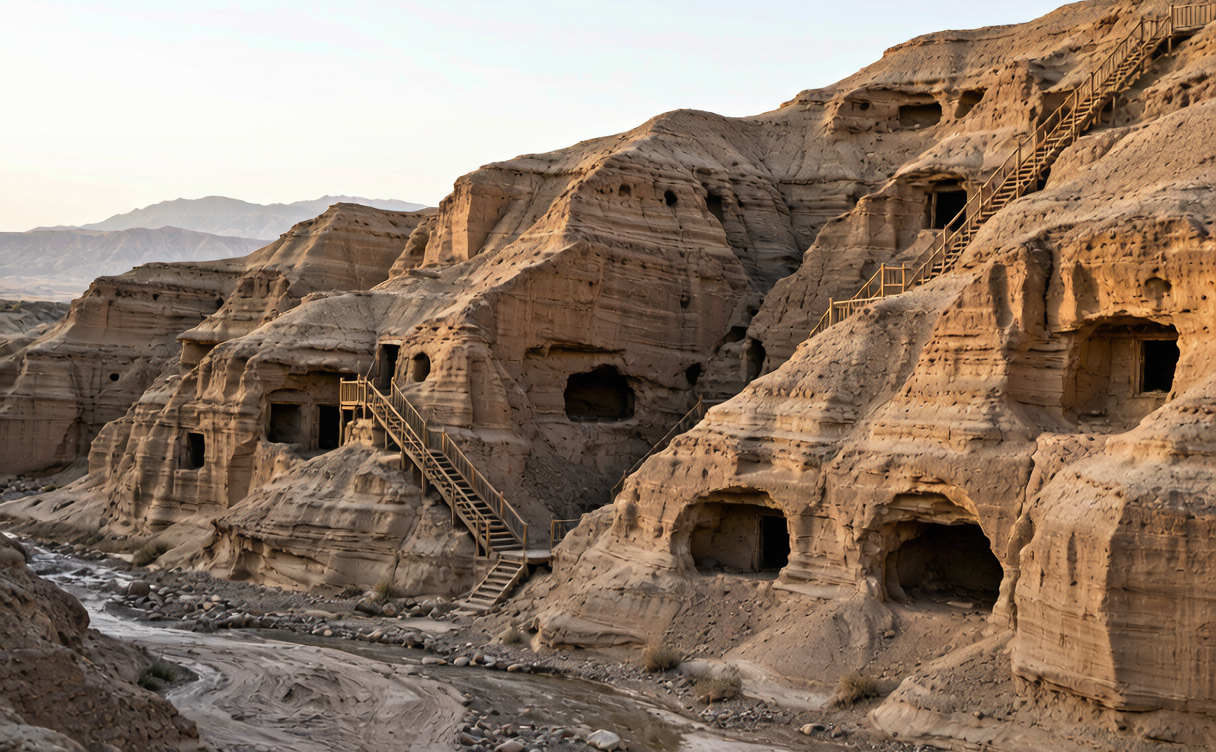
Xumishan (须弥山) is the Chinese rendering of Mount Sumeru, the world-mountain of Buddhist cosmology — an ambitious name for eight modest sandstone hills. Carving began under the Northern Wei in the late fifth century and continued through the Northern Zhou, Sui and Tang, which means you can walk from spare, elongated fifth-century figures to plump, confident Tang bodhisattvas in about ninety minutes.
The reason the caves are here at all is trade. Guyuan was Yuanzhou, a garrison town on the road running northwest from Chang’an towards the Hexi Corridor and the wider network now inscribed as the UNESCO-listed Silk Roads Tian-shan Corridor. Merchants, monks and soldiers passed below these ridges, and the money for the carving came from them. If you are assembling a Silk Road itinerary across northwest China, Xumishan is the missing eastern link most routes skip.
The other reason is atmosphere. Unlike the glass-fronted, timed-entry conservation at the Mogao Caves in Dunhuang, Xumishan is open hillside: wooden stairways, unlocked chambers, birdsong, and a great deal of erosion. Purists will note the losses. Everyone else will notice they are standing alone in a fifteen-hundred-year-old shrine.
Best Time to Visit Xumishan Grottoes
May and June. The best window. Guyuan sits above 1,700 metres, so summer here is mild — 18–27°C — and the valley apricot and peach trees flower in early May, which is when the site’s most photogenic corner, Peach Blossom Cave, earns its name.
July and August. Warm rather than hot, 22–30°C, but this is Ningxia’s short rainy season and the sandstone paths get slick. It is also domestic holiday season; still quiet by Chinese standards.
September and October — the other strong choice. Dry, clear, 10–22°C, with low afternoon light that rakes across the carvings. Avoid the 1–7 October national holiday, when Guyuan hotel prices double.
November to March. Cold, down to −10°C, brown and windswept, with shortened hours. Genuinely empty, but bring serious layers.
How to Get to Xumishan Grottoes
The site is about 55 km northwest of Guyuan city, near Sanying (三营), and there is no direct public transport to the gate. Guyuan itself has a railway station on the Baoji–Zhongwei line and a small airport (Guyuan Liupanshan, GYU) with flights from Yinchuan, Xi’an and Beijing. There is no high-speed rail to Guyuan, so most travellers come in from Yinchuan by expressway.
| From | Mode | Typical duration | Approx. cost |
|—|—|—|—|
| Yinchuan → Guyuan | Long-distance coach (G70 expressway) | 3 hr 30 min – 4 hr | ¥100–130 (US$14–18) |
| Yinchuan → Guyuan | Conventional train | 4 hr 30 min – 6 hr | ¥45–90 (US$6–13) |
| Xi’an → Guyuan | Flight | 1 hr | ¥400–800 (US$56–112) |
| Xi’an → Guyuan | Coach via Pingliang | 6–7 hr | ¥150 (US$21) |
| Guyuan → Xumishan | Chartered car, return with waiting | 1 hr each way | ¥250–350 (US$35–49) |
| Guyuan → Sanying | Local bus, then taxi | 1 hr + 25 min | ¥15 + ¥60 (US$10 total) |
Chartering a car for the day is what almost everyone does, and it is the sensible call: negotiate a return fare with three hours of waiting time, agree it before you set off, and save the driver’s WeChat. A Xumishan Grottoes day trip from Yinchuan is possible in one very long day — leave at 06:00, back by 21:00 — but staying a night in Guyuan is far more civilised.
What to See at Xumishan
The caves are numbered and spread across eight ridges over roughly two kilometres, linked by stairs, bridges and a shuttle road. Only a fraction are open, which is fine — the best ones are.
Cave 5: The Great Buddha (大佛楼)
The image everyone comes for. A seated Maitreya of about 20.6 metres, carved in the Tang dynasty into a niche whose covering hall collapsed long ago, so the figure now sits fully exposed against red rock and open sky. The scale is startling from the path below and the face — broad, calm, faintly amused — is intact. Come in the morning when the sun is on it.
Yuanguang Temple Caves 45 and 46 (圆光寺)
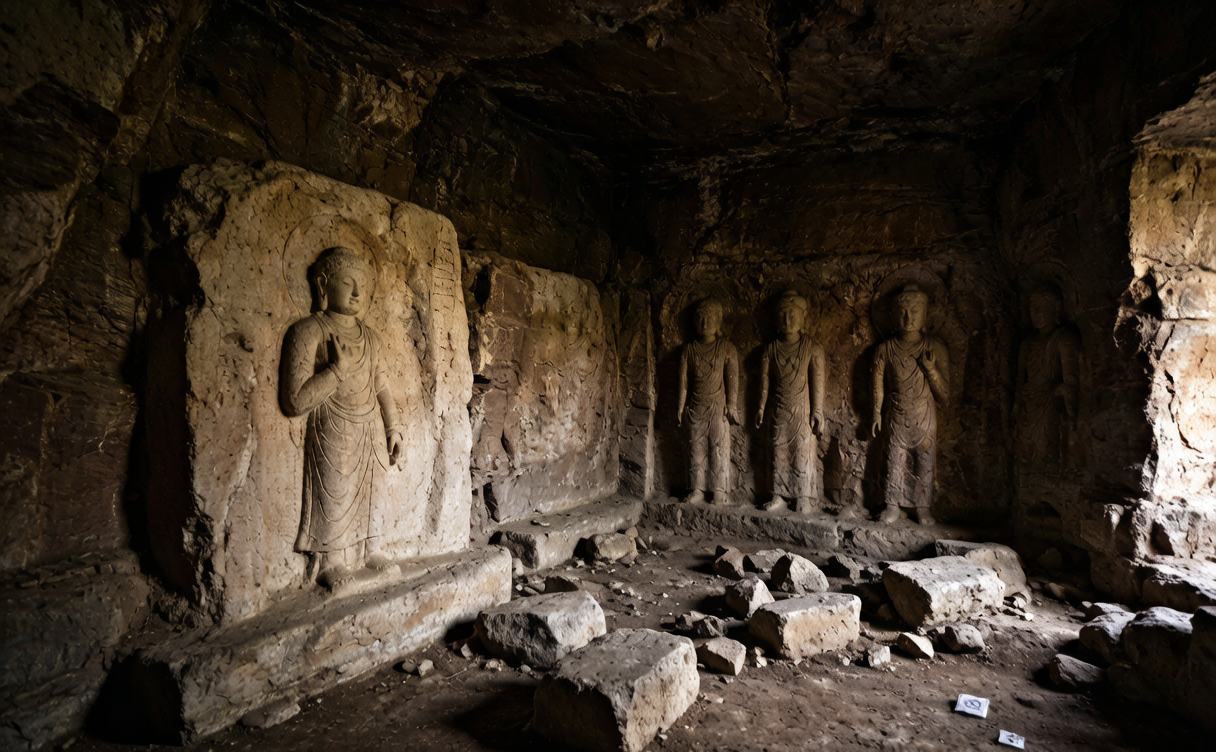
The richest interiors on the site, cut in the Northern Zhou and reworked later. Central pillars carved on all four faces with tiers of Buddhas and attendants, apsaras across the ceilings, and traces of pigment in the recesses. Bring a torch; there is no interior lighting and phone flashes flatten everything.
Xiangguo Temple Cave 51 (相国寺)
The largest Northern Zhou chamber in China, and my favourite. Three colossal seated Buddhas around six metres tall share a high square hall reached by a climb up the ridge. The proportions here are transitional — the severe northern style loosening into something rounder — and the room’s silence is total.
Peach Blossom Cave (桃花洞)
Further along the upper ridge, named for the wild fruit trees that flower around it in spring. The carvings are weathered but the setting, looking back down the gorge over the whole complex, is the best viewpoint at Xumishan.
The Site Museum
Small, near the entrance, with excavated fragments, stelae and a Chinese-and-English timeline of the four carving periods. Fifteen minutes here makes the rest of the day legible.
Xumishan Grottoes Hiking Trails and Routes
Allow three to four hours. From the gate, take the shuttle cart to the upper stop, then walk downhill: Cave 51 → Peach Blossom Cave and the ridge viewpoint → Yuanguang Temple caves 45 and 46 → the stairways along the middle ridge → Cave 5 and the Great Buddha last, finishing at the museum. Doing it in this order means the climbing is done for you and the biggest sight comes at the end. Total walking is around 4 km with a lot of steps, and there is no food inside — bring water and something to eat.
Where to Stay Nearby
There is no accommodation at the grottoes, so base yourself in Guyuan, an hour away.
Budget — ¥100–180 (US$14–25). Chain hotels near Guyuan railway station and along Wenhua Street. Clean, modern, unglamorous.
Mid-range — ¥250–450 (US$35–63). Business hotels around the city centre and Government Square; the best-value tier and where I would stay.
Splurge — ¥500–800 (US$70–112). Guyuan’s few four-star properties. Comfortable, not luxurious — this is not a resort town.
Confirm by phone or through your booking platform that the hotel registers foreign passports. Larger chains do; small guesthouses in Guyuan often cannot.
Xumishan Grottoes Tickets and Opening Hours
Entry is around ¥60 (US$8.50), with the internal shuttle cart an extra ¥15–20 each way. Students and over-60s get discounts with ID. Opening hours run roughly 08:00–18:00 from April to October and 08:30–17:30 from November to March, with last entry an hour before closing. Hours shorten in deep winter and after heavy rain some upper stairways close, so have your driver call ahead. Tickets are sold at the gate and through a WeChat mini-program; a passport is required for both.
Practical Tips
- Bring a torch and a wide lens. Interiors are unlit and chambers are narrow. Flash photography is prohibited in several caves; check the signs.
- No English on site. Signage is Chinese with occasional short English panels, and guides work in Chinese only. Download an offline translation app before you leave Guyuan.
- Sun and altitude. At 1,700 metres the UV is fierce even at 20°C. Hat, sunscreen, two litres of water.
- Payment. Alipay and WeChat Pay work at the ticket office and cover taxis in Guyuan, but carry ¥300 in cash for rural drivers and roadside stalls.
- Combine it. Guyuan is also the base for the Liupanshan forest area, and the drive back to Yinchuan passes close to the Western Xia Tombs — an easy pairing over three days.
- Timing. Arrive at opening. By 11:00 the tour groups from Guyuan schools and work units start turning up in summer, and the light on the Great Buddha has gone flat.
FAQ
Is Xumishan worth visiting if I have already seen Dunhuang?
Yes, for a different reason. Mogao is about painting and preservation; Xumishan is about sculpture and setting, seen without glass or crowds. If you are already in Ningxia, this is the best cultural site in the province.
How long do I need at the grottoes?
Three to four hours on site, plus two hours of driving. From Guyuan it is comfortably done between 08:00 and 15:00.
Can I visit Xumishan Grottoes without a car?
With difficulty. Take a bus to Sanying and a taxi the last 20 km, then arrange your return with the same driver — nothing waits at the gate. Chartering from Guyuan costs little more.
Are the caves suitable for children or older travellers?
The lower ridge and the Great Buddha need only modest walking. The upper caves involve steep stairs and narrow walkways with drops, so anyone unsteady should stay on the shuttle route and skip Cave 51.
What is the best time of day for photographs?
Morning, from opening until about 10:30, when direct light hits the Great Buddha’s niche.
Written by Karl, China Travel Places — updated August 2026.