

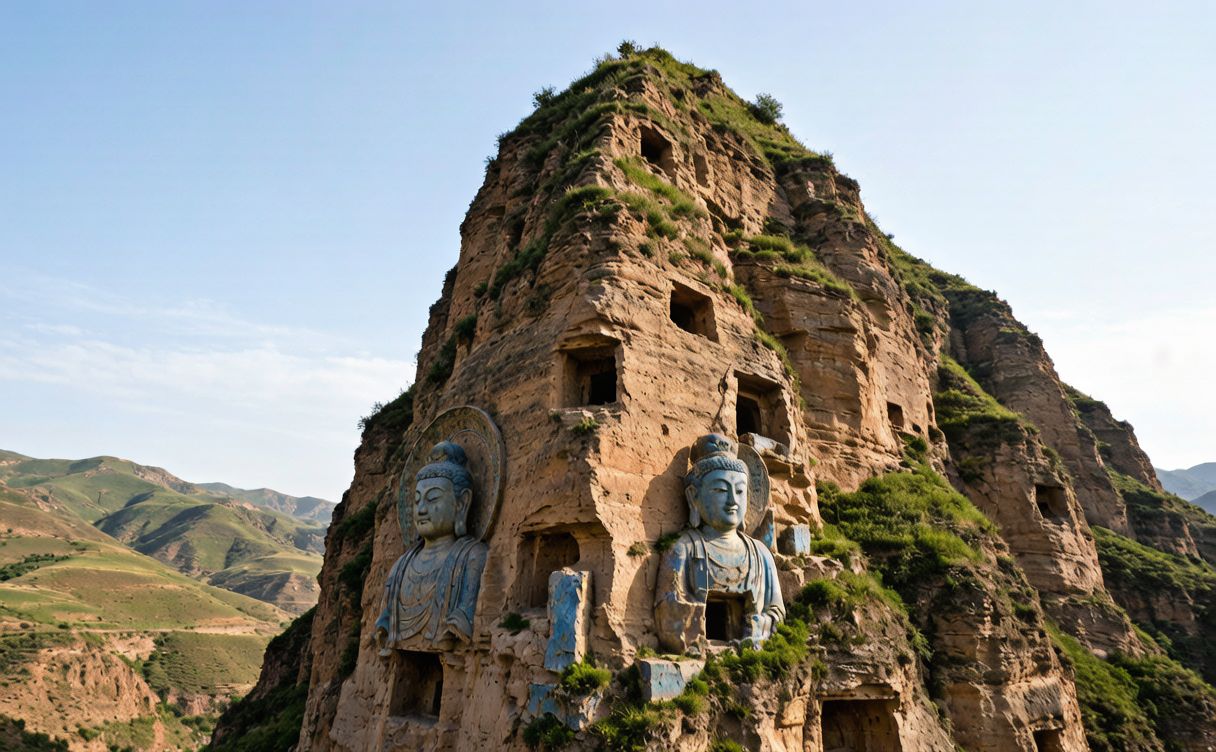
I still remember the moment the bus rounded the last bend and the mountain simply appeared. There it was — a solitary, rounded peak rising out of the green folds of southeastern Gansu, its grey cliff face dotted with what looked like hundreds of square windows. Up close, those windows turned into caves, and inside each one sat a Buddha, a bodhisattva, or a row of serene disciples carved more than a thousand years ago. That was my first sight of Maijishan Grottoes, and I have not stopped thinking about it since.
Maijishan — the name means “Wheat Stack Mountain” — gets its shape from a conical hill that genuinely looks like a pile of harvested wheat. Over the centuries, devout monks and patrons tunneled into this soft sandstone to build one of China’s four greatest grotto complexes, alongside the more famous sites you may already know. What makes Maijishan different is the cliff itself. The caves are not spread across a long hillside but clustered on a near-vertical face, connected by a dizzying scaffold of walkways that cling to the rock like the frame of a giant lantern.
Getting There
Getting to Maijishan is half the adventure, and I want to be honest with you: it is not the easiest spot in China to reach, but it is absolutely worth the effort. The grottoes sit about 45 kilometers southeast of Tianshui, a mid-sized city in Gansu Province. Most travelers arrive in Tianshui first, and from there it is a straightforward bus or taxi ride to the scenic area.
I flew into Tianshui Maijishan Airport, which has connections from major hubs, then took a pre-arranged car for the hour-long drive. If you are coming overland, the high-speed train to Tianshui South Railway Station is a comfortable option from Xi’an or Lanzhou. From the station, local buses labeled for Maijishan run regularly during the day. I recommend building Tianshui into a longer Silk Road route rather than treating it as a quick detour — it pairs beautifully with the cave art further west.
In fact, many foreign visitors combine Maijishan with the famous caves of Dunhuang. If you are planning that kind of journey, my Dunhuang Mogao Caves guide walks you through what to expect at China’s most celebrated grotto site, and it makes a natural companion to this one.
What to See
Once inside the park, the path leads you to the foot of the mountain and then, almost before you are ready, up onto the suspended walkways. This is the part I was not prepared for. The plank routes tilt and curve with the cliff, and at points you are looking straight down through gaps in the boards to the forest far below. I clutched the rail more than once — but I also could not stop looking at the sculptures.
Maijishan is renowned for its clay sculptures rather than stone carving. Because the local rock is too soft for fine relief, artisans modeled thousands of figures in painted clay, and an astonishing number survive. The faces are the real draw: rounded, gentle, almost smiling, with the kind of human warmth you rarely find in older, more austere Buddhist art. The famous “sending-child” niche and the rows of celestial musicians stopped me in my tracks.
The site holds more than 200 caves and nearly 8,000 sculptures spanning from the 4th century right through the Ming dynasty. I found myself lingering in Cave 44 and Cave 133, where the detail of the robes and the calm of the expressions made the long climb worthwhile. If your legs allow, keep going higher — the upper tiers reward you with both finer carvings and a sweeping view across the valley.
The Cliff Paintings
Beyond the sculptures, Maijishan hides something quieter and, to my eye, just as moving: its murals. The cliff paintings here are less famous than those at Mogao, but they are intimate, weathered, and luminous in places where the pigment has survived. In several caves I traced, with my eyes only, the faded outlines of flying apsaras, lotus scrolls, and donor figures in flowing robes.
What struck me was the layering of time. A single wall might hold a Northern Wei sketch beneath a Tang dynasty repaint, each generation adding its own hand to the same sacred surface. The colors — ochre, malachite green, a deep lead red — have faded to the tone of old paper, but stand close and you can still feel the devotion that put them there. Photography inside the caves is restricted, and I understood why: the light that would make a good photo is exactly what damages these fragile surfaces. I put the camera away and simply looked.
Tips
A few things I wish someone had told me before I went. First, wear real shoes. The walkways are uneven and the steps are steep; sandals made the whole climb more stressful than it needed to be. Second, go early. I arrived when the gate opened and had the lower caves almost to myself for the first hour — by late morning the pathways were busy and the photo spots crowded.
Third, pace yourself and respect the height. The climb is not technical, but it is exposed, and if you are nervous about heights the upper tiers may test you. There is no shame in turning back at a level you are comfortable with; the best sculptures are spread through several tiers, not only at the top. Fourth, bring water and a light layer — the mountain air is cooler and damper than the surrounding plains, and I was glad of a jacket even in summer.
Finally, hire the audio guide or a local explainer if you can. The art history here runs deep, and a good guide turned what could have been a pretty walk into a story about emperors, pilgrims, and a thousand years of faith. If you are also visiting the great cave sites of Henan, my write-up on the Luoyang Longmen Grottoes will help you compare the different regional styles.
Best Time
Timing your visit makes a real difference. I went in late spring and found mild temperatures, green hills, and manageable crowds — for me, the sweet spot. Autumn, from September to early November, is equally lovely, with clear skies and comfortable hiking weather. Summer brings lush scenery but also more domestic tourists and the occasional heavy shower, while winter is cold and quiet, offering solitude at the cost of some facilities running reduced hours.
If flexibility allows, aim for a weekday in the shoulder seasons. The mountain is at its most atmospheric when mist drifts across the cliff face and soft light falls on the clay figures. I built my own trip around a quiet Tuesday in May and would choose that again without hesitation.
Good to Know
A few practical notes before you book. The site sits inside a protected scenic area, so expect a combined ticket that covers park entry and the grottoes; prices shift by season, so check the official tourism board for current rates rather than relying on older blog posts. Facilities near the base include a visitor center, simple restaurants, and souvenir stalls, but options thin out once you start climbing, so eat and hydrate beforehand.
Guides, restrooms, and shuttle buses are available, though the last shuttle times matter if you are staying in Tianshui and returning the same day. I built in a generous buffer and was glad I did. Mobile coverage on the cliff is patchy, which I actually enjoyed — it forced me to be present with the art instead of scrolling. One last thing: this is an active cultural and religious heritage site, so dress modestly and keep your voice low near the caves. Treat it as a temple, because in many ways it still is.
For official visitor information, opening hours, and ticketing, see Gansu Culture and Tourism.