

Huangshan holds one of the hardest lodging decisions in China: sleep on the mountain or sleep in the town at its foot. Get it wrong and you will either stand in a queue at 5 a.m. for a cable car you could have walked to, or pay a small fortune for a room with no view of anything at all. We have stayed on both sides of this decision a dozen times, in every season from a −9°C January to a thunder-washed May, and this guide is the compromise we have settled on after all those trips.
The mountain itself is the point. Huangshan (Yellow Mountain) rises 1,864 metres at its Lotus Peak summit, and the granite pillars that stick out of its slopes are close enough to the sky that the weather becomes part of the building. Visitors come for the sea of clouds at Dawn’s Pavilion, the Hundred-Step Cloud-Ladder, and the pines that grow sideways out of nothing. Staying inside the scenic area means you can be there for sunrise. Staying in Tangxi, twenty minutes downhill, means a 5:30 alarm and a scramble.
Where to stay in Huangshan: the mountain-versus-town decision
Three zones, and you should choose between them deliberately.
On the mountain (山上). Hotels inside the scenic area — around Beihai, the West Sea, and Yupinglou. Prices run ¥700–2,000 a night in peak season and ¥300–600 in deep winter, and the rooms are functional rather than plush, with thin walls and shared-ish heating. What you buy is time: sunrise over the Lotus Peak summit from a five-minute walk from your door, and the West Sea canyon silences after the last tour bus leaves.
At the foot, in Tangxi and Tunxi (山下). A cluster of larger hotels and business-chain properties 20–40 minutes from the cable cars, at ¥260–600. This is where most foreign packages put you, and it is fine if your plan is a day trip. It is not fine if you want dawn on the ridges.
In the villages, Hongcun and Xidi. Preserved Ming and Qing villages an hour east, full of converted courtyard guesthouses at ¥200–500. If you are pairing the mountain with a slow cultural leg, this is the prettier base.
The encyclopaedia entry on Huangshan covers the geology — the granite batholith that cooled 120 million years ago and then got sliced by glaciers — which helps explain why the peaks stand so far apart and why the trail networks look the way they do.
Best hotels on the mountain
Our standing recommendation for the best hotels in Huangshan on the mountain is the 西海饭店 (Xihai Hotel) and the 白云宾馆 (Baiyun Hotel) cluster, which sit at the junction of the West Sea trails. Xihai is the smarter of the two for first-timers: it is a ten-minute walk from the 排云亭 (Paiyun Pavilion) sunset point and close to the 西海大峡谷 (West Sea Grand Canyon) cable car, so you can do the canyon loop in the afternoon and the sunset without a teardown. Baiyun is larger, busier, and better for families, with hot food in the restaurant at odd hours.
Up north, 狮林大酒店 (Shilin Hotel) near Beihai is the warmest rooms on the mountain in winter and a five-minute walk from the 始信峰 (Shixin Peak) trailhead. 玉屏楼宾馆 (Yupinglou Hotel) sits beneath the famous 迎客松 (Guest-Greeting Pine) at the south entrance and is the only realistic option if you specifically want to photograph that pine at sunrise. Book it in the autumn or you will not get it.
Room quality honestly varies. We have had a ¥900 room with a superb balcony facing a cliff, and a ¥1,300 room where the window frame was rotting. Ask for a south- or east-facing room, bring earplugs for the generator, and take the thick blanket from the cupboard rather than the thin one on the bed.
Foothill hotels in Tangxi and Tunxi
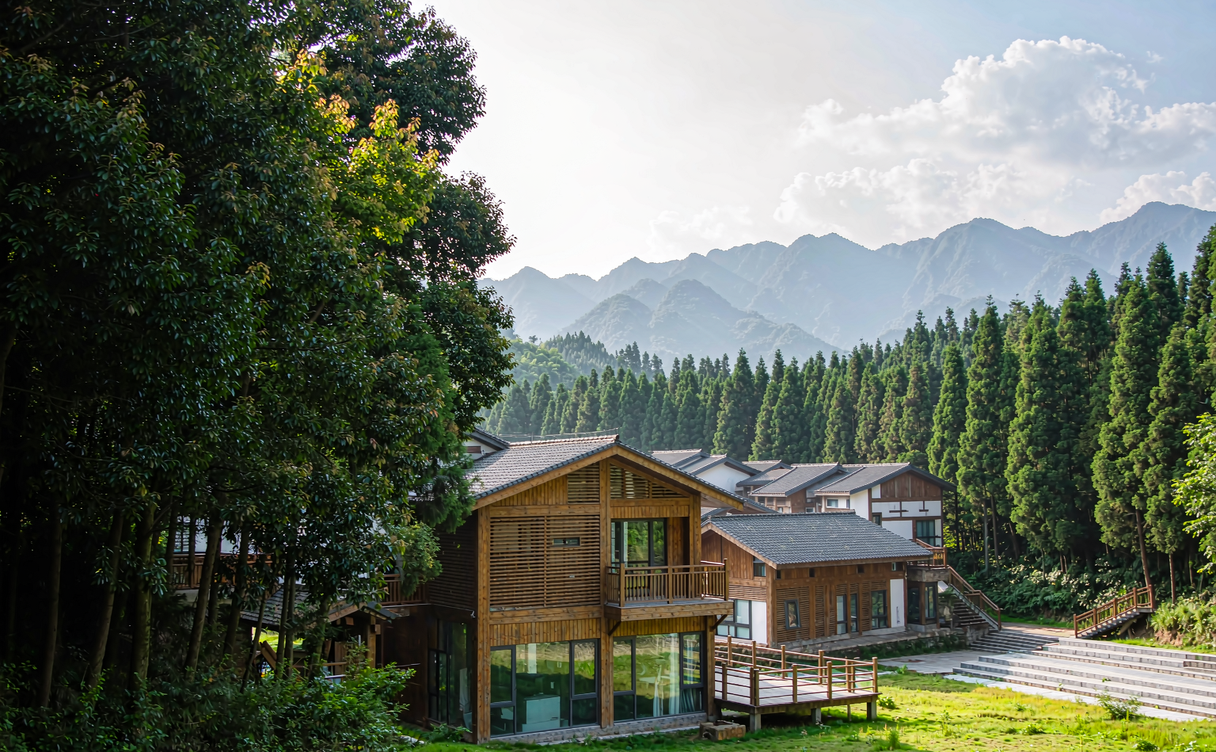
If you must sleep below, 黄山云谷山庄 (Yungu Mountain Villa) near the north entrance is the one we pick — it is a low, timber-framed building set in its own trees, with a restaurant that does a proper Anhui 臭鳜鱼 (fermented mandarin fish) when the mountain kitchens have closed. In Tunxi, the old 黄山 Hotel and the newer domestic chains (Atour, All season, Jinjiang Inn) all cluster around the Tunxi old street, mostly ¥200–450, and they make a decent restful base for a second day.
Split your stay: one night on the mountain for sunrise, one night in Tangxi or Hongcun to wash your feet and eat properly — trying to do Huangshan as a single day trip means four hours of your life spent in cable-car queues.
Budget hotels in Huangshan
The budget hotels in Huangshan worth naming are not downtown chain properties — they are the guesthouses in Hongcun and Xidi, where a converted ancestral hall with a tiled courtyard runs ¥180–320 in shoulder season and ¥280–500 in October and April. Take a room that wraps around the courtyard rather than one looking onto the car park, and ask whether the bathroom has a window. In the villages, breakfast is usually 茶叶蛋 congee and a bowl of 炒粉 at the gate, ¥8–15.
On the mountain itself the “budget” tier is the dormitory-style rooms at the older guesthouses: bunk rooms at ¥120–220 per bed in low season, ¥260–400 in peak. We only recommend these for groups of four who can bear shared bathrooms and a 5 a.m. wake-up; the alternative is a ¥700 private room that nobody would call luxurious but that gets you onto the 光明顶 (Guangming Summit) path before the crowds.
Prices, seasons and when to book
Huangshan pricing is seasonal in an extreme way. Peak season (1 March – 30 November, roughly) puts a mid-range mountain room at ¥800–1,600 and a foothill room at ¥350–600. Winter rates drop 40–60%: the same mountain room can be ¥350–500 in January and February, which is when the sea of clouds is most reliable and the cable cars run with almost no queue.
We would avoid 1 October to 7 October entirely. We did it once, 2019, and the 云谷寺 cable car queue was ninety minutes with a small child in our party. Mid-November to mid-December is our own favourite: cold, clear, golden larch on the ridges, and prices that have already fallen. Spring, April and May, is second best.
Book eight to twelve weeks ahead for October, four weeks for November, and at least two weeks for any public holiday. Our best time to visit China guide maps the national holiday dates against regional weather, which is what you need before you commit.
What to eat near your hotel
Huangshan Anhui cuisine is badly undersold. Close to every on-mountain hotel, the one dish to order is 臭鳜鱼 (wánjù yú, fermented mandarin fish — fish cured in rice water for several days, then braised with pickled mustard and pork; ¥120–180 for a small portion, and it tastes nothing like it smells). 毛豆腐 (hair tofu, wise-fermed and pan-fried, ¥45–70) is the other signature and is genuinely addictive. Down in Hongcun, 五城茶干 (five-town tea dried tofu) makes a good packet to take home, and the village restaurant tables do a 笋干烧肉 (bamboo-shoot braised pork, ¥60–90) that is worth a full dinner by itself.
Breakfast at altitude is 面条 or 馄饨 from the hotel canteen, ¥15–25, and it arrives early because the day starts early. Carry trail snacks — the mountain shops are expensive and close at 6 p.m.
Getting there and getting up the mountain
Most people reach Huangshan by high-speed rail to 黄山北站 (Huangshan North), then a 30–50 minute taxi or shuttle south to the Tangxi or Hongcun area. Our China high-speed train guide for foreigners covers how to read the ticket and where the station shuttle leaves from. Buses from Shanghai and Hangzhou also run direct to the Tunxi coach station.
Inside the park, the gate ticket is ¥190 in peak season and ¥150 in winter, and the cable cars cost ¥80 (Yungu), ¥70 (Taiping) and ¥100 (West Sea canyon) one way — budget ¥500–700 per person for entry, cable cars and one mountain night. The West Sea canyon tram is the single best value on the mountain in our experience, and the one most people skip.
[IMAGE: A courtyard guesthouse in Hongcun village with white-walled Anhui facades and a tiled roof | alt=”Hongcun village courtyard guesthouse Anhui white walls Huangshan”]
Pairing a Huangshan hotel stay with Hangzhou and Shanghai
The obvious add-ons. Hangzhou is two and a half hours east by high-speed rail and pairs beautifully — a West Lake afternoon against a sunrise on Huangshan’s ridges makes a very balanced five-day trip. Shanghai is four hours east and works as an exit city. Our Huangshan and Yellow Mountain guide covers the trail loops in detail, and if you are comparing cities we keep our hotel guide to Hangzhou and our hotel guide to Shanghai updated for exactly this kind of multi-city route.
Give Huangshan two nights minimum — one to climb the West Sea canyon and one to watch the sunrise from the Guangming Summit, because the mountain looks like a different place in the first light of the morning than it does at 10 a.m. under a bus load of visitors.
For the wider picture, our best things to do in China roundup places Huangshan among the country’s five essential landscapes, and our China travel guide for first-timers handles the payment apps and taxi-hailing that make a mountain town with no English signage comfortable.
Final thoughts
Huangshan is one of the few places in China where paying more for the room genuinely buys you a better experience rather than a bigger bed. The difference between a foothill hotel and a mountain one is not thread count; it is whether you are standing on the 光明顶 before the light arrives. We would take a functional, heated, noisy mountain room over a soft downtown bed every time — and then, honestly, we would take one night back down in Hongcun to sleep in the silence of a village.
Reserve the on-mountain room first and plan the rest around it, because in peak season the mountain sells out while the town next to it still has beds at 6 p.m.