

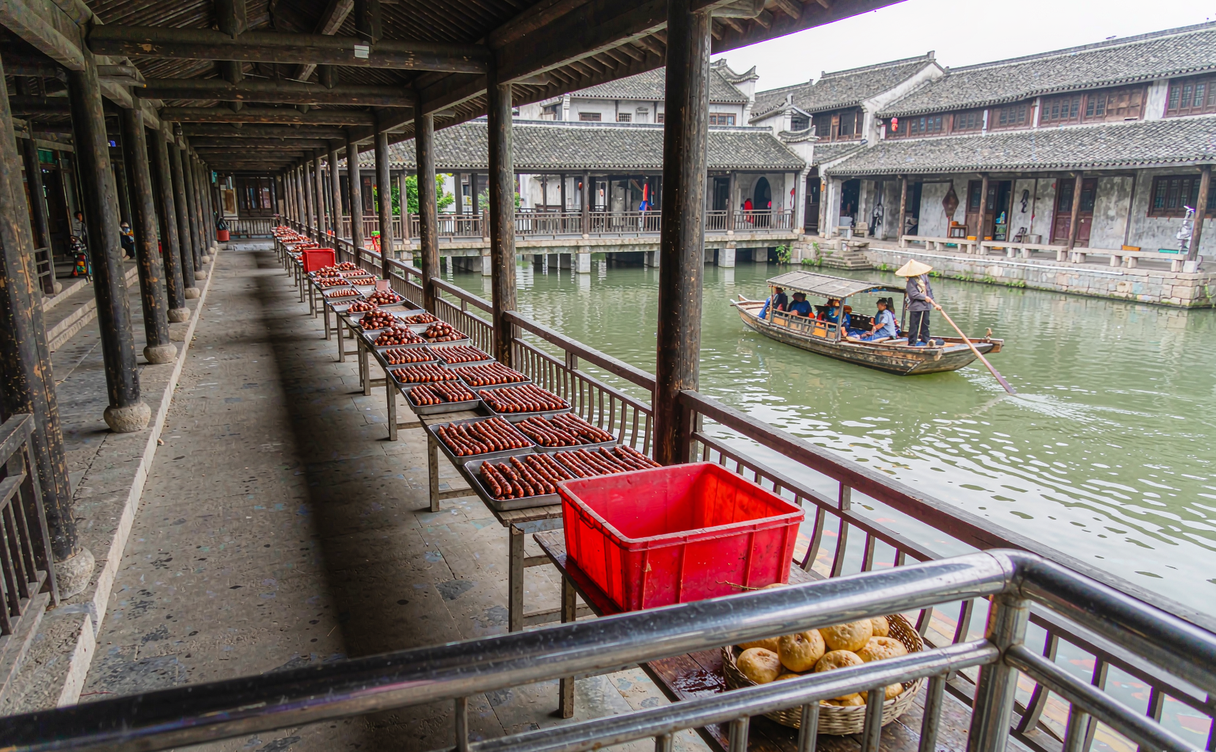
The smell hits before the view does. Walk into Anchang from the eastern car park on a December morning and the air is thick with smoke, soy and rendered pork fat, because every household along the canal has strings of sausages and flattened soy-cured ducks hanging from the eaves to dry in the cold north wind. I’ve taken groups to a dozen canal towns in Zhejiang and Jiangsu, and this is the only one where I tell people to arrive hungry rather than photogenic.
Anchang sits about 15 km west of central Shaoxing, in Keqiao District. It was a market and transport town, not a scholar’s retreat, and it still behaves like one: one long canal, a covered wooden arcade running along the north bank, seventeen stone bridges, and a working population who use the waterfront to wash vegetables and gossip. This Anchang ancient town guide is the briefing I give clients — practical logistics, real prices, and what makes this place distinct from the polished water towns an hour up the road.
A Working Town, Not a Stage Set
The defining piece of architecture here is the langpeng — a continuous roofed walkway, timber posts on stone footings, shading roughly a kilometre of the northern quay. It was built for commerce: porters, boatmen and stallholders needed to work through Zhejiang’s long rains. That utility still shows. Under the arcade you’ll find a knife sharpener, a stall of fennel-braised broad beans, a woman selling brown-sugar rice pudding from a wheeled cart, and elderly men playing cards where tourists have to walk around them.
Anchang has no admission gate for the streets themselves, no scripted performances every twenty minutes, and comparatively few boutique hotels. On weekday mornings I’ve had entire stone bridges to myself. It is scruffier than the famous towns. If your idea of a good travel day includes peeling paint and laundry lines, you’ll like it a great deal.
New to travelling independently in China? Start with our practical guide to visas, payments and getting around before you plan a canal-town day.
Anchang Water Town Sausages and the Twelfth-Month Larder
Anchang water town sausages are the reason many Chinese visitors come, and they deserve the reputation. The local style is a lean pork sausage cured with soy sauce and Shaoxing rice wine rather than heavy spice, air-dried under the eaves through the coldest weeks. Vacuum-packed strings sell for roughly ¥60–110 per 500 g depending on grade; a plate of steamed sausage in a canalside restaurant runs ¥28–45.
Alongside them hang soy-cured duck, dried fish and cured pork belly. Order a table of local classics and you’ll get stinky tofu deep-fried and dressed with chilli (¥10–15), fennel-scented broad beans, steamed river shrimp, dried mustard greens with pork belly, and a warmed bowl of Shaoxing yellow rice wine (¥15–30). Two people eat properly for ¥120–180. Do watch the sugar pullers: at several shopfronts, men stretch and fold hot maltose over a wooden peg until it turns opaque white, then chop it into brittle sticks — ¥10 a bag, and genuinely good.
The festive peak is the twelfth lunar month. From roughly late December until the Lunar New Year, Anchang runs a folk-custom season with a water-borne wedding procession, dragon dances, opera excerpts and every eave loaded with meat. It is crowded, loud and the most atmospheric time of the year.
How to Get to Anchang From Shaoxing
The practical answer to how to get to Anchang from Shaoxing depends on where you start the day.
From Hangzhou, take a high-speed train to Shaoxing North, which takes about 20 minutes and costs ¥15–25; if train ticketing in China is new to you, our guide to booking and boarding high-speed trains covers passport collection at the counter. Shaoxing North station sits in Keqiao, roughly 10 km from Anchang: a taxi or ride-hail costs ¥35–60 and takes 20–25 minutes.
From central Shaoxing (the Lu Xun Native Place area), a taxi is ¥55–80 and 30–40 minutes in normal traffic. Local buses run from Keqiao’s bus hubs toward Anchang for ¥2–5, but they are slow and stop constantly — fine if you enjoy that, frustrating if you’re on a tight schedule. From Shanghai, allow about 1.5–2 hours by train to Shaoxing North, making Anchang a long but feasible day trip.
Ask your driver for 安昌古镇 and specify the east entrance (东入口), which puts you closest to the arcade. Parking is ¥5–10.
Behind the Arcade: Clerks, Money Houses and Stone Carving
Anchang’s other claim is administrative rather than culinary. For centuries this district produced shiye — the private secretaries and legal advisers who ran the paperwork of county magistrates across imperial China. “Shaoxing shiye” became a byword for a sharp, indispensable, slightly feared professional class, and Anchang was one of their nurseries. The town’s Shiye Museum, set in a former practitioner’s courtyard house, lays out how they were trained, what they earned and how they operated the machinery of local justice. It is the most interesting small museum I know in the delta.
Cluster it with the restored Suikang money house, where you can see the ledgers and strongrooms of a rural bank; the stone-carving hall, with salvaged lintels and window screens; the town god temple; and a folk-customs hall on marriage and boat culture. A combined ticket covering these has run ¥35–50; individual halls are ¥10 or so. Streets and bridges are free, and honestly you could enjoy Anchang without buying anything — but the shiye story is what makes the visit stick.
Taking an Anchang Ancient Town Boat Ride
An Anchang ancient town boat ride is worth the money, mostly because Shaoxing’s boats are unusual. The wupeng boat has a black bamboo canopy and is traditionally propelled by a boatman who sits at the stern and pushes the oar with his foot while steering with a hand paddle. Watching that technique from a metre away is half the experience.
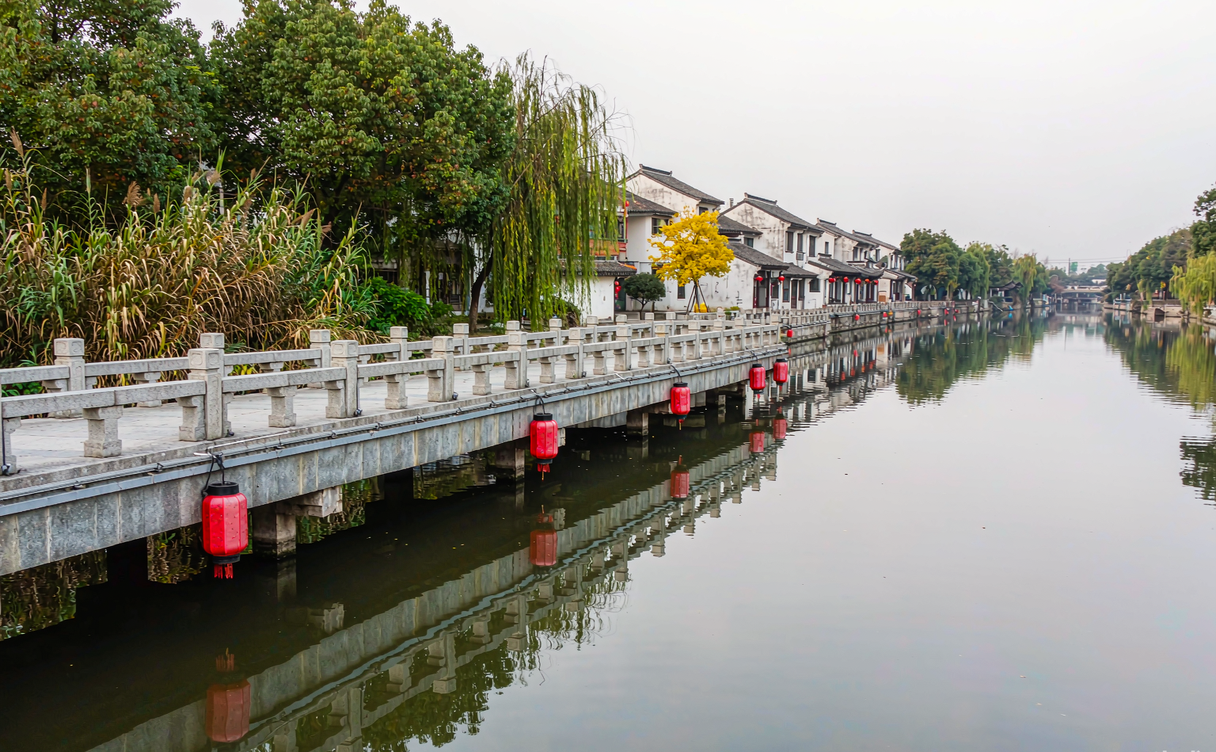
Expect ¥100–180 per boat rather than per person for a 20–30 minute run along the main canal, and the price is usually negotiable on quiet weekdays. Boats seat two to four comfortably. Go in the first hour after opening or the last hour before dusk, when the water is still and the arcade’s reflection is unbroken. Confirm the price and route before you step aboard — a nod is not a contract.
Building a Zhejiang itinerary around food and canals? Browse our shortlist of the experiences most worth your days in China and slot Anchang in as a half day.
An Anchang Old Town Walking Route
My standard Anchang old town walking route takes about three hours, plus lunch.
Enter from the east and walk the full length of the covered arcade westward along the north bank, roughly 1 km, stopping at the sausage stalls and the sugar pullers. Cross at the third or fourth arched bridge and return along the south bank, which is more residential and better for photographs of the arcade itself. Duck into the Shiye Museum and money house mid-route while your legs are fresh. Finish at the town god temple, then loop back to a canalside table for a late lunch around 12:30, once the tour groups have thinned. If you still have energy, the lanes behind the south bank hold laundry courtyards, a small ancestral hall and almost no visitors.
Best Time to Visit Anchang
The best time to visit Anchang is December to mid-January if you want the curing season and the folk festival, or late March to April and October to November if you want mild weather and lighter crowds. Winter days sit around 3–10°C with damp air; bring a windproof layer, because the canal channels the cold.
Avoid mid-June to early July, the plum rain period, when persistent drizzle makes the flagstones treacherous. July and August reach 32–37°C with high humidity, which sours quickly for most visitors. Weekends year-round bring domestic day-trippers from Hangzhou and Shanghai, so aim for Tuesday to Thursday. Our broader breakdown of seasonal timing across China’s regions helps if you’re fitting this into a longer trip.
Costs, Pitfalls and How Anchang Fits a Trip
Realistic budget for two people: ¥70–100 tickets, ¥100–180 boat, ¥120–180 lunch, ¥70–120 transport, plus whatever the sausages cost you on the way out. Anchang has a handful of simple guesthouses at ¥200–400 a night, but I usually sleep in Shaoxing or Hangzhou, where mid-range hotels run ¥300–600 and evening options are far better.
Two pitfalls. First, arriving at 11:00 on a Saturday, when the arcade becomes a shuffling queue — come at 08:30 instead. Second, assuming the whole town is ticketed and paying for a bundle you won’t use; buy the combined ticket only if you intend to visit at least three halls.
For sequencing, I like Anchang as a morning after a night in Shaoxing, whose long history of rice wine, canals and letters frames everything you’ll see here. Pair it with a day around West Lake and the tea terraces of Hangzhou, and if you want green space rather than another old street, spend an afternoon drifting the reed channels at Hangzhou’s wetland park. Three days, three textures, no repetition.
Want help stitching Shaoxing, Hangzhou and Anchang into a workable route with train times that actually connect? Send us your dates and we’ll sketch it out.