

Most travelers who fly into Chongqing never leave the hot, noisy haze of the river-city proper. That is a mistake we have corrected for hundreds of readers. Two hours northeast by car, the Yangtze gives way to the limestone plateau of Shizhu, a Tujia autonomous county where the summer temperature rarely touches 28°C and the air smells of fir and wet stone. This is the Shizhu travel guide we wish someone had handed us before our first trip — and a good place to start is the encyclopaedic background on Shizhu for the county’s administrative and cultural history.
Shizhu sits at the eastern edge of the Chongqing municipality, bordering the mountains of Hubei. It is best understood not as a city but as a collection of highland settlements built around the Huangshui highland Shizhu is known for — a forested plateau between 1,500 and 1,700 metres above sea level. For Chongqingers, it has been the default summer escape for decades; for foreign visitors, it remains almost entirely off the radar, which is precisely why it rewards the detour.
Why Shizhu deserves a spot on your itinerary
We have sent travelers to Shizhu for two reasons: relief from Chongqing’s brutal summer, and a slice of Tujia mountain culture that the major tourist towns have long since packaged and sanitized. Here you get the real version. The county produces most of China’s coptis (黄连, a bitter medicinal root), and the highland meadows, virgin forest, and riverside ancient town make a compact, low-cost loop that fits easily between a few days in the city and a trip east toward Enshi or Zhangjiajie.
If you are already building a Chongqing-area plan, our Chongqing travel guide explains how the municipality’s scattered districts and far-flung counties actually connect.
Best time to visit Shizhu
The single most useful piece of advice we can give is about timing. The best time to visit Shizhu is late June through early September, when the highland is 8–12°C cooler than downtown Chongqing and the coptis terraces and fir woods are at their greenest. July and August are peak season locally — Chongqing families rent houses for the whole summer — but the plateau absorbs crowds far better than the city, and even in August you can find quiet trails within ten minutes of the car park.
Spring (April–May) is excellent for wildflowers across the Qianye grassland and for avoiding the summer price bump. Autumn (late September–October) brings red foliage and clearer skies, though nights get cold quickly above 1,600 metres. Winter is quiet and sometimes snowy on the ridge tops; many forest-park facilities close, so we generally don’t send first-timers then. If you are flexible, aim for a weekday in June or September. For a wider seasonal picture of the region, our best time to visit China guide breaks down the climate month by month.
How to get to Shizhu
Understanding how to get to Shizhu saves a half-day of confusion. The nearest major airport is Chongqing Jiangbei (CKG). From there, you have three realistic options:
- Train: High-speed services run from Chongqing North or Chongqing East to Shizhu County Railway Station (石柱县站) in roughly 1 to 1.5 hours, with second-class fares around ¥55–¥90. This is the option we recommend for most travelers. A useful primer is our China high-speed train guide for foreigners, which covers booking and station navigation.
- Bus / car: Long-distance coaches leave from Chongqing’s Longtou Temple and Sigongli bus stations; the drive is 2–2.5 hours via the expressway and costs ¥60–¥80. A private car or Didi gives the most freedom once you arrive, because the scenic spots are spread out.
- From other hubs: Coming from the east (Enshi, Wuhan), you can reach Shizhu by train on the Chongqing–Lichuan line, which threads the same mountain corridor.
Within the county, the Huangshui scenic area is another 40–60 minutes by local bus or car from the railway station. There is no metro; plan on taxis, the occasional tourist shuttle, or a rented car.
Things to do in Shizhu
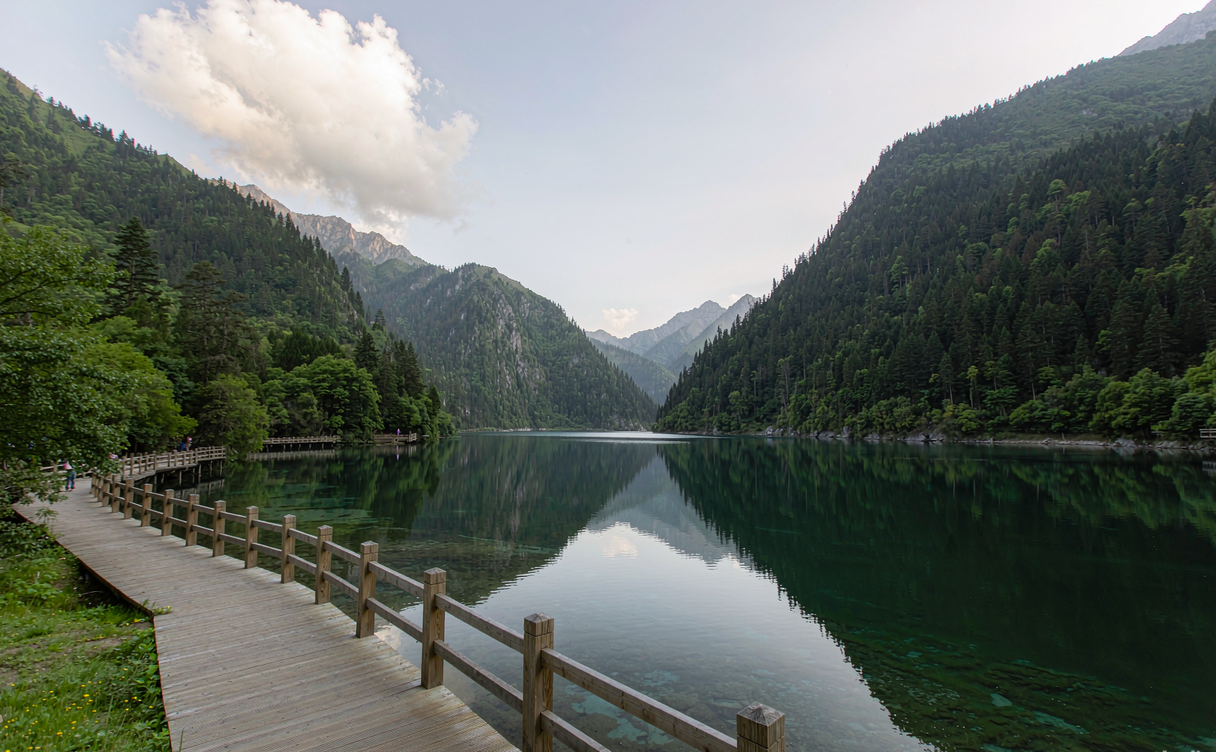
The heart of things to do in Shizhu clusters around the Huangshui highland and the Yangtze-side town of Xituo. The headline stop is Huangshui National Forest Park (黄水国家森林公园), a 3,000-hectare spread of virgin fir and ginkgo forest, boardwalk trails, and the Dafengbao (大风堡) ridge, the highest point in the Chongqing section of these mountains at 1,930 metres. A glass viewing platform juts over the valley — queues form on weekends, but on a weekday morning the only sound is wind in the canopy.
Nearby, Qianye Grassland (千野草场) is exactly what it sounds like: rolling alpine pasture threaded with stone forests and scattered Tujia herding huts. We have sent travelers here for easy half-day hikes and picnic lunches; entry is around ¥50. Sun Lake and Moon Lake (太阳湖/月亮湖), a pair of reservoirs inside the park, rent pedal boats (¥40–¥60 per hour) and are the calmest place to be at sunset.
Down on the Yangtze, Xituo Ancient Town (西沱古镇) is the cultural counterweight to all that forest. Its Yunti Street (云梯街) — a stairway of several hundred stone steps climbing straight from the riverbank into the hills — is one of the best-preserved Tang–Song trade streets on the old salt route. It is free to wander, largely uncommercialised, and the riverside teahouses make a fine afternoon.
Finally, Shizhu is the ancestral home of the Tujia people in Chongqing. If your visit lines up with a festival, you may catch a 摆手舞 (hand-waving dance) or hear 啰儿调 folk songs; the County Tujia Culture Museum in the seat town gives context for ¥20.
For more ideas on what fits a Chongqing-area trip, see our best things to do in China roundup, which places Shizhu among the country’s underrated highland escapes.
The Huangshui highland in depth
The Huangshui highland Shizhu is built around is not one sight but a network of them, and a day is not enough to do it justice. Start at the Dafengbao cable car (¥60 round trip), which lifts you from the park entrance to near the ridge in eight minutes and spares a steep climb. From the top, a 2.5 km loop boardwalk passes through old-growth forest to the glass platform and a series of cliff-edge viewpoints over the Sichuan–Hubei foothills. On clear mornings a sea of clouds fills the valleys below — we tell travelers to be at the top by 8 a.m., before the wind rises and the view hazes over.
Below the ridge, the Bizika Green Palace (毕兹卡绿宫) offers a gentler, family-friendly canopy walk and an evening Tujia song-and-dance show (¥80 with dinner) that, unlike many such performances, is performed largely by locals rather than imported troupes. Tiansheng Lake is a quieter boat circuit than the busier Sun and Moon lakes and is our pick for an early-morning paddle before tour groups arrive.
Shizhu Chongqing summer and where to stay
The phrase Shizhu Chongqing summer describes a local institution: tens of thousands of Chongqing residents who rent a highland apartment for the hottest months and commute down to the city for work. If you want that experience on a short visit, base yourself in Huangshui town, where guesthouses run ¥150–¥300 a night in shoulder season and ¥300–¥600 in July–August; a handful of dated but comfortable hotels sit near the forest-park gate. In the county seat (Nanbin), standards are higher and prices lower (¥200–¥400), with the trade-off of a 45-minute transfer to the trails.
Eating is straightforward and cheap. Tujia bacon (腊肉), cured and smoked over fir wood, turns up in almost every dish; try it with the local 咂酒 (rice wine) or a bowl of 莼菜 (water shield) soup, a Shizhu speciality harvested from the highland ponds. A solid dinner for two runs ¥60–¥120. Street breakfasts of 油香 (fried glutinous cakes) cost under ¥10.
Practical tips before you go
A few things we wish we had known on our first trip. First, the highland weather flips fast: a sunny 26°C afternoon can drop to 15°C after rain, so pack a light fleece even in August. Second, mobile signal in the deeper forest trails is patchy — download offline maps before you set out. Third, most smaller restaurants take cash or WeChat but not foreign cards, so carry some RMB. Finally, English signage is minimal; a translation app and a screenshot of your destination in Chinese characters will save arguments with taxi drivers.
If you are building a broader itinerary, Shizhu pairs naturally with the rest of the municipality’s east — the China summer destinations guide lists several comparable plateau escapes, and Shizhu is among the easiest to reach from a major airport.
A note for first-time visitors
Shizhu is not a place with tour buses on every corner. That is the appeal. The trade-off is that you should arrive with a rough plan rather than expecting to improvise. Our China travel guide for first-timers covers the practical essentials — SIM cards, payment apps, and getting around — that make a quiet county like this far less intimidating.
What to do beyond the obvious
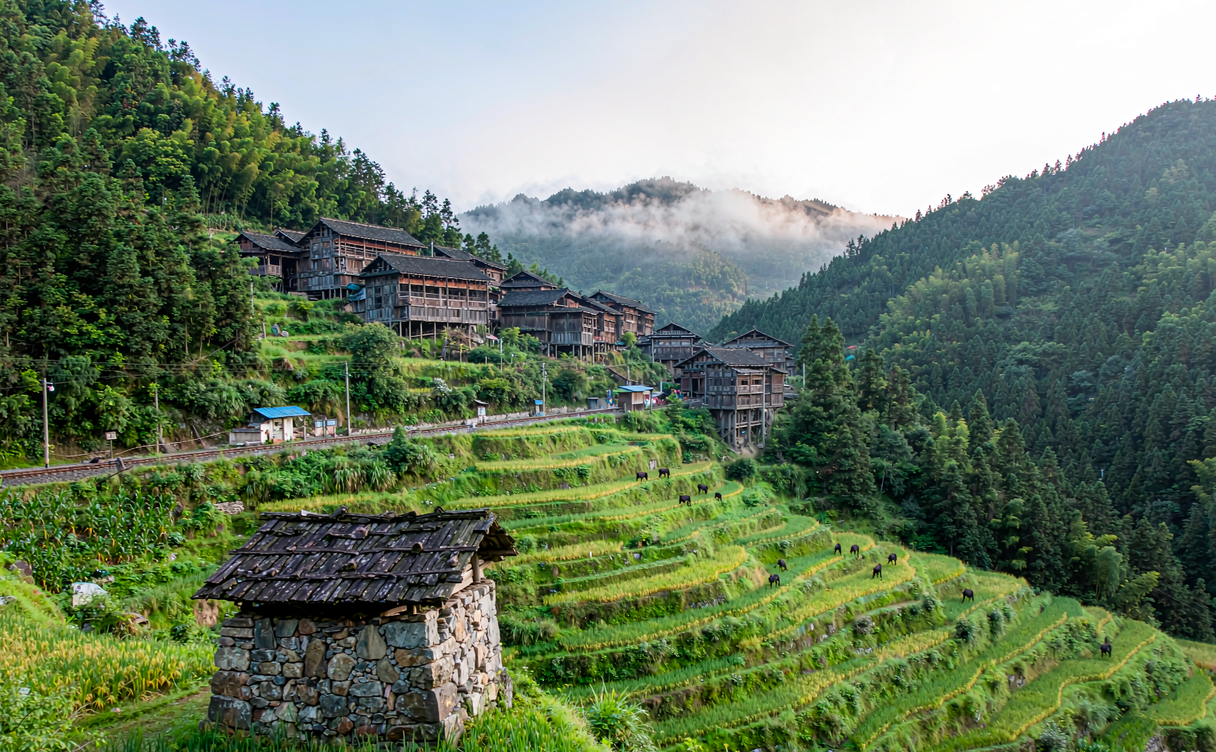
Once you have done the forest park and Xituo, two lower-key stops are worth your time. Qianye Grassland at dawn is a different place from its midday self: the mist sits in the stone forest and the only traffic is grazing sheep. Bring a thermos and plan 90 minutes. And if you have a car, the drive south toward the Hubei border along the Jialing tributary is a genuine highlight — terraced fields, suspension footbridges, and villages where nobody expects foreign faces.
Final thoughts
Shizhu will not make anyone’s top-ten China list, and that is exactly the point. It is the kind of place our readers come back from saying they “actually saw China” rather than a postcard version of it. Cool, green, cheap, and genuinely local, the Huangshui highland is the escape Chongqing itself relies on — and now you know about it too.