

This Xishuangbanna food guide comes out of the better part of a month I have spent eating my way through Yunnan’s far south, and if there is one thing I want you to leave with, it is this: the food here tastes like nowhere else in China. Xishuangbanna, China sits squeezed against the borders of Laos and Myanmar, and its kitchens carry the sour, herbal, smoke-kissed DNA of the Dai, Hani, Bulang and Jino peoples. When you plan a Xishuangbanna food tour, you are really signing up for one of the most distinct regional cuisines on the planet, a world away from the wheat-and-soy belt of the north.
The single most useful thing to understand before you arrive is that the region’s cooking is defined by acidity and fresh herbs rather than chili heat alone. Where Sichuan numbs and Hunan scorches, Xishuangbanna brightens everything with fermented bamboo shoot, wild tamarind, lemongrass, mint, cilantro and a souring agent the locals call “suan” that you will not find on a Beijing table. If you only remember one rule, make it this: order the sour soup first, then build around it.
The night markets are the true heart of the region
If you do nothing else, go to the night markets, because Xishuangbanna night market food is where the culture actually lives. The biggest and most tourist-friendly is the Starlight Night Market (Shibo Yanhua) along the Lancang River in Jinghong, which runs every evening from roughly 6 pm until midnight. Rows of blue-and-white Dai umbrellas shelter hundreds of stalls selling grilled fish rubbed with lemongrass, sticky-rice parcels steamed inside bamboo tubes, and skewers of everything from quail eggs to river snails.
A more local scene is the Manting Road night market and the smaller Ganlanba market about 30 km out of town, where you will see whole chickens charcoal-roasted on improvised grills and baskets of foraged ferns that change with the season. Prices are honest: a full plate of grilled river fish runs 25–40 yuan, a bamboo-tube of sticky rice is 5–8 yuan, and a cup of fresh sugarcane juice costs 6 yuan. I usually budget about 80–120 yuan per person for a satisfying crawl across a dozen stalls, beer included.
What to eat: the Dai cuisine staples
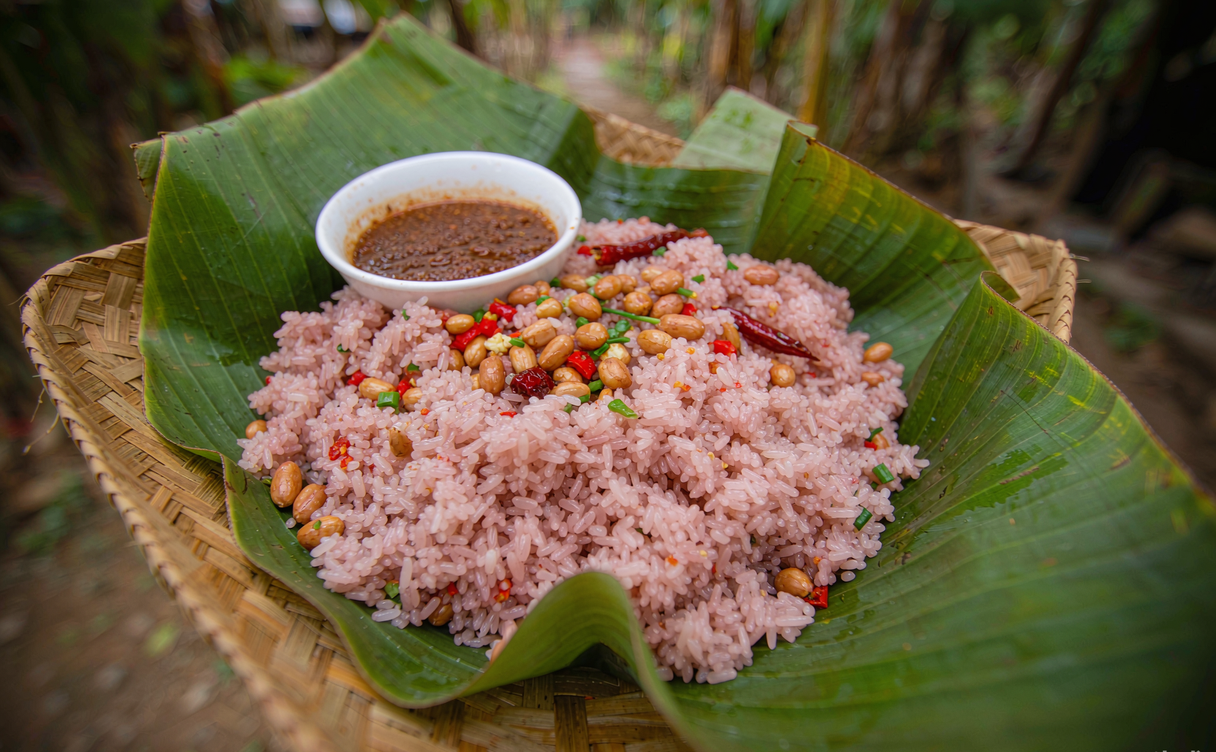
The question every first-timer asks is what to eat in Xishuangbanna, and the honest answer is “everything grilled and everything sour.” Start with kaonan — beef or pork grilled over open coals with a crust of salt, cumin and dried chili, then torn apart with your hands. Dai-style pineapple rice is a sleeper hit: glutinous rice steamed inside a hollowed pineapple with raisins and a little coconut, sweet and savory at once, about 18–25 yuan a portion.
Then there is shouzhuafan, “hand-grabbed rice,” a platter of sticky rice surrounded by small dishes of spicy beef floss, sour bamboo shoot salad and fried tofu, designed for sharing. The signature sour soup, dongyin or fish-sour hotpot, is built on fermented fish and tomato and will wake up a tired palate in one spoonful. For the adventurous, chongcai — insects, usually bee larvae, grasshoppers and bamboo worms stir-fried crispy — is a protein-rich local snack sold by the small bowl for 15–20 yuan.
Xishuangbanna Dai cuisine is fundamentally about balance: every rich, fatty bite is answered by something pickled, bitter or herbal. The bitter melon and wild vegetable stir-fries you see piled at lunch counters are not ailing afterthoughts; they are the point. I learned to love kuo greens, a mildly bitter leaf sauteed with garlic, after a humid afternoon hike left me craving something clean.
Tropical fruit you cannot get up north
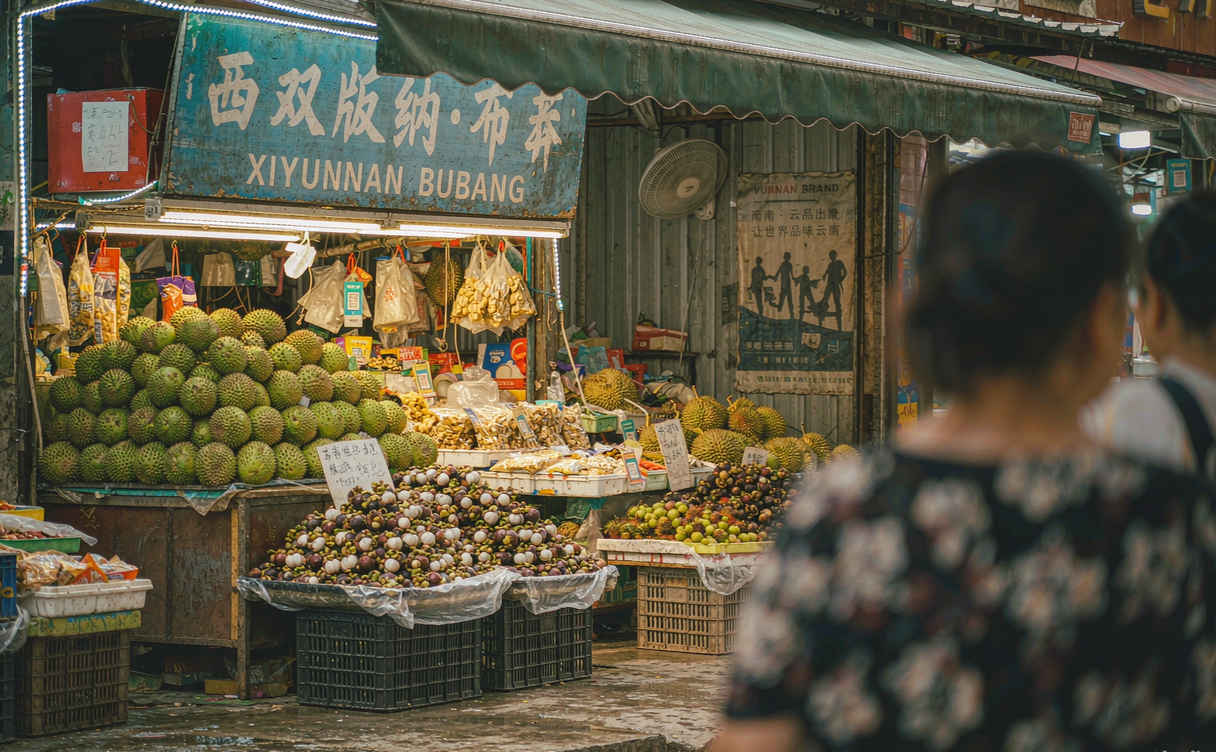
One of the quiet joys of the region is the fruit, and Xishuangbanna tropical fruit is a category of its own. Because the climate is genuinely equatorial, you get Southeast Asian varieties that rarely travel: mangosteen in June and July for 8–12 yuan a kilo, rambutan, salak (snake fruit), and small sweet pineapples that dwarf anything in a northern supermarket. The durian here is local and cheap in season — 10–18 yuan a kilo from roadside trucks in July — and far milder than the imported Thai stuff.
My favorite ritual is the morning fruit market behind the Jinghong bus station, where hill-tribe vendors sell tiny bananas, passion fruit and a pale orange called ganjuzi that tastes like a cross between a tangerine and a flower. A kilo bag of mixed tropical fruit for breakfast costs under 15 yuan and fuels a morning of temple-hopping. If you are here between April and September, ask specifically for mangguo (green mango) eaten with a chili-salt dip — it is the region’s version of summer.
Where I actually send friends to eat
For the best Xishuangbanna food that is still approachable for newcomers, I point people to a handful of dependable spots. Manfeilong Dai Restaurant near Manting Park does a textbook sour fish hotpot for around 88 yuan for two. The tiny hole-in-the-wall “Laozhai Grill” on Ganlanba road turns out the best kaonan I have had, with a chili dip that lingers pleasantly. For a sit-down introduction to minority cooking, the restaurants inside the Xishuangbanna travel guide route around Jinghong’s old town are a safe, well-priced starting point.
If you want to connect this region to the rest of Yunnan, it helps to build north: most travelers fly into Kunming travel guide first, then take the high-speed train or a short flight down. The food changes dramatically as you climb in altitude, which is why I also recommend pairing this trip with the plateau cooking you will find in the Dali Yunnan travel guide — the Bai-style cheese and rice there is a neat counterpoint to Dai sourness.
Practical notes for the hungry traveler
Timing matters. The dry season from November to April is the most comfortable for eating outdoors every night, while the wet summer (June–September) brings the best fruit but heavier evening rain. Most Dai restaurants open for lunch around 11 am and dinner from 5:30 pm; night markets are an evening-only affair. Vegetarians do fine here thanks to the abundance of tofu, fern and mushroom dishes, though you should specify “budong rou” (no meat) clearly, because fish sauce and shrimp paste sneak into broths.
Cash is rarely needed — Alipay and WeChat Pay cover even the smallest stall — but carrying a translation app helps, since menus are often Dai-only with no pictures. If you want the deeper story of the peoples behind the plates, our China ethnic minorities travel guide explains the Dai, Hani and Bulang foodways in context, and the Yunnan rice noodles guide will teach you to tell a good guoqiao mix from a tourist trap.
A note on the people behind the food
It is worth knowing that the Dai are part of the broader Tai language family spread across mainland Southeast Asia, and their cuisine shares clear roots with northern Thailand and Laos — though the political and cultural borders that separate them are real and should be respected. The region’s foodways are a living record of trade, migration and river life along the Lancang, which becomes the Mekong downstream. For a neutral, well-sourced overview of the Dai people and their cultural geography, see the Dai people entry on Wikipedia.
Bringing it home
The best souvenir is not a fridge magnet but a bag of Pu’er tea or a jar of fermented bamboo shoot, both available at the Jinghong morning market for 20–50 yuan. If you want to extend the tea theme, the nearby hills of Pu’er city produce some of China’s most famous aged tea; the Pu’er travel guide covers where to watch it pressed by hand. I have flown home with a vacuum-packed kilo of sour bamboo shoot paste more than once, and it turns a dull weeknight stew into something that smells like a Xishuangbanna evening.
The short version: come hungry, come curious, and let the sour soups and charcoal smoke lead. Xishuangbanna rewards the traveler who skips the hotel buffet and follows the smell of lemongrass down to the river. A single long weekend will only scratch the surface, but it will change how you think about Chinese food forever.