

Ask anyone who has spent a week eating their way across Hong Kong, China and they will tell you the same thing: the best meals are rarely the ones with white tablecloths. This Hong Kong street food guide is built from years of wandering dai pai dong lanes, night-market stalls and bakery windows, and it is meant to help you eat extraordinarily well for the price of a metro ticket. From the egg waffles crackling on griddles in Central to the curry fish balls steaming in Mong Kok, the city’s street kitchens are where its Cantonese soul actually lives. Cantonese cooking, documented in detail on Wikipedia’s overview of Hong Kong cuisine, prizes freshness and texture above heavy seasoning — which is exactly why a good fish ball tastes of fish rather than sauce. You do not need reservations, dress codes or a translator app to join in — just a little curiosity and an appetite that survives the humidity.
Where to Begin: The Neighbourhoods That Matter
The single most useful thing to know is that each district has its own street-food personality. Sham Shui Po in Kowloon is my first recommendation for serious eaters: it is older, cheaper and less polished than the tourist core, and the stalls along Kweilin Street and Pei Ho Street serve some of the best bowls in the city for HK$15–30. Temple Street in Yau Ma Tei is the classic night-market run, loud and theatrical, best after 8pm when the fortune tellers and opera singers are out. Central’s Graham Street and the lanes around Wan Chai’s Johnston Road are where office workers grab quick lunch siu mai and cheung fun. Tsim Sha Tsui along the waterfront is more about the view than the value, but the mango mochi stands there are genuinely good.
If your time is short, pair a food crawl with a sunset walk using our Victoria Harbour guide — the harbour lights make a perfect backdrop to a paper cone of snacks.
The Dishes You Should Not Leave Without Trying
Egg waffles (雞蛋仔, gai daan jai). The signature street snack and the one everybody photographs. Batter is cooked in a spherical mould until the little bubbles turn golden and slightly crisp outside, chewy inside. The best ones have a malt aroma and a hollow centre you can pull apart. Expect HK$25–40 from a dedicated stall; the cart near the exit of the MTR in Causeway Bay does a superb original, and matcha or peanut versions run slightly higher. This is the heart of any proper Hong Kong street food tour, and it is endlessly customisable with chocolate chips or custard filling.
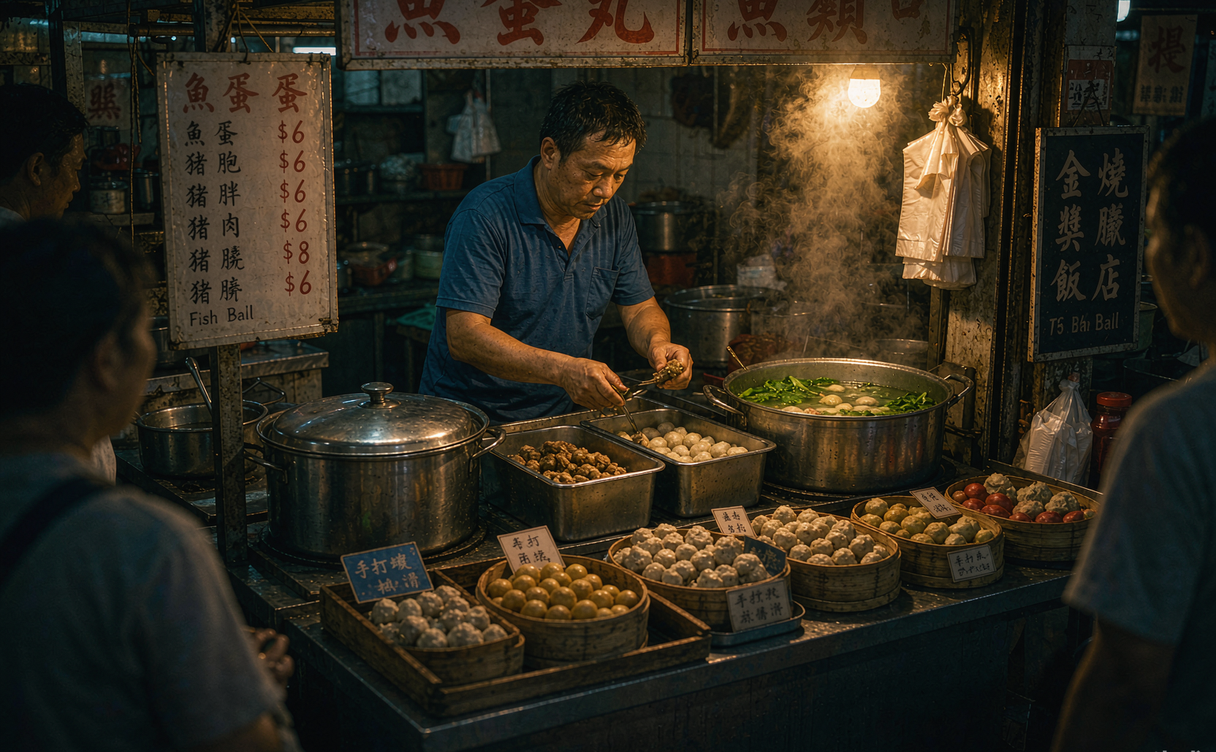
Curry fish balls (咖喱魚蛋). Sold from red-rimmed carts on almost every busy corner, these springy balls of surimi sit in a mild, turmeric-yellow curry broth and are speared three or four to a stick for HK$10–15. Eat them immediately while hot; the broth is the point, so don’t be shy about slurping it from the paper cup.
Pineapple bun with butter (菠蘿油, bo lo bao yau). Despite the name there is no pineapple — the topping is a sugary crust that cracks like a biscuit. A fresh one is split and a slab of cold butter wedged inside so it melts into the warm crumb. Bakeries charge HK$12–18, and the version at the old cha chaan teng near Mong Kok MTR is worth a detour.
Street siu mai (燒賣). Not the dim sum variety but the late-night cart version: a pork-and-mushroom dumpling topped with a dot of orange roe, sold by the piece for HK$8–12 and often finished with a squirt of chili oil and a soy dip. I have lost count of the number of these I have eaten standing up at a Temple Street stall at midnight.
Cheung fun (腸粉). Silky rice-noodle rolls folded around shrimp, beef or youtiao (fried dough) and drenched in a sweetened soy and sesame sauce. A plate runs HK$15–25 and the cart outside Sham Shui Po MTR does a peanut-sauce version that locals queue for.
Roast chestnuts and sweet potatoes. In the cooler months, the charcoal drums on street corners perfume entire blocks. A paper twist of hot chestnuts is HK$20–30 and the perfect pocket-warmer on a winter evening.
Seasonal Eating: When the Menu Changes
Hong Kong, China runs hot and humid from May to September, and the street kitchens respond with cold desserts and herbal drinks. Mango sago, durian sticky rice and grass jelly (qing cao) with evaporated milk are the summer standouts, usually HK$20–35 from a dessert stall. Winters, by contrast, bring claypot rice (煲仔飯) cooked to order over gas burners and scraped off the scorched pot, and snake soup (蛇羹), a velvety, peppery broth believed to warm the bones — a acquired taste best tried at a specialist stall in Sham Shui Po for HK$40–60 a bowl between December and February.
The autumn months are also when the city’s biggest food festival fringes spill into the markets, so a Hong Kong night markets guide is worth reading before you fly, since several of the best temporary stalls only appear for a few weeks.
Beyond the Island: Day-Trip Snacking
Two easy escapes turn a food trip into a small adventure. Lamma Island, a short ferry from Central, has a famous seafood strip at Sok Kwu Wan where the “wet” restaurants will cook your market-bought prawns, but the walk from Yung Shui Wan also hides tofu-pudding ladies and coconut-water carts. Our Lamma Island guide maps the walk and the ferry times. Sai Kung, out in the New Territories, is known for waterfront seafood you choose live from the tanks, then have a nearby cookhouse prepare for a modest fee — a different rhythm from city street food but the same spirit of eating close to the source. See our Sai Kung guide for the cookhouse drill.
If you want a calmer morning before the eating begins, the cable car up to the Big Buddha pairs surprisingly well with the vegetarian pastries sold at the base villages; our Ngong Ping Big Buddha guide covers the logistics.
Practical Tips for Eating on the Street
Carry small notes and coins — many carts still don’t take cards, though AlipayHK and Octopus work almost everywhere now. Stalls with a steady local queue and a high turnover are almost always the safer and tastier bet; the food hasn’t sat. Watch how a place handles its oil: the best fryers change oil often and the batter stays pale gold rather than dark brown. Most snacks are eaten standing or walking, so comfortable shoes and a free hand help.
A note on hygiene: the busiest stalls are usually the cleanest by virtue of volume. If a cart looks empty at peak time, that is a signal, not a bargain. Tap water is not for drinking; buy a bottle, or order a hot lemon with honey from any cha chaan teng to keep cool.
Vegetarians have a harder time on the street than in restaurants — fish balls, pork and lard turn up constantly — but cheung fun with youtiao, baked pineapple buns (hold the butter), and the fruit stalls of Mong Kok are safe and delicious. In rural Lamma and Sai Kung you’ll also find Buddhist-run vegetarian set meals for HK$50–80.
How to Build Your Own Crawl
My favourite half-day loop starts at Sham Shui Po MTR around 4pm: egg waffles first, then cheung fun, then a stroll to a cha chaan teng for pineapple bun with butter and a silky milk tea. Ride the MTR to Yau Ma Tei and walk Temple Street from 8pm for siu mai, curry fish balls and chestnuts, finishing with a mango sago dessert. That is six or seven snacks, maybe HK$150 all in, and a far better story than any hotel buffet.
For a longer trip, string the city together with the outlying islands and you could spend a week eating almost nothing twice. The street food here rewards repetition: the second egg waffle is always better than the first because now you know which stall to return to.