

On my last trip up the Yangtze, I watched the river fold itself into the walls of Qutang Gorge and realized the small hilltop town we were approaching was not just a photo stop — it was the place where Tang dynasty poetry and Three Kingdoms loyalty were born. Baidicheng (White Emperor City) sits on a green mound where the Yangtze meets the Daning River in Fengjie County, Chongqing, and it is one of the most atmospheric stops on any Yangtze River cruise. This Baidicheng guide covers what you’ll actually see, when to go, and exactly how to get there, drawn from the dozen-odd groups I’ve sent through the gorges over the past few years.
Where Baidicheng Actually Is
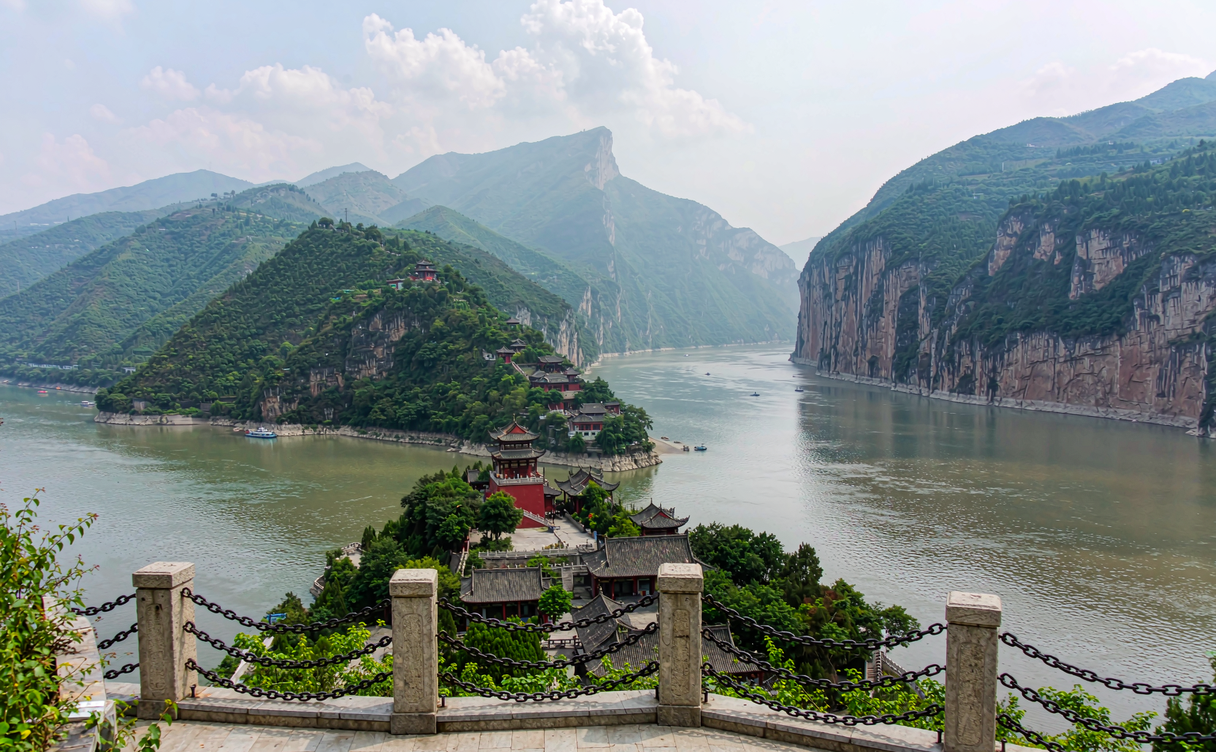
White Emperor City is not in central Chongqing. It’s about 200 km downriver from the city, in Fengjie County, perched on a rocky peninsula that juts into the river right at the western mouth of Qutang Gorge — the shortest and most dramatic of the Three Gorges. Because the Three Gorges Dam raised the water level, the old town gates are now partly submerged, and the site is reached by a 300-meter cable-stayed bridge that swings you across from the mainland to the island hilltop. That approach alone is worth the detour: you cross open water with the gorge walls closing in on both sides.
The name comes from the late Western Han, when a local leader named Gongsun Shu saw a white vapour rising from a well and took it as a sign he should declare himself “White Emperor.” The fortress he built became Baidicheng. A thousand years later the place was immortalized for a very different reason.
The Two Stories Everyone Remembers
Most visitors arrive knowing one of two things. The first is Li Bai’s poem “Departing from Baidi in the Morning” — “Leaving Baidi amid colourful clouds at dawn / A thousand miles to Jiangling in a single day” — which every Chinese schoolchild recites. Standing on the wall at dawn with mist on the water, you understand why the line sticks. The second is the “Tuogu” (entrusting the orphan) story from the Three Kingdoms period: the dying Shu-Han emperor Liu Bei entrusted his son and his kingdom to the strategist Zhuge Liang right here. The Ming-era temple complex on the hill re-enacts that moment with a hall of painted clay figures — Liu Bei on his deathbed, Zhuge Liang weeping, the generals lined up behind them. It’s theatrical, but it tells the story better than any plaque.
I’ve found that guides who rush this hall do their groups a disservice. Spend ten quiet minutes here and the rest of the gorge makes more sense.
Things to See at Baidicheng
Walking the loop takes most visitors 1.5 to 2.5 hours at a relaxed pace. The main stops:
- Temple of the White Emperor (Baidi Temple): The core shrine, with the Liu Bei–Zhuge Liang tableau and a small museum of inscribed stone tablets.
- The Qutang Gorge viewing terrace: The single best wide-angle view of the gorge mouth, where the river squeezes between the sheer cliffs of Chijia and Baiyan mountains. This is the classic postcard shot.
- The Suspended Catwalk and city walls: Ming-dynasty masonry running along the ridge, with cannons and arrow-slit windows aimed at the channel.
- The stele corridor: Hundreds of carved poems on stone, including works by Lu You and other travelers who passed this way.
- The Mingliang sub-temple: A quieter shrine dedicated to Zhuge Liang specifically, good for escaping tour-bus crowds.
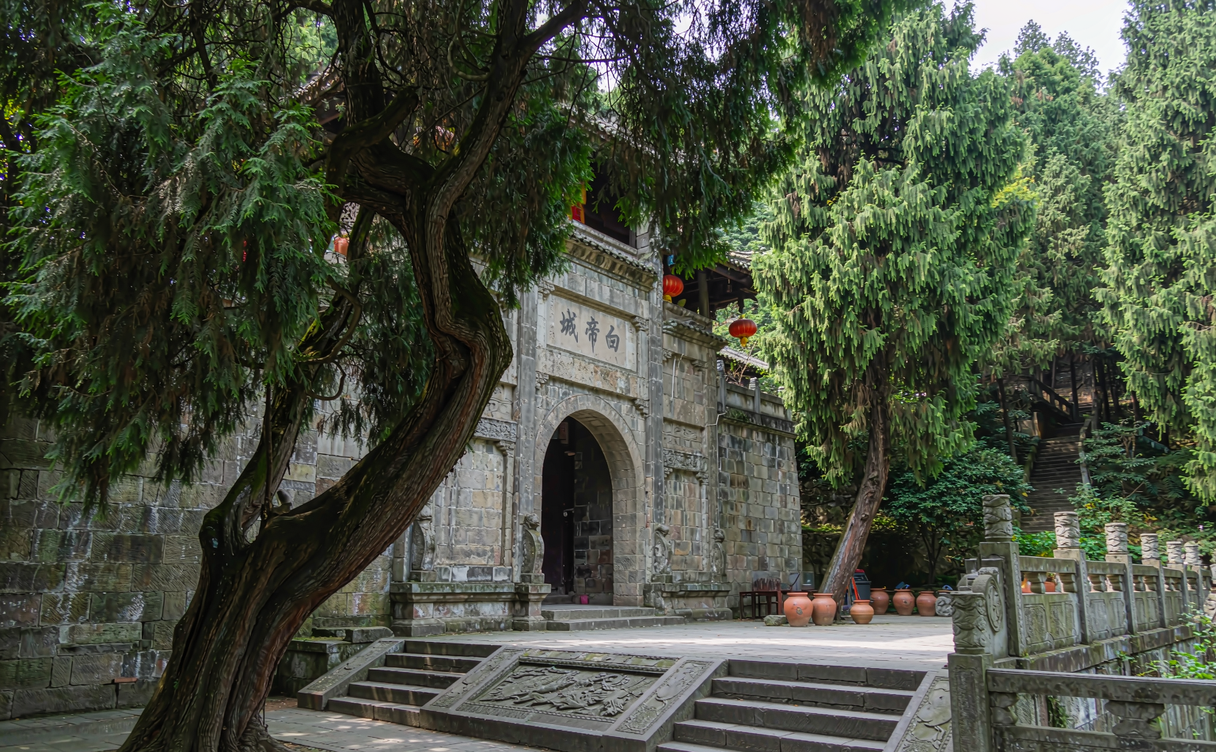
If you’re a photographer, the light is best between 7 and 9 a.m., before the cruise tenders bunch up. I tell clients to be on the first shuttle of the morning.
How to Get to Baidicheng
There are three realistic ways in, and which one you pick depends on your itinerary.
By Yangtze cruise (easiest). Most 3- or 4-night Chongqing–Yichang cruises include Baidicheng as a shore excursion, usually on the second morning. The ship docks at Fengjie and a tender or bus brings you to the bridge foot. The excursion is typically included; some budget lines charge a separate RMB 100–180 for the transfer plus ticket.
By high-speed train. Fengjie has a station on the Chongqing–Wanzhou–Xiangyang line. From central Chongqing you can reach Fengjie in roughly 2 to 2.5 hours on a G-train (around RMB 130–180 second class), then a 40-minute taxi or bus (RMB 60–90) to the site. This is the route I recommend for independent travelers who don’t want a full cruise.
By road. Private car or bus from Chongqing takes 3.5 to 4.5 hours depending on traffic. Fine if you’re already touring the east of the city.
Whichever you choose, buy the combined bridge-and-temple ticket at the mainland entrance; it runs about RMB 100 in peak season and RMB 60–70 in winter, with the cable-stayed bridge crossing included.
For train planning across the region, our China high-speed train guide for foreigners explains how to book seats with a passport and what the station signs actually say.
Best Time to Visit Baidicheng
Spring (March–May) and autumn (September–November) are the sweet spots. The river is full but not flooding, the gorge air is clear, and you avoid both the July–August heat (often 35°C+ and very humid) and the winter fog that can erase the cliffs entirely. I’ve stood on the terrace in February when the mist never lifted — atmospheric, but you see nothing. If you must go in summer, aim for an early sailing and bring water; the hill has little shade.
One practical note: the gorges get a “red leaf” season in late November when the hillsides turn. It’s crowded on weekends but spectacular mid-week.
How Long to Spend, and What to Combine It With
A cruise excursion gives you a fixed window — usually 2 to 3 hours — which is enough to walk the loop once and photograph the terrace. Independent travelers should budget half a day including transit. I don’t think you need a full day; the site is compact and the magic is the view, not the square footage.
Because Fengjie is a long way from downtown Chongqing, I usually pair Baidicheng with the cruise itself rather than with city sights. But if you have extra days in Chongqing before or after, the Ciqikou old town and the Hongyadong stilt-house district are both easy half-day add-ons back in the city.
A Bit of History You’ll Hear On-Site
The hill has been a military lookout, a poet’s refuge, and a temple town in turn. Poets of the Tang and Song — Li Bai, Du Fu, Bai Juyi, Lu You — all passed through and left verses carved into the stone you’ll walk past today. Du Fu actually lived nearby for two years and wrote some of his most famous gorge poems here. That literary layer is why UNESCO-listed Yangtze heritage groups and Chinese authorities both protect the site; the White Emperor City entry on Wikipedia has a useful summary if you want the dynasty-by-dynasty timeline before you go.
Planning a Yangtze sailing? Tell us your dates and we’ll match you with a cruise that actually stops at Baidicheng rather than rushing the gorge — most mid-range ships include it, but the budget lines sometimes skip it to save time.
Practical Tips From the Deck
A few things I wish every first-timer knew. Wear proper shoes: the hill path is paved but uneven, and the terrace gets slick after rain. There’s a café and souvenir stalls near the bridge entrance, but prices are cruise-inflated — bring a snack. Toilets are basic but present. And don’t skip the small museum by the gate; the English labels are hit-or-miss, but the maps showing the old submerged town gates are genuinely interesting.
If you’re coming independently, the last tender back to a docked cruise leaves on a strict schedule — missing it means a pricey taxi chase down the gorge road. Set a phone alarm for 30 minutes before departure.
Who Baidicheng Is For
This is not a thrill destination. It’s for travelers who like their scenery with a story — history buffs, poetry readers, photographers, and anyone who wants to stand where a thousand years of river traffic paused to look up at the cliffs. If you only have one gorge stop in you, make it this one; the combination of vertical rock, slow water, and a temple on a hill is the image most people carry home from the Yangtze.
Want the gorge without the four-day commitment? A Chongqing-based day cruise to Fengjie gets you Baidicheng and the Qutang Gorge mouth in a single long day — ask us about the fast catamaran option that beats the bus by two hours.
My Honest Take
I’ve done this stop a lot, and it still catches me. There’s a moment, usually just after the bridge, when the tour group thins out and you’re alone on the wall with the river moving below you and the cliff faces leaning in. That’s the Baidicheng I try to give every client — not the plaque, but the pause. Go early, go slow, and read Li Bai’s line out loud if you have to. It earns it.
Ready to build this into a Yangtze or Chongqing itinerary? Send us your travel dates and we’ll wire Baidicheng, the gorges, and the dam into one smooth route with the right cruise and train links.
The White Emperor City reward is simple: a hillside, a river, and a story that has outlasted every dynasty that claimed it. Get there before the midday crowds and it’s yours for an hour.