

When I first stepped into the cool dimness of a Bezeklik cave, the desert heat of the Flaming Mountains vanished and I found myself face to face with a thousand-year-old painted gaze. The Bezeklik Thousand Buddha Caves near Turpan, Xinjiang, China are a cliff-carved complex of Buddhist grottoes whose surviving murals record the faith, fashion, and faces of the Silk Road at its peak. This is one of the few places in northwest China where you can stand inside the actual art rather than view a replica behind glass, and it is an essential half-day stop for anyone interested in the region’s layered history.
A Cliff of Caves Above the Mutou Valley
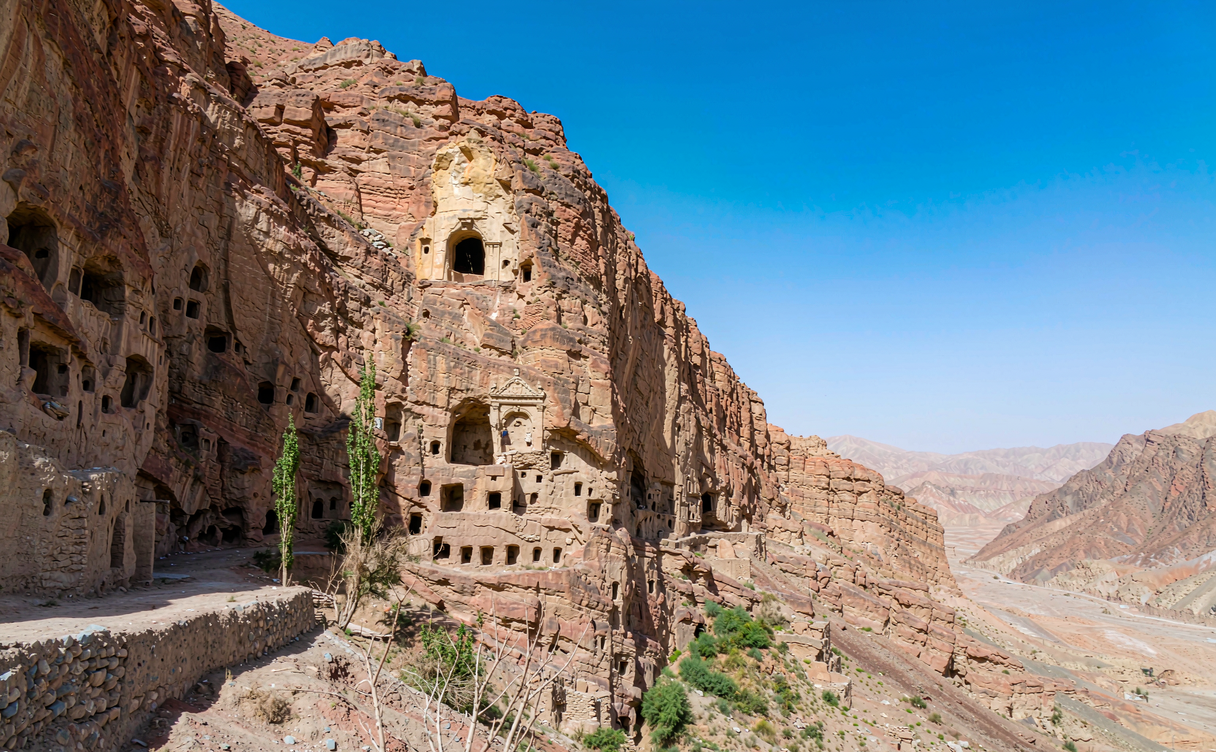
Bezeklik (柏孜克里克) means “place of beautifully decorated paintings” in Uyghur, and the name fits. Carved into a cliff on the west bank of the Mutou Valley beneath the Flaming Mountains, the complex once held more than 80 caves, with construction spanning from the fifth century through the Yuan dynasty. The site flourished under the Uyghur Gaochang Kingdom between the ninth and thirteenth centuries, when local rulers patronized Buddhist art on a grand scale even as the faith was already giving way to Islam across other parts of Central Asia.
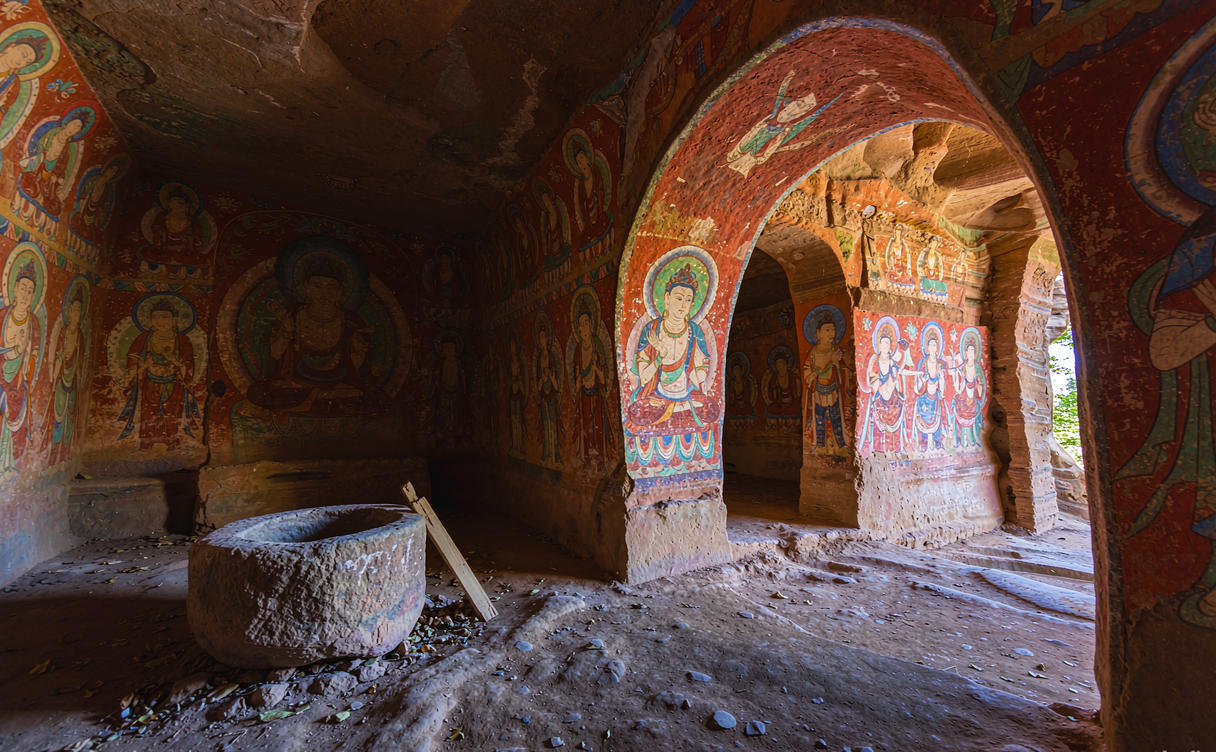
Today about 57 caves remain, of which roughly a dozen are open to visitors and only a handful retain substantial wall paintings. The murals are remarkable for their blend of styles: Indian Buddhist iconography, Persian-influenced patterns, and Central Asian facial features sit alongside Chinese decorative motifs in a single chamber. I was struck by the donor portraits — rows of Uyghur nobles and royal women rendered in vivid ochre and green, a rare visual record of a people whose written language and appearance are otherwise scattered across museum fragments far from Xinjiang, China.
Because the caves sit in a steep gorge, the air inside stays noticeably cooler than the valley floor, which makes the visit comfortable even on hot afternoons. Photography is forbidden inside the grottoes to protect the pigments, so I recommend simply sitting for ten minutes and letting the detail sink in. The walkway along the cliff gives you a sense of the full complex even where caves are closed, and the short climb from the parking area is manageable for most fitness levels.
What to See and How the Art Survived
The standout caves show large central Buddhas flanked by attendant bodhisattvas, celestial apsaras, and narrative scenes from sutras. Look for the chamber with the giant standing Buddha and the rows of sermon listeners, and the grotto whose ceiling still carries geometric and lotus medallions. What you will not see is complete — many of the finest murals were cut from the walls by early twentieth-century expeditions and now reside in Berlin, St. Petersburg, Tokyo, and New York. Standing in an emptied niche, I felt both the loss and the privilege of seeing what remains in situ, lit only by the careful fixtures the site managers have installed.
The site is best appreciated as part of a Turpan cultural loop. Pair it with the Gaochang Ruins just down the road and the Jiaohe Ruins across the oasis so the paintings and the empty cities tell one continuous story of a Buddhist oasis world. Our our Turpan travel guide lays out the logical driving order so you avoid backtracking in the heat and catch each site in the best light.
Want the murals to make sense before you arrive? Grab our cave-by-cave interpretation notes and a map of which grottoes hold the best surviving paintings so you spend your time where it matters.
Tickets, Hours, and Getting There
Bezeklik is part of the Flaming Mountains scenic zone and is ticketed separately from the nearby canyon viewpoint. As of the 2025 season, admission is about 50–70 RMB per person, with opening hours generally 09:30 to 19:00 in summer and 10:00 to 18:00 in winter. The site sits roughly 45 kilometers (28 miles) east of Turpan city and about 10 kilometers past the Flaming Mountains photo stop, so most visitors combine all three on one circuit rather than making a special trip.
The most practical way to visit is by private car or taxi from Turpan, costing around 150–220 RMB one way and taking about 50 minutes, or as part of a half-day loop priced at 400–600 RMB with a local driver. Public transport is limited and unreliable for reaching the exact cliff entrance, so a driver is the realistic option. If you are threading this into a bigger northwest China plan, the a 7-day Xinjiang, China itinerary includes Turpan’s cave sites alongside Urumqi and the southern deserts, while our the China Silk Road itinerary connects the grottoes with the wider trade routes that once funded them. There are basic toilets and a shaded rest area at the cliff entrance, and a small café in the parking lot sells cold drinks, instant noodles, and the local raisin bread that Turpan is known for if you arrive hungry between sites.
Only have one afternoon for cave art? Focus on the open grottoes with intact murals and skip the closed ones — our priority list tells you exactly which chambers to enter first and which to photograph from the walkway without wasting your limited light.
Best Season and Where to Base Yourself
Spring (April–May) and autumn (September–October) are ideal: comfortable 18–28°C (64–82°F) days, clear light, and far fewer tour buses than July and August. Summer heat in the Flaming Mountains can exceed 45°C (113°F), so if you must go then, arrive at opening and carry at least two liters of water per person. Winter is quiet and cold but atmospheric, with occasional snow dusting the red cliffs and almost no other visitors on the walkway.
Stay in Turpan city, where clean mid-range hotels run 250–500 RMB per night and you can also reach the Karez wells, Grape Valley, and Jiaohe Ruins without changing base. For a broader picture of the region’s Silk Road heritage, our this Xinjiang, China travel guide explains how the cave art fits between the oasis cultures and the great deserts, and the Kashgar old town guide shows the western end of the same route where the Buddhist world met the Islamic one.
For authoritative background on the site’s art and history, the Wikipedia page on the Bezeklik Thousand Buddha Caves documents the dynasties, the mural styles, and the fate of the removed panels.
Visiting tips & costs at the Bezeklik caves
A little planning turns the Bezeklik Thousand Buddha Caves near Turpan, Xinjiang, China from a quick photo stop into the highlight of your Turpan day. The admission is about 50–70 RMB per person, ticketed separately from the Flaming Mountains canyon viewpoint, with hours of 09:30–19:00 in summer and 10:00–18:00 in winter. The site sits roughly 45 kilometers east of Turpan city and about 10 kilometers past the Flaming Mountains photo stop, so most visitors combine all three on one circuit rather than making a special trip — a private car or taxi runs 150–220 RMB one way (about 50 minutes), or a half-day loop with a local driver costs 400–600 RMB. There is no reliable public bus to the cliff entrance, so a driver is the realistic option.
Two rules we always give travelers. First, arrive at opening: the grottoes face into the gorge and the walkway crowds by mid-morning in July and August, when Flaming Mountains heat can exceed 45°C. Second, no photography inside the caves — the pigments are fragile and the ban is strictly enforced, so simply sit for ten minutes and let the donor portraits and lotus medallions sink in. Bring at least two liters of water per person, a brimmed hat, and closed shoes for the short climb from the parking area. The cliff entrance has basic toilets, a shaded rest area, and a small café selling cold drinks, instant noodles, and Turpan raisin bread if you arrive hungry between sites. We recommend budgeting 90 minutes on site: 20 minutes on the walkway overview, an hour inside the open grottoes, and ten minutes at the café. Pair the visit with Gaochang just down the road so the paintings and the empty city tell one continuous story of a Buddhist oasis world — our Turpan travel guide lays out the driving order to avoid backtracking in the heat.
Build your Turpan cave day with confidence — get our driver contact tips, combined-ticket advice, and the best photo stops along the Flaming Mountains road so the murals and the red cliffs both make your camera.
Bezeklik is a place to slow down. The murals have already waited a thousand years; give them an hour of your attention and they will show you the face of the Silk Road like no textbook can, here in the quiet of a cliff above the Mutou Valley.