

When we last visited Xuedou Mountain in late April, the morning mist had not yet lifted off the gorge below Qianzhangyan, and the only sounds were the rush of the waterfall and the occasional clang of a temple bell. Most foreign travelers who come to Zhejiang head straight for Hangzhou or the islands, but a Xuedou Mountain guide worth its name needs to start in Fenghua — the district of Ningbo where this “Zhejiang sacred mountain” quietly guards one of the most important Maitreya Buddhist sites in the country. We’ve sent clients here as a relaxed Ningbo mountain day trip, and almost all of them come back surprised that such a serene, layered landscape sits barely 40 minutes from a major city.
Why Xuedou Mountain Matters
Xuedou Mountain (雪窦山) rises to about 800 meters in Xikou Town, Fenghua District, Ningbo, in Zhejiang province. It has been a pilgrimage peak for over 1,500 years and is honored as the dojo of Maitreya, the Buddha of the future. The monk Budai (the laughing “cloth-bag” monk) is traditionally identified with Maitreya, and Xuedou Temple became the recognized center of his worship. For a traveler, the appeal is twofold: a real working monastery with a 33-meter open-air bronze Maitreya statue, and a string of waterfalls and cliff walks that justify the “Zhejiang sacred mountain” label without the crowds you’d meet on better-known peaks.
Getting There
Ningbo is the gateway. Flying in, you’ll land at Ningbo Lishe International Airport (NGB), which has domestic connections from Beijing, Guangzhou, Chengdu, and Shenzhen, plus a handful of regional international flights; a taxi from the airport to Xikou runs around 180–240 RMB (about 25–34 USD) and takes roughly 50 minutes. More reliably, take the high-speed train (G/D trains) to Ningbo Station from Shanghai Hongqiao (about 2 hours, 85–160 RMB / 12–22 USD) or Hangzhou East (about 1 hour, 50–90 RMB / 7–13 USD).
From Ningbo, the simplest option is the tourist shuttle. Buses leave Ningbo South Bus Station (汽车南站) for Xikou roughly every 30–40 minutes between 6:30 and 17:30; the fare is about 18–25 RMB (2.5–3.5 USD) and the ride takes around 50 minutes. Once in Xikou, a local green minibus or taxi covers the final 9 km up to the Xuedou Mountain scenic entrance for 10–20 RMB per person. If you’d rather not piece together buses, a private car with driver from Ningbo city is around 400–600 RMB (55–85 USD) for a full day, which we usually recommend for first-timers doing a Ningbo mountain day trip. You can fold this into a broader plan using our Ningbo travel guide.
Tickets, Passes, and Bookability
The Xikou–Xuedou complex is managed as one scenic area. As of the latest season, a through ticket covering Xikou town sights plus Xuedou Mountain runs about 230 RMB (32 USD) in peak season, while a Xuedou-only ticket is around 120–150 RMB (17–21 USD). Inside the mountain there is a mandatory sightseeing shuttle (about 30 RMB / 4 USD) because the parking lots sit well below the temple; a one-way cable car down to the Qianzhangyan viewing ledge is another 35–40 RMB (5 USD). Children under 1.2 m and seniors over 70 with valid ID usually enter free, with half-price for students.
Bookability is straightforward: the official 溪口-滕头 (Xikou–Tengtou) WeChat mini-program and major Chinese travel apps (Ctrip/Trip.com, Meituan) sell timed e-tickets, and you scan in with a passport. We advise booking the night before on weekends and during the May and October holidays, when the shuttle queues can stretch to 40 minutes. The mountain is open roughly 8:00–17:00, with last entry around 16:00.
What to See: Temples, Falls, and the Cliff Walk
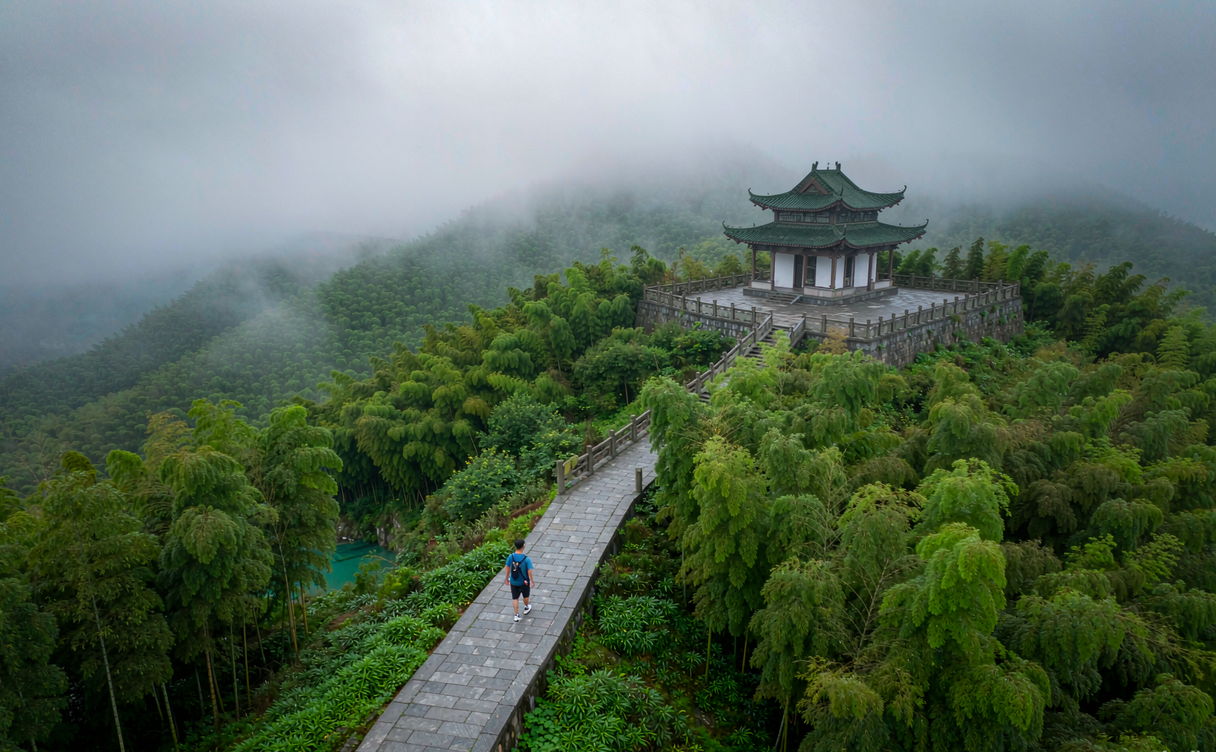
Start at Xuedou Temple (雪窦寺) itself, the spiritual heart of any Xuedou Mountain guide. The current halls date largely from reconstructions in the 1980s and 1990s, but the layout follows the old monastic plan, and the highlight is the open-air Maitreya. The bronze figure sits about 33 meters tall on a lotus base and faces out over the valley; arrive before 10:00 and you’ll often have the lower terrace to yourself. Behind the temple, a short wooded path leads to the old “sixth patriarch” stupa and a tea house where monks sell simple vegetarian snacks. A quieter branch trails off through bamboo before reaching a small hillside pavilion — the kind of spot where you hear nothing but wind in the culms.
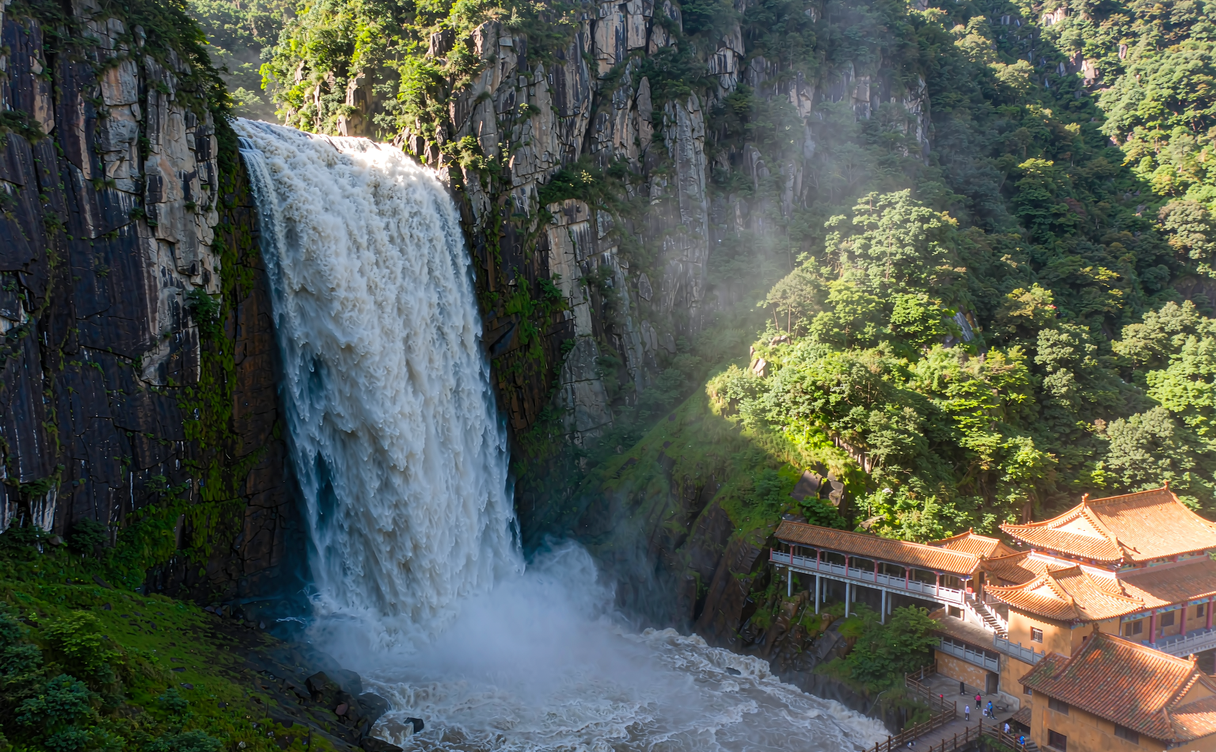
The headline natural sight is Qianzhangyan (千丈岩), the Xuedou waterfall. The water drops roughly 186 meters off a sheer cliff into a narrow pool; there’s a glass-floored viewing platform and a cable-car ledge that lets you look straight down the fall. After heavy rain in early summer the spray soaks the front row — bring a light rain layer. Further along, the “Sanguang” (Three Lights) waterfall and the Yulantang stream make an easy 40-minute loop that’s stroller-friendly on the paved sections.
For walkers, the ridge trail toward Dongshan (东山村) and the Miaogao Terrace offers the best “Zhejiang sacred mountain” atmosphere: ancient trees, stone slabs worn smooth by pilgrims, and occasional openings where you see the whole Xikou basin. It’s not technical — think a 2–3 hour amble, not a climb — which makes it a gentle intro for travelers who later want something bigger. If you catch the hiking bug here, our China hiking treks guide maps out progressively tougher routes.
Where to Eat and Stay
You won’t go hungry. Xikou’s signature snack is the Qianceng bing (千层饼), a crisp layered sesame biscuit sold for 10–15 RMB a bag along Wuling West Road; buy it from the old stone-mill shops rather than the airport packs. Fenghua is also famous for its honey peaches (水蜜桃), in season June–August, and for taro heads (芋艿头) braised with scallops. Up on the mountain, the temple’s vegetarian canteen serves noodles and tofu for 20–30 RMB (3–4 USD) — basic but filling. For a proper Zhejiang meal, Ningbo city is the place to sample seafood and river delicacies; our Zhejiang cuisine guide lists the dishes worth ordering.
On lodging, Xikou town has the widest range: mid-range hotels like the Xikou Hotel and numerous family guesthouses run 200–450 RMB (28–62 USD) per night on weekdays, doubling on holidays. Staying in town lets you reach the lower cable-car station before the buses arrive. If you prefer city comforts, Ningbo has every chain from budget to five-star, and you can still do this as a Ningbo mountain day trip with an early start. Book ahead for spring weekends through Trip.com or Ctrip, where English interfaces and passport check-in are supported.
Best Seasons and Our Timing Advice
Spring (April–early May) is our favorite: the mist sits in the gorge, azaleas and camellias bloom along the ridge, and temperatures hover a pleasant 16–24°C. Autumn (October–November) gives the clearest long-distance views and cooler, dry hiking. Summer is lush and busy, with the waterfall at full roar but occasional typhoon-day closures — check the weather app the morning of your visit. Winter brings occasional light snow and near-empty trails, though some upper paths close. Whatever the season, a Xuedou Mountain Ningbo visit pairs naturally with nearby Buddhist peaks, and travelers heading to the coast often combine it with the quieter Tiantai Mountain Zhejiang guide for a two-mountain Zhejiang loop.
The Maitreya connection that makes Xuedou Temple a national center of worship is explained in detail on the Wikipedia entry for Maitreya, which traces the laughing Budai figure honored here back to the broader Buddhist tradition.
A practical note on the day: wear grippy shoes (the Qianzhangyan platform gets slick), carry cash for the small snack stalls that don’t take foreign cards, and download an offline map before you leave Ningbo, since mobile data can drop on the upper ridge. The whole Xuedou Temple and waterfall loop is very doable in half a day, leaving the afternoon for Xikou’s old streets.
Planning a Zhejiang sacred-mountain circuit? Our Hangzhou travel guide pairs well with this stop for a balanced city-and-mountain itinerary.
Want us to book the timed shuttle tickets and a driver for your Ningbo mountain day trip? Send your dates and we’ll line up the Xuedou Mountain passes in advance.
If the misty-peak atmosphere appeals, read our Putuo Mountain guide next for another ferry-and-foot Buddhist escape on the Zhejiang coast.
Xuedou Mountain won’t top anyone’s list of China’s tallest or most famous summits, and that’s exactly the point. A solid Xuedou Mountain guide sends you here for the combination you can’t get in the cities: a working Maitreya monastery, a 186-meter waterfall you can stand above on glass, and ridges where the only schedule is the shuttle’s. Go on a weekday in spring, ride the first bus up, and let the morning mist do the rest.