

Anhui is better known for Huangshan and the ancient villages of the south, so most travelers skip the province’s north entirely. That’s a mistake, and Huaibei is the quiet proof. This small city in northern Anhui sits on the plain where the Sui–Tang Grand Canal once carried the empire’s grain, and today it pairs those buried ruins with a genuinely surprising amount of green space. This Huaibei travel guide comes from a slow trip through the Huai River plain, and the honest take is that Huaibei is a low-key, high-value stop for history buffs and walkers alike.
Huaibei is a coal city by origin, and you’ll see that industrial backbone — but it has spent years greening itself, and the result is a compact, easy place to explore on foot. The draws are specific: a canal archaeological park, a wooded hill right in the city, and a reclaimed wetland lake that’s now the town’s leisure heart.
Getting there
Start with the practical question: how to get to Huaibei. The city has no airport, so you arrive by rail or road. The nearest major hub is Xuzhou, just across the provincial border in Jiangsu, which has a major high-speed station and an airport; from Xuzhou it’s about 40–60 minutes by high-speed train or an hour by car to Huaibei (fares roughly ¥20–¥40). Our Xuzhou travel guide is the natural entry point, and many travelers combine the two. From Hefei, the provincial capital, high-speed trains take around 1.5 to 2 hours. For the capital-side logistics, see our Hefei travel guide.
Once in town, Huaibei is flat and small; buses and Didi cover it, but the central sights are close enough to walk or bike.
The Sui–Tang Grand Canal site
The headline historical stop is the Sui Tang Grand Canal site Huaibei (隋唐大运河遗址), centered on the old channel at Liuzi town (柳孜运河遗址). This is the real thing — excavated sections of the Tang-era canal embankment, stone locks, and a trove of ceramics and ship remains pulled from the silt, now displayed in a modest site museum. Standing on a 1,400-year-old canal bed that once linked the Yellow and Huai river systems is a quietly powerful experience, especially if you’ve read about the Grand Canal’s role in feeding the capitals.
The site is about 20 km from the city center; a taxi or hired car runs ¥60–¥100 round trip. Entry is cheap (around ¥20–¥30, sometimes free on certain days), and you’ll want 90 minutes including the small exhibition hall. For the wider story, our China Grand Canal travel guide explains how Huaibei’s stretch fits into the 1,700-km waterway that’s now a UNESCO World Heritage property. On that note, the UNESCO listing for the Grand Canal is worth a read before you go — it puts the local ruins in their imperial context.
Walking Xiangshan
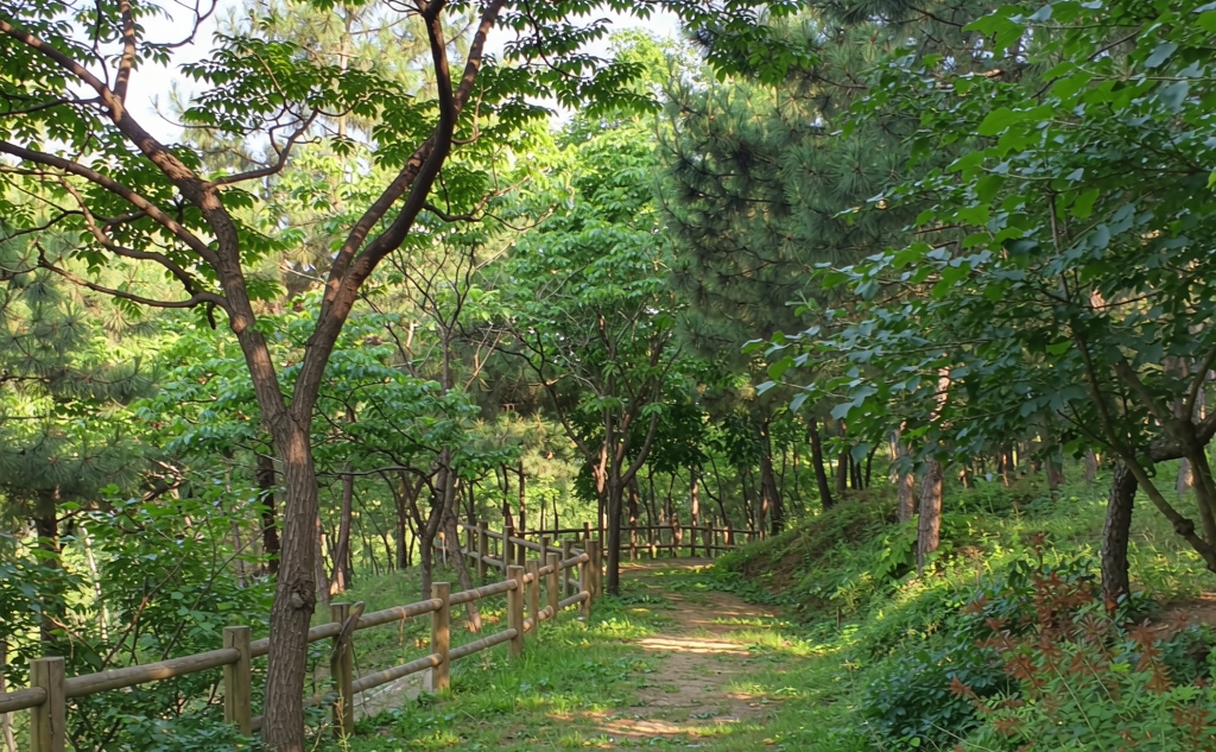
Back in the city, the easiest pleasure is the Xiangshan park Huaibei walk (相山公园). Xiangshan (相山) is a low wooded hill right on the edge of the urban core, crisscrossed with stone paths, shaded by pines, and crowned by a small temple and a pagoda with views across the plain. It’s where locals go to exercise, and on a morning or early-evening stroll you’ll pass tai chi groups, kite flyers, and old men with caged songbirds. Entry is free, and the climb to the top takes a relaxed 30–45 minutes.
We like Xiangshan precisely because it’s unremarkable in the best way — no tickets, no crowds, just a green hill that shows how northern Chinese cities actually live. Bring water in summer; it gets hot and the shade is your friend.
The South Lake wetland
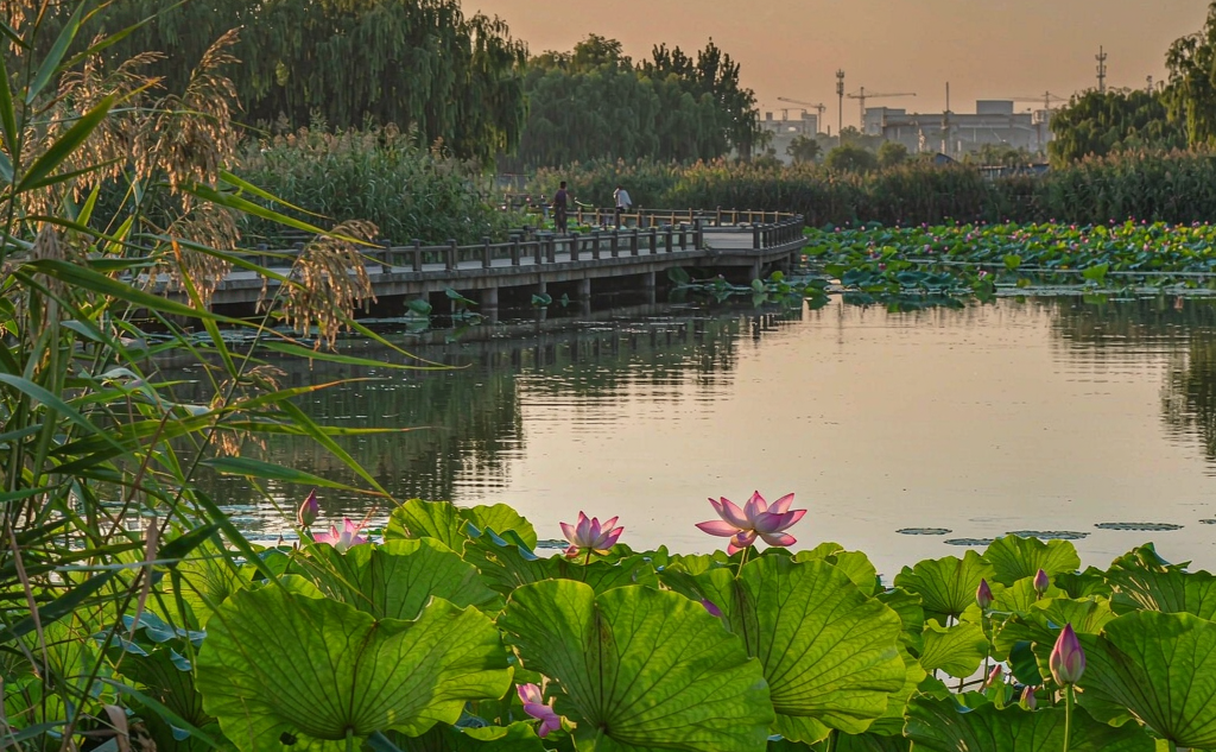
The city’s other green gem is the Huaibei South Lake wetland (南湖国家城市湿地公园), a reclaimed mining subsidence area turned into a large lake-and-reed park on the south side of town. It’s now the city’s favorite leisure spot — flat loop trails, paddle boats, lotus beds in summer, and a long boardwalk over the water. Sunset there, with the reeds glowing and the city skyline behind, is the best free view in Huaibei. Entry is free; boat rental is a few tens of yuan.
We’ve sent travelers who spent a whole relaxed afternoon here doing nothing in particular, which is exactly the point after days of temples and trains. It also pairs naturally with an evening in the nearby new district, where the waterfront promenade has cafes and snack stalls.
Local culture
Huaibei also has a cultural layer worth a look if your timing is right. The region is home to 淮北花鼓戏 (Huaibei flower-drum opera), a local form of folk singing and dance performed at festivals and temple fairs, and you’ll sometimes catch open-air rehearsals in the parks. The surrounding Suixi countryside, a short ride out, is dotted with old 临涣 tea houses where villagers brew strong 棒棒茶 and gossip the morning away — a slow, very northern-Anhui ritual. None of this is packaged for tourists, which is precisely why it rewards the traveler willing to simply sit and watch rather than tick a sight off a list.
Food and where to stay
Huaibei eats like the Huaibei–Xuzhou border region: hearty northern Anhui cooking. Look for 地锅鸡 (diguochi, chicken braised with flatbread pressed to the pot rim), 羊肉汤 (mutton soup, a morning staple), and 烙馍 (thin rolled flatbread with fillings). A filling meal rarely tops ¥50–¥70 a head. For a deeper regional dive, our Suzhou Anhui travel guide covers the neighboring city’s overlapping palate, and our Bozhou travel guide adds the famous herbal-medicine town just west.
Hotels in Huaibei are inexpensive and perfectly comfortable — ¥180–¥350 a night for a clean mid-range room, mostly around the train station and the new district. Nothing luxurious, but you’re paying for location and value, not thread count.
When to go
The best time to visit Huaibei is spring (April–May) and autumn (September–October), when the plain is mild and the parks are at their greenest. Summer is hot and humid, often above 35°C, though the lakes and shade make it bearable. Winter is cold and grey but quiet, and the canal site is still open. We’d avoid the height of summer unless you’re a heat lover — the walking pleasures here are outdoor, and the plain doesn’t offer much relief.
A suggested one-day plan
Arrive by late morning from Xuzhou or Hefei, drop bags at the hotel, then taxi out to the Sui–Tang canal site (90 min). Back to the city for lunch on diguochi, then an afternoon split between Xiangshan Park and a sunset at South Lake wetland. Dinner on mutton soup and flatbread, early train out the next day. Huaibei is fundamentally a day-and-a-half town, and that’s enough to see it properly.
For travelers who like places like this — real, unglamorous, and overlooked — our China off the beaten path guide is where Huaibei properly belongs.
Practical notes
Carry a little cash for the canal-site stall and small temples; mobile pay dominates but not everywhere. Wear decent shoes for Xiangshan’s stone steps. And check the canal-site opening days before you go — it’s a managed archaeological park, not a 24-hour attraction, and occasional closures happen for conservation work.
Why Huaibei is worth a stop
Huaibei won’t headline anyone’s China trip, and it doesn’t try to. What it offers is specific and sincere: a 1,400-year-old canal bed, a free green hill in the city, and a reclaimed wetland lake — all cheap, close, and uncrowded. For travelers crossing the Huai plain or basing out of Xuzhou, it’s a rewarding half-detour into the China that doesn’t make the brochures.