

Every China huangjiu guide has to start by clearing up the confusion, because nine out of ten travellers who ask us about Chinese alcohol are thinking of baijiu — the clear, fierce grain spirit poured at banquets. Huangjiu is the other tradition, and the older one: a brewed rice wine of 12–18% alcohol, amber to brown, aged in clay jars and drunk warm from small cups. We’ve watched clients who flatly refused a second baijiu toast happily work through a warmed pot of eight-year Shaoxing wine with a plate of fennel beans. To drink like the Yangtze delta rather than like a business dinner, this is the bottle to learn.
What Chinese Yellow Rice Wine Actually Is
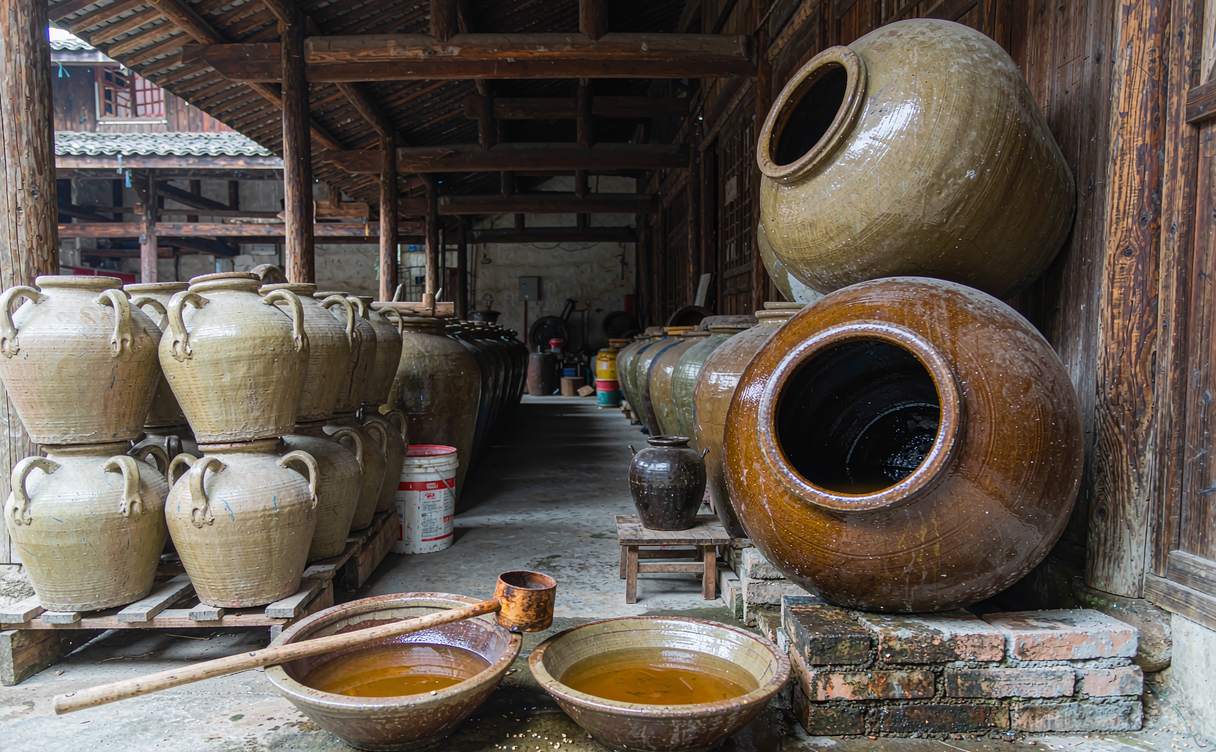
The short answer to what is Chinese yellow rice wine: glutinous rice (sometimes millet, or a rice-and-wheat blend) is steamed, inoculated with a starter culture called qu (jiuqu, a mould-and-yeast cake), fermented in clay jars for months, then pressed, filtered, heat-treated and aged. Nothing is distilled. Flavours run to caramel, dried dates, soy, toasted grain, mushroom and a faint sourness.
Brewing of this type in the Yangtze and Yellow River basins goes back roughly three thousand years, and the technique travelled to Japan and Korea, which is why sake feels like a cousin. The difference is the starter: Japanese brewers use koji on rice, Chinese brewers use qu containing wheat, the source of much of huangjiu’s darker, savoury character. Colour comes from ageing, not additives — a one-year wine is pale straw, a twenty-year wine the colour of strong tea.
Huangjiu Versus Baijiu
The huangjiu versus baijiu difference in one table:
| | Huangjiu | Baijiu |
|—|—|—|
| Process | Brewed and pressed | Fermented then distilled |
| Strength | 8–20% ABV, usually 12–18% | 38–65% ABV |
| Colour | Amber to dark brown | Clear |
| Served | Warmed to 38–45°C, or chilled in summer | Room temperature, in tiny cups |
| Flavour | Caramel, dates, soy, umami | Intense; sauce, rice or strong aroma types |
| Typical cost | ¥25–120 a bottle | ¥60–2,000+ a bottle |
| Where it rules | Zhejiang, Jiangsu, Shanghai, Fujian, Shandong | Nationwide, especially Sichuan and Guizhou |
Practical consequence: huangjiu is forgiving. You drink it through a meal rather than in ambush toasts. If the banquet spirit is what you need to survive, our China baijiu guide covers the toasting protocol.
The Four Sweetness Classes
Chinese labels sort huangjiu by residual sugar, and these four terms let you order anywhere:
- 干型 (gān xíng), dry. The Shaoxing style called yuanhongjiu — sharp, lean, low sugar. Cheapest, and what village taverns pour by the bowl.
- 半干型 (bàn gān), semi-dry. Jiafan and the aged wines sold as Huadiao (花雕). This is the classic, the one to start with, and the one that ages well. A five- to eight-year Huadiao is the reference point for the whole category.
- 半甜型 (bàn tián), semi-sweet. Shanniang — richer, made by fermenting with wine instead of water. Good with rich braised dishes.
- 甜型 (tián), sweet. Xiangxue, dense and dessert-like, sometimes 15–20% ABV. Small cups only.
Ask for “五年花雕” (five-year Huadiao) and you will almost never be steered wrong.
Regional Styles Worth Seeking Out
Shaoxing, Zhejiang. The benchmark: rice plus wheat qu, Jian Lake water, jars sealed with clay and lotus leaf, brewed in winter. The big names — Gu Yue Long Shan, Kuaijishan, Ta Pai, Nu’er Hong — are all Shaoxing houses. Shaoxing rice wine tasting at source means a factory or museum visit plus a flight of three to five ages, ¥40–120.
Jimo, Shandong. A northern style from broomcorn millet, the mash boiled before fermentation, giving a darker, bitter-caramel wine drunk warm with ginger. Bottles cost ¥25–60.
Fuzhou and Minqing, Fujian. Red yeast rice (hongqu) wine — pinkish-brown, tangy, used as heavily in cooking as in drinking. If you have eaten Fujian red-wine-lees chicken, this is the source.
Shanghai. The city’s own bottlings are semi-dry and deliberately smooth for a modern palate, served in old taverns warmed with dried sour plum.
Danyang and Wuxi, Jiangsu. Sweeter, softer wines, often the entry point for people who dislike dry styles.
Hakka areas of Guangdong and Fujian. Niangjiu, a home-brewed sweet rice wine simmered with ginger and treated as a tonic.
These styles slot neatly into the local cooking they grew up beside — our Zhejiang cuisine guide explains why Shaoxing wine and the region’s braised, sugar-and-soy dishes evolved together.
How to Drink Warm Huangjiu
How to drink warm huangjiu properly, in the order it happens:
1. Warm it, don’t cook it. Target 38–45°C, just above body temperature: a pewter pot (tangzi) standing in hot water for three to five minutes, usually done at the table. Never microwave it.
2. Small cups. 30–50 ml ceramic or pewter cups, refilled often. A 500 ml bottle serves two or three across a meal.
3. Additions are normal. Two or three dried sour plums (huamei) in Shanghai; ginger slivers in winter or with crab; brown sugar in northern versions. Purists drink aged Huadiao neat, and they are right about the twenty-year bottles.
4. Chilled works in summer. Dry and semi-dry styles at 8–10°C are refreshing, and increasingly fashionable in city bars.
5. Pace. Three or four small cups over a two-hour meal; at 15% ABV it accumulates quietly.
Pairings that never fail: drunken chicken and drunken shrimp (both cooked with the wine), Dongpo pork, soy-braised river fish, stinky tofu, salted duck, and above all steamed hairy crab in October and November, where warm huangjiu with ginger offsets the crab’s “coldness” in Chinese dietary thinking. Also fennel beans — the ¥10–15 plate of aniseed-simmered broad beans Lu Xun made famous in Kong Yiji, still sold in Shaoxing’s old taverns.
Where to Buy and Where to Drink
Where to buy huangjiu in China is easy: any supermarket has a shelf of it, usually near the cooking oils rather than in the spirits cabinet.
| What | Where | Price |
|—|—|—|
| Everyday bottle, 1–3 years, 500 ml | Supermarket, convenience store | ¥15–40 (US$2–5.60) |
| Five-year Huadiao, 500 ml | Supermarket, specialist shop | ¥40–90 (US$5.60–12.60) |
| Eight to ten years | Specialist shop, brand store | ¥100–220 (US$14–31) |
| Twenty years, gift-boxed | Brand store, airport | ¥300–800 (US$42–112) |
| Warmed pot in a restaurant | Zhejiang, Jiangsu, Shanghai | ¥30–90 per pot |
One warning we repeat constantly: do not buy 料酒 (liàojiǔ). It is cooking wine, salted and often with additives, shelved right beside the drinking bottles. Check the label for 黄酒 and an alcohol percentage, and avoid anything listing salt.
Best places to drink it in context: the old taverns and canal-side shops of Shaoxing, where a bowl of basic yuanhong still costs ¥5–15; Anchang ancient town nearby, which pairs it with local sausage; and Ningbo and Hangzhou seafood restaurants in crab season. Urban bars increasingly build cocktails on aged huangjiu — see our China nightlife and bar guide for where that scene is strongest.
When to Go: The Brewing Season
Traditional Shaoxing brewing begins around Lidong, the start of winter in early November, when cold water and cool air slow fermentation and produce cleaner wine; the jars then rest through spring. To see steaming rice, spinning paddles and rows of sealed jars, visit between early November and February. Late October and November also bring jar-opening ceremonies and wine festivals in Shaoxing, plus hairy crab season — the best fortnight of the year to be eating and drinking in the Yangtze delta.
Summer visits still work for tasting and cellar tours, but the workshops are quiet. Museums and brand houses open year-round, typically 08:30–17:00, entry ¥40–70.

Drinking Etiquette
- Wait for the first toast at a formal meal, then drink freely. Huangjiu culture is gentler than baijiu culture.
- Hold your cup lower than a senior person’s when you clink, supporting the base with your other hand.
- “Suíyì” (随意) means drink as you like — the accepted alternative to ganbei (bottoms up).
- Pour for others before yourself, and top up neighbours’ cups when they empty.
- Refusing is fine: say you are driving, or cover the cup briefly with your hand.
A Simple Tasting Flight
Given the choice, taste in this order: dry yuanhong (one year), five-year Huadiao, ten-year Huadiao, semi-sweet shanniang, sweet xiangxue. Five 20 ml pours costs ¥40–90 in Shaoxing.
Practical Tips
- Buy at the source, not the airport — the same five-year bottle is often 30–50% cheaper in a Shaoxing brand store.
- Packing: bottles are glass and heavy. Wrap them in clothing and check your home allowance (commonly 1–2 litres).
- Sediment is normal in unfiltered styles. Decant gently, leave the last centimetre.
- Hangover management: at 15% it goes down like juice with food. Alternate with tea or water.
- Background reading: the Wikipedia entry on huangjiu has a solid rundown of the sweetness classifications and regional types if you want the technical terms before you shop.
FAQ
Is huangjiu the same as Shaoxing wine?
Shaoxing wine is the most famous type of huangjiu, not a synonym. Shandong’s millet wines and Fujian’s red-yeast wines are also huangjiu and taste noticeably different.
How strong is it, really?
Usually 12–18% ABV, comparable to a robust grape wine. Warming makes it feel gentler than it is.
Will I like it if I dislike baijiu?
Very likely — the two share almost nothing beyond a grain base. The closest reference points are dry sherry, aged sake and Madeira.
What should a beginner order in a restaurant?
A warmed pot of five-year semi-dry Huadiao, ¥40–70, with sour plums if offered. Pair it with braised pork or river fish rather than chilli-heavy food; the flavour map in our eight great cuisines guide shows which regional dishes suit it.
Can I find it in bars, or only restaurants?
Both. Restaurants across Zhejiang, Jiangsu and Shanghai serve it by the pot, and craft bars in the big cities now use aged bottles in cocktails — the same venues covered in our China craft beer guide often stock it.
Written by Karl, China Travel Places — updated August 2026.