

When a traveler tells us they want to see both the Great Wall and the karst peaks of Guilin in one trip, China domestic flight booking is usually the fastest way to make it happen. China’s air network is the busiest in the world, with more than 4,000 daily domestic departures linking every provincial capital and most smaller cities. We have booked visitors onto Beijing to Kunming, Shanghai to Sanya, and Chengdu to Harbin routes, and the process is more foreigner-friendly than most people expect. This guide covers where to book, what it costs in RMB, the passport rule that surprises everyone, and when a flight beats the train.
Why fly instead of taking the train
The high-speed rail is brilliant for trips under 1,000 km, but China is huge. Flying Beijing to Kunming saves you roughly 10 hours of seat time versus the train. For long hauls across the west and south, or for reaching island destinations like Hainan, planes are the practical choice. We generally tell travelers to fly when the rail journey would exceed five hours, and to take the train when it is three hours or less for the scenery and city-center convenience.
Flights also unlock places the rail map has not fully reached. Scenic spots like Jiuzhaigou in Sichuan or Zhangjiajie in Hunan sit an hour or more from the nearest bullet-train stop, and a short hop to the local airport beats a long bus transfer after a full day of travel. When a traveler has only ten days and wants three regions, flying is not a luxury, it is the only way the math works.
Airlines that serve foreign passport holders
All major Chinese carriers sell to foreigners without fuss. Air China, China Eastern, and China Southern run the widest networks and the most English-supportive apps. Hainan Airlines adds solid comfort on longer routes, and Spring Airlines (春秋航空) and West Air (西部航空) undercut them by 40 to 60 percent if you travel with hand luggage only. Budget carriers charge for checked bags and seat selection, so the headline fare is not the whole story. We have flown Spring from Shanghai to Shenzhen for as little as 290 RMB, but a 23 kg checked bag added another 120 RMB.
Where to book flights in China
You have three reliable routes. First, Trip.com (the international face of Ctrip) lets you search and pay in English with a foreign card, and it sends confirmation to your email. Second, the airline’s own app, Air China or China Eastern for example, often shows the lowest fare but may ask for a Chinese phone number at checkout; a hotel number or roaming SIM usually works. Third, Ctrip’s Chinese app (携程) has the deepest inventory but a clunkier translation. For most visitors we suggest starting on Trip.com, then price-checking the airline app before you pay. People who want to know how to travel China efficiently usually pair flight bookings with train reservations in the same trip planner, and our China travel guide for first-timers explains how to stitch the two together.
The passport and real-name rule
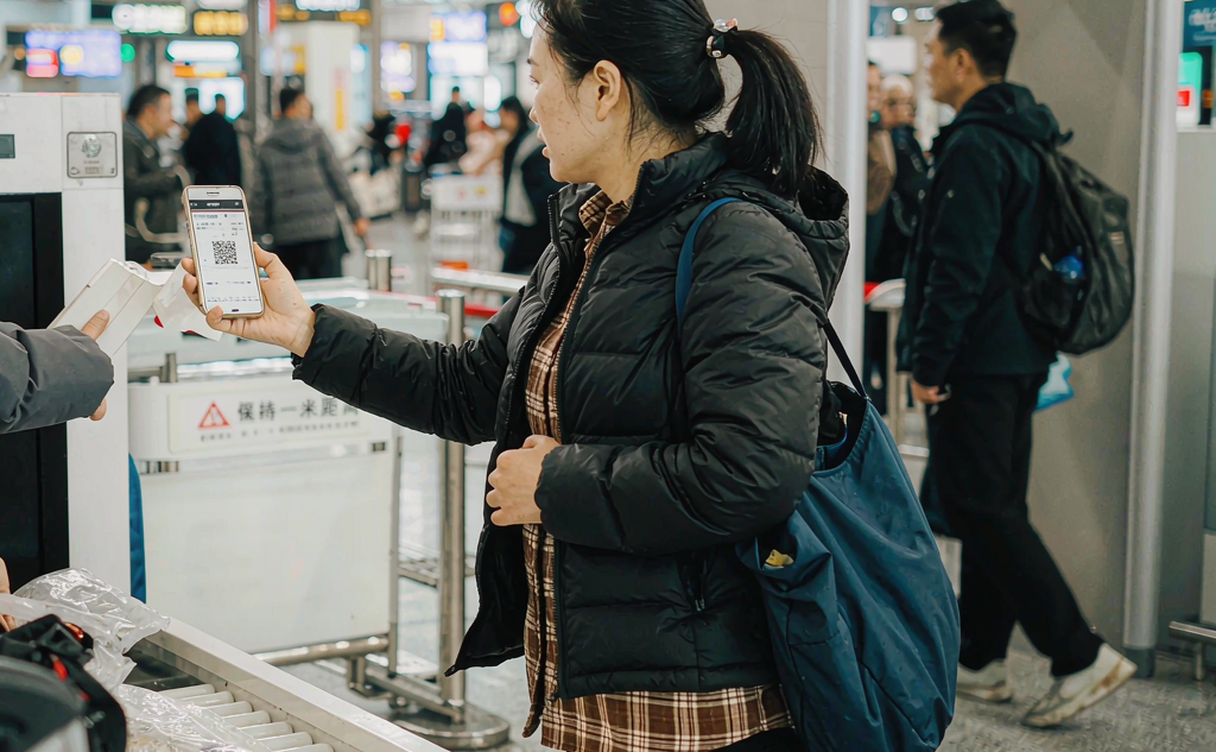
This is the part that catches newcomers. In China, every domestic ticket is tied to your passport number through a real-name system. You must enter your passport exactly as it appears on the document, including the spaces in the number, and you must show that same passport at check-in and the gate. A typo means a cancelled booking and a reissue fee. We always double-check the passport field before payment. Unlike some home countries, the ticket is not transferable, and a name mismatch at the counter is not fixable with a polite explanation.
What it costs in 2026
Domestic fares swing hard with season and how early you book. A Beijing to Shanghai seat runs 500 to 1,200 RMB, cheapest 21 to 30 days out. Beijing to Kunming sits at 800 to 1,800 RMB, and Shanghai to Sanya climbs to 1,500 RMB or more during the winter sun season from December to March. The absolute cheapest windows are the low periods after Spring Festival and in early November, when we have seen Beijing to Chengdu under 400 RMB. The official fare bands and consumer rules are published by the Civil Aviation Administration of China, which is the authority to check if a fare dispute ever arises.
Book at least three weeks ahead for holiday periods; Golden Week in early October and Spring Festival sell out entirely on popular routes. Mid-week departures, Tuesday and Wednesday, are routinely cheaper than Friday and Sunday.
Baggage and check-in for foreigners
Full-service airlines allow 20 kg in economy on most domestic flights, while Spring and similar discounters allow only 5 to 10 kg of cabin baggage and charge for the hold. Arrive 90 minutes early at big hubs like Beijing Capital or Shanghai Pudong, and 60 minutes at smaller cities. Self-service kiosks rarely read foreign passports well, so head to the staffed counter with your passport. We remind travelers that liquid limits and the 100 ml rule apply exactly as in Europe or North America, and that duty-free bags sealed at an international connection are fine to carry on.
Getting to and from the airport
Chinese hubs are well connected, and the ride into town is part of the plan. Beijing Capital Airport runs the Airport Express subway to Dongzhimen in about 30 minutes for 25 RMB, while Beijing Daxing uses a dedicated intercity rail link. Shanghai Pudong has the Maglev to Longyang Road in 8 minutes for 50 RMB, then metro onward, and both Shanghai airports connect to the metro for 7 to 10 RMB. For door-to-door, Didi, the local ride app, from Pudong to central Shanghai runs 140 to 180 RMB depending on traffic; from Beijing Capital to the city it is similar. We tell travelers to load Didi before they land and bind an international card, because taxi queues at peak can be 30 minutes and the drivers prefer Alipay. Budget an extra hour for the airport transfer on both ends when you build a flight day, and you will never miss a connection.
China train vs flight: which should you pick
The honest answer depends on distance and temperament. Our China train vs flight guide breaks the tradeoffs down route by route, but the short version is this: for 300 to 800 km, the train wins on city-center access and reliability; for 1,500 km plus, flying saves a full day. We have had travelers do both in one trip, a daytime train to taste the countryside, then a red-eye flight to leap across the country. If you like the train option, our China high-speed train guide for foreigners walks through the 12306 booking steps in plain English.
Booking timeline and practical tips
One China travel tip we repeat to every flyer: set a fare alert on Trip.com as soon as dates lock, because prices drop and spike daily. Another is to keep your passport number saved in your phone notes so booking takes seconds. If a connection goes through a hub like Chengdu or Xi’an, leave at least 90 minutes between flights, since these airports are vast. And always screenshot your e-ticket, the Chinese apps sometimes load slowly on airport Wi-Fi.
We also suggest travelers weigh flying against the rail pass options. A solid budget travel plan shows where cheap flights actually beat train savings once you add baggage and airport transit, and where they do not. Done with a little planning, booking domestic flights in China becomes as routine as any trip back home, just with better airport noodles.