

When you plan a multi-city trip across mainland China, the single biggest scheduling decision is not which city to visit next but how to get there: train or plane. The country runs the world’s largest high-speed rail network — about 45,000 km of lines carrying trains at 250–350 km/h — yet it also has one of the world’s busiest domestic aviation markets, with more than 200 civil airports. This China train vs flight guide breaks the choice down by real routes, real prices, and real door-to-door time, so you can stop guessing and start booking. If you’re building a first China itinerary, pair this with our China travel guide for first-timers before locking in routes.
The network at a glance
China’s high-speed trains (the G, D and C prefixes you’ll see on the 12306 app) connect almost every provincial capital and most major tourist cities. A G-train between Beijing and Shanghai covers 1,318 km in as little as 4 hours 18 minutes. Conventional Z and T overnight trains still exist for budget sleepers, but for visitors the high-speed network is the default. Flights fill the gaps the rail map doesn’t reach efficiently — long west–east hops like Shanghai to Chengdu, or anywhere into the far southwest where rail is slow.
The headline rule of thumb: under roughly 1,000 km, the train almost always wins on total time; between 1,000 and 1,500 km it’s a toss-up that usually still favors the train; beyond 1,800 km, flying starts to save you real hours. But “real hours” means door-to-airport, a two-hour check-in, the flight, then another hour to leave the airport and reach the city — not the flight duration printed on your ticket. Our broader things to do in China planning starts with getting this math right.
Route-by-route: train vs flight
The table below uses typical 2026 published fares and schedules. Train prices are standard second-class; flight prices are the common economy range for a tourist booking a few weeks out (holiday periods spike higher). All costs include the realistic fare you’ll pay, not promo loss-leaders.
| Route | Distance | High-speed train | Flight (air time) | Train 2nd class | Flight economy |
|—|—|—|—|—|—|
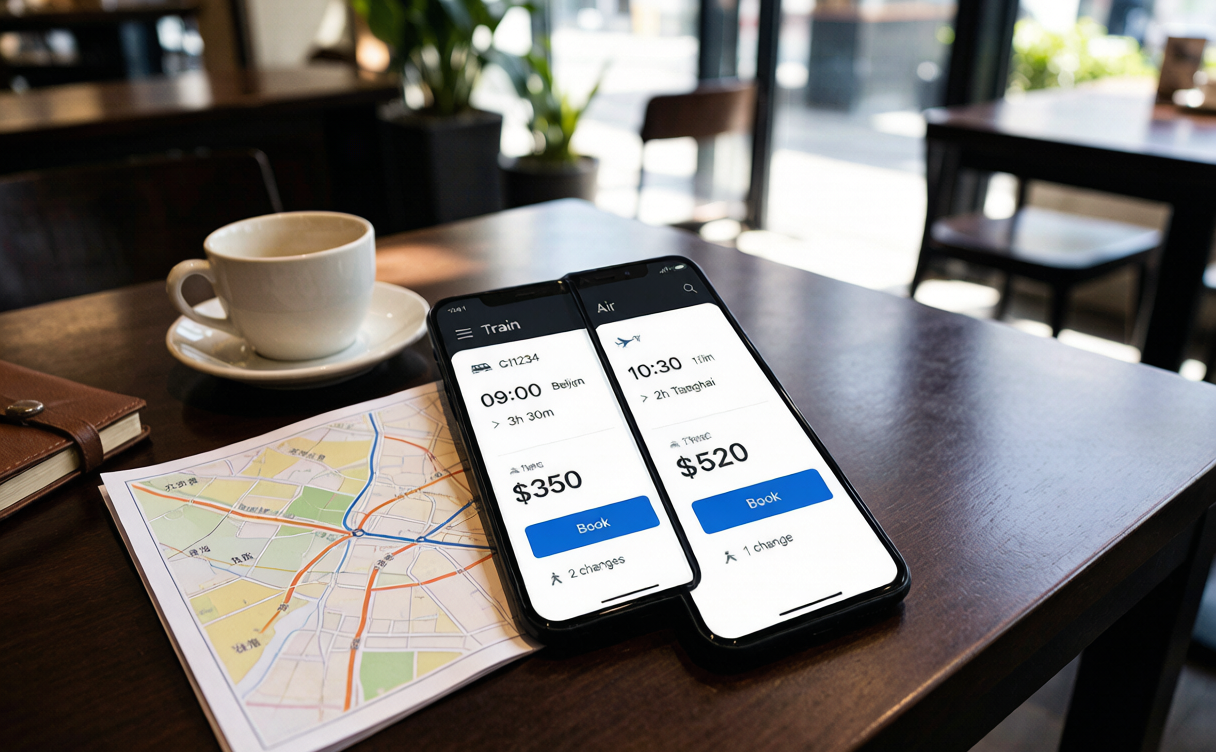
| Beijing → Shanghai | 1,318 km | 4h18–6h | 2h10 | RMB 553 (US$78) | RMB 500–1,400 (US$70–200) |
| Beijing → Xi’an | 1,200 km | 4h20–6h | 2h | RMB 515 (US$73) | RMB 400–1,000 (US$56–140) |
| Chengdu → Xi’an | ~700 km | 3h–4h | 1h20 | RMB 263 (US$37) | RMB 300–800 (US$42–113) |
| Guangzhou → Wuhan | 1,069 km | 3h40–4h30 | 1h50 | RMB 464 (US$65) | RMB 350–900 (US$49–127) |
| Shanghai → Chengdu | ~1,700 km | 10–14h | 2h40 | RMB 1,000+ (US$140+) | RMB 600–1,500 (US$85–212) |
Notice that on Beijing–Shanghai and Beijing–Xi’an the train is cheaper and faster once you add airport overhead. On Shanghai–Chengdu the train is slower by a wide margin, so flying usually makes sense unless you specifically want a scenic daytime ride.
When to take the train
Take the train when the cities sit on a high-speed line and the distance is under ~1,500 km. The advantages are concrete:
- City-center to city-center. Train stations in China are almost always on metro lines in the heart of town. Airports are 30–60 minutes out. On Beijing–Shanghai, the train puts you downtown in 4.5 hours; the plane takes about the same door-to-door once you factor in two airport transfers and security.
- No baggage roulette. You carry your own bag on board; there’s no checked-baggage loss and no liquid restrictions.
- Reliability. Rail delays are rare and small (minutes). Flights in summer thunderstorm season and winter fog get cancelled or stacked for hours.
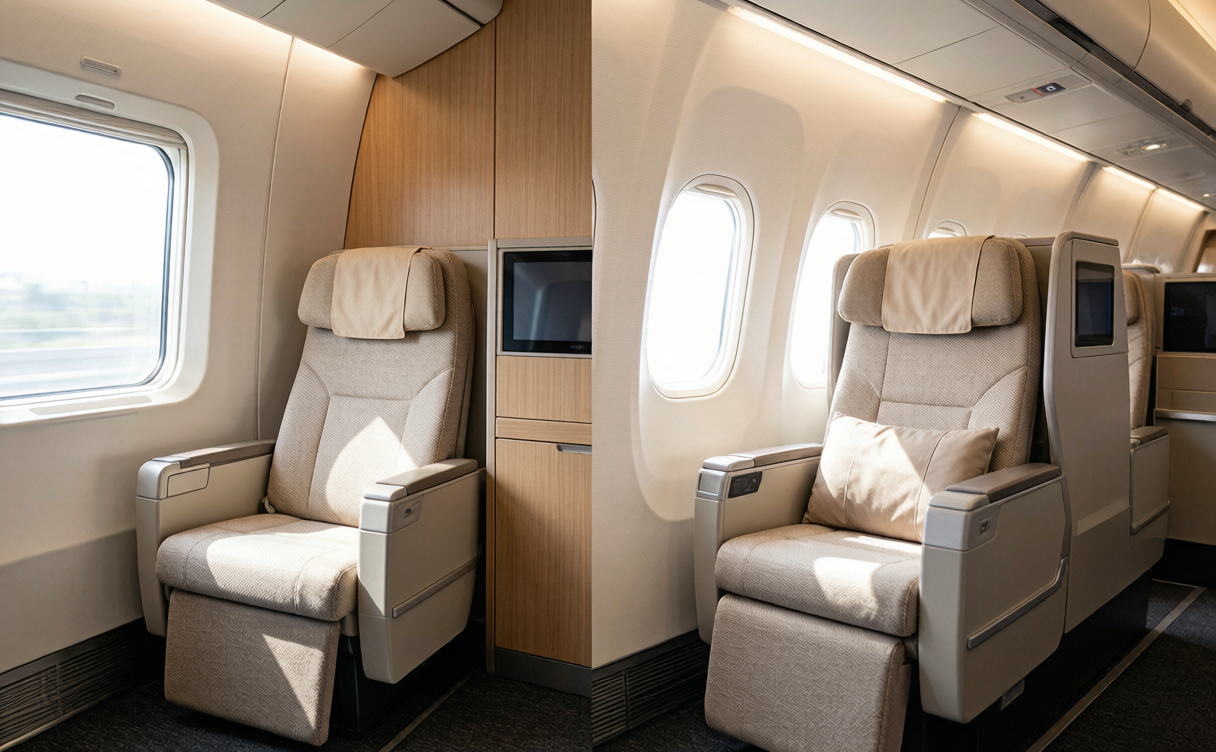
- Scenery and comfort. A window seat on the Beijing–Xi’an line crosses the Yellow River plain; the Chengdu–Guilin stretch is genuinely beautiful. Seats are roomy with a power socket, and the smooth ride beats a narrow Economy seat.
For our full breakdown of classes, seat selection and the passport-booking process, see the high-speed train guide for foreigners.
When to fly
Fly when the train would take more than about 8–10 hours, or when no convenient high-speed line serves your pair of cities. Good flight cases:
- Shanghai, Beijing or Guangzhou to Chengdu, Kunming or Guilin — the train is long or involves a transfer, while flights are frequent and often cheap in the low season.
- Reaching far western destinations where rail is slow and indirect.
- Tight schedules where saving half a day per leg compounds across a two-week trip.
Beware the hidden time tax: Chinese airports recommend arriving 2 hours early for domestic flights, and major hubs like Beijing Capital or Shanghai Pudong are enormous — walking to your gate can add 20 minutes. The things to know before visiting China covers airport and station logistics in detail.
Train classes and what you get
On a G-train the tiers are Second Class (2+3 seating, the default and best value), First Class (2+2, wider, quieter) at roughly 1.5× the second-class fare, and Business Class (1+1 lie-flat pods) at roughly 3× — worth it only on long hauls. Overnight D and Z trains add Soft Sleeper (four bunks per cabin) and Hard Sleeper (six open bunks); a soft-sleeper bunk from Beijing to Shanghai runs about RMB 600–700 (US$85–99) and saves a hotel night. For most visitors, second class is comfortable enough for any sub-6-hour ride.
Flight classes and budget carriers
Full-service carriers (Air China, China Eastern, China Southern) include 20 kg checked baggage and a meal. Budget carriers (Spring Airlines, 9 Air, Lucky Air) often charge separately for checked bags — sometimes RMB 50–150 (US$7–21) per segment — and seat selection. Read the fare rules before you book; a “cheap” RMB 300 flight can become RMB 500 once you add a bag. The lowest fares appear mid-week and in the low season (March, November).
Booking both as a foreigner
Trains are booked through the official 12306 app or website (an English version exists) using your passport number — there is no foreigner surcharge, and the fare you see is the fare you pay. Flights are booked through Trip.com, Ctrip, or the airline directly; prices fluctuate daily, so set alerts. One key China train vs flight tip worth repeating: for popular holiday routes (Spring Festival, National Day Oct 1–7), both trains and flights sell out — book the train the moment tickets release (typically 15 days ahead) and compare flight prices the week before, when carriers sometimes drop empty seats.
For official schedules and fares, the authoritative source is China Railway’s own portal at 12306.cn.
Hidden costs and time realities
- Airport transfers: a metro ride is RMB 5–10; a taxi from a major airport to the center runs RMB 120–200 (US$17–28). Two of those per flight add up.
- Train station transfers: usually a RMB 3–6 metro hop.
- Baggage fees: most Chinese domestic flights include 20 kg on full-service carriers, but budget carriers may charge.
- Food: both options let you bring your own; train dining cars are overpriced, airport food worse.
A sample two-week transport plan
A common first trip — Beijing (3 nights), Xi’an (2), Chengdu (2), Shanghai (3) — is best done entirely by rail: Beijing→Xi’an (4.5h), Xi’an→Chengdu (3.5h), Chengdu→Shanghai (10–14h, use an overnight sleeper or fly). If you add Guilin or Yunnan, switch to flying for those long legs. Build the backbone first, then fill in things to do in China once the transport is settled.
Practical Tips
- Build a “rail-first” default and only fly when the train exceeds ~8 hours.
- On routes under 700 km the train is almost always cheaper and faster — don’t even check flights.
- Travel mid-week (Tuesday–Thursday) for the lowest flight fares.
- Keep your passport handy: both station entry and boarding pass issuance check it.
- Save your train ticket QR in the 12306 app; screenshot it in case of signal drop.
- If you’re unsure which season keeps prices and crowds low, our best time to visit China guide maps weather, holidays and costs month by month.
FAQ
Is the train really faster than flying on Beijing–Shanghai?
Door to door, yes for most travelers — about 4.5–5 hours station-to-station versus 5+ hours once you add airport transfers and check-in.
Can I book Chinese trains without a Chinese bank card?
Yes. The 12306 app and many third-party sites accept international cards; see the train guide for foreigners for the step-by-step.
Are flights in China safe and reliable?
Extremely safe, with a strong safety record. The main reliability issue is weather delays in summer thunderstorms and winter fog, not safety.
What about overnight trains — are they worth it?
Soft-sleeper and high-speed overnight D-trains can save a hotel night on routes like Beijing–Shanghai or Xi’an–Chengdu, but book the lower bunk if you’re tall.
Do I need to print anything?
No. A passport plus the app QR suffices for trains; a mobile boarding pass works for most domestic flights.
Should I worry about train stations being crowded?
They’re busy but efficient and well-policed; our China travel safety tips explains the security-check routine you’ll pass through.
Beyond the big cities
Once the obvious rail hubs are covered, the same logic helps with off-the-beaten-path China — smaller cities often have stations the flights skip, making the train the only sane way in. Whatever you choose, the choice between train and plane is the backbone of a smooth China trip, and it makes every other part of how to get to China far easier to plan.
Written by Karl Huang, updated August 2026.