

Anshun is the town most travelers rush through on the way to Huangguoshu — Asia’s largest waterfall — without realizing they’ve just skipped one of Guizhou’s strangest and most rewarding bases. Stay a night or two and you can drift by boat through a cave palace lit like a dream, watch masked opera performed the way Ming dynasty soldiers staged it 600 years ago, and sleep in stone villages where women still wear the robes their ancestors brought from Nanjing. This Anshun travel guide covers the waterfalls, the caves, and the time-capsule Tunbao culture that makes this corner of Guizhou unlike anywhere else in China.
Why Visit Anshun
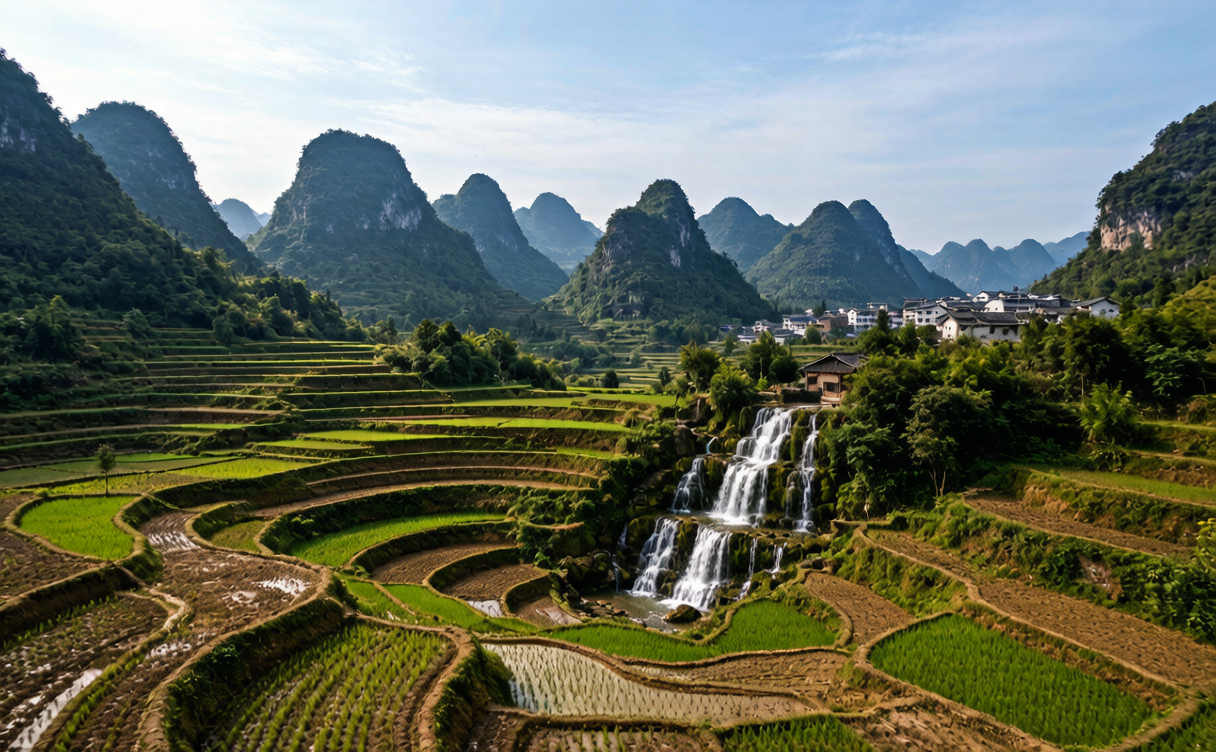
Three reasons. First, geography: Anshun sits in the heart of Guizhou’s karst plateau, surrounded by the densest concentration of waterfalls, sinkholes, and show caves in the country — the reason it markets itself as the “waterfall capital.” Second, culture: in the 1380s the Ming court garrisoned hundreds of thousands of soldiers here from eastern China; their descendants, the Tunbao people, preserved Ming-era dress, dialect, stone architecture, and dixi (“ground opera”) masked drama in fortified villages that still stand. Third, practicality: high-speed rail put Anshun within 35 minutes of Guiyang, so what once demanded a rugged overland trip now fits a weekend.
Best Time to Visit Anshun
The best time to visit Anshun depends on what you want from the water. June through August is peak flow season — after summer rains, Huangguoshu thunders at full width and the spray soaks the viewing paths (ponchos sold everywhere, ¥10). It’s also the busiest and most humid period, though Anshun’s altitude (about 1,400 m) keeps summer far cooler than lowland China — a genuine escape at 22–28°C.
September–October offers strong flow, clearer skies, and thinner crowds: the overall sweet spot. Winter (December–February) is cool and misty, the falls shrink to elegant ribbons, and hotels drop to bargain rates. Spring is pleasant but the falls are at their thinnest before May. For matching Guizhou with the rest of a China route, our best time to visit China guide breaks down the trade-offs region by region.
How to Get There
| From | Option | Time | Approx. Cost |
|—|—|—|—|
| Guiyang | High-speed train to Anshun West | ~35 min | $7–10 |
| Kunming | High-speed train | 2–2.5 hr | $22–30 |
| Chengdu | High-speed train (via Guiyang) | 4–5 hr | $35–50 |
| Guangzhou | High-speed train | 4.5–5 hr | $40–60 |
| Chongqing | High-speed train | 2.5–3.5 hr | $25–40 |
| Beijing / Shanghai | Flight to Anshun Huangguoshu Airport or Guiyang | 3–3.5 hr | $90–220 |
How to get to Anshun is simplest via Guiyang: dozens of daily bullet trains make the 35-minute hop to Anshun West station. From the station, tourist buses and Didi rides reach Huangguoshu (about 45 minutes, ¥20–60) and Longgong (about 40 minutes). Ticketing walkthroughs are in our China high-speed train guide for foreigners.
Top Things to Do
Huangguoshu Waterfall
The Anshun to Huangguoshu waterfall run is the region’s headline day: a 77.8-meter-high, 101-meter-wide cataract you can walk behind, through the dripping Water Curtain Cave cut into the cliff. The scenic area bundles three sections — the main falls, the Doupotang cascade upstream, and the Tianxingqiao stone-forest-and-stream park, which many visitors rate as highly as the falls themselves. Entry runs around ¥160 plus ¥50 for shuttle buses between sections; typically opens around 7:30–8am, and going early beats both tour buses and afternoon haze. Our full Huangguoshu Waterfall guide covers routes, viewpoints, and the rainbow timing.
Longgong Dragon Palace Caves
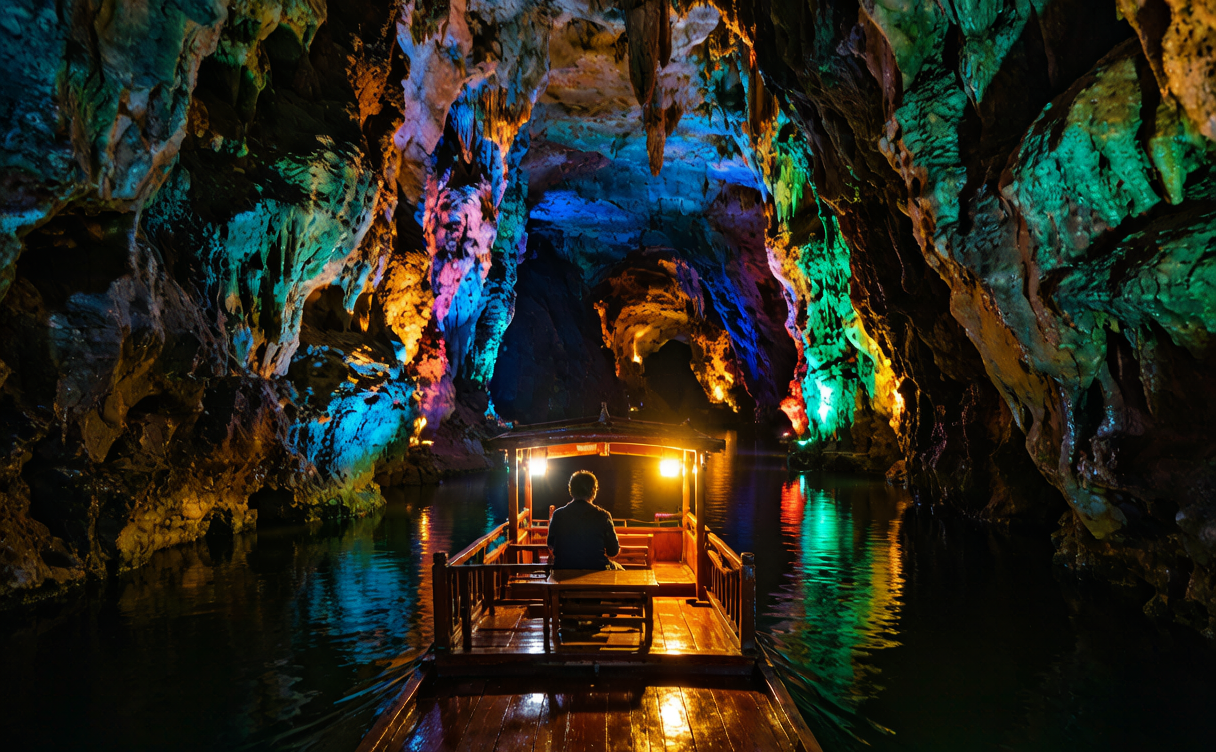
The Longgong Dragon Palace caves hide China’s longest underground river open to boat tours: you glide in near-silence through chambers of lit stalactites, then walk galleries where a subterranean waterfall crashes through a sinkhole. It is theatrical, occasionally kitschy, and genuinely spectacular. Entry about ¥130 including the boat; allow three hours. Combine Longgong and Huangguoshu in one long day only if pressed — each deserves its own half-day.
Tianlong Tunbao Village
Tianlong Tunbao village, 30 minutes east of Anshun, is the easiest place to meet Tunbao culture: stone-slab roofs, defensive lanes, women in Ming-style blue robes with distinctive headdresses, and daily dixi ground-opera performances in which masked players re-enact ancient battles in a courtyard (performances typically run mid-morning and early afternoon). Entry about ¥50–60. The steep Wulong Temple fortress above the village rewards the 30-minute climb. Quieter alternatives include Yunshantun and Benzhai, where tourism barely registers.
Getu River and the “Spider-Men”
Ninety minutes south, the Getu River Scenic Area combines a colossal karst arch, cliff coffins, and local climbers who scale bare rock faces without ropes — a former hunting skill turned performance. It’s a worthy add-on for a third day.
Where to Stay
- Anshun city center: Practical base with the best transport links and night food streets; domestic chains and mid-range hotels $20–45.
- Huangguoshu scenic area: Guesthouses and a couple of upscale resorts within walking distance of the gates ($30–120) — staying here lets you enter at opening time before day-trippers arrive from Guiyang.
- Tianlong Tunbao: Simple courtyard homestays ($15–30) for stone-village atmosphere after the tour buses leave.
- Getu River: Basic guesthouses inside the park for climbers and photographers, $15–35.
What to Eat
Anshun’s table is classic western Guizhou: sour, spicy, herbal. Don’t miss Anshun youzhaba (crisp fried dough pockets stuffed with tofu and chili), siwawa (rice-paper wraps you fill with shredded vegetables and sour sauce at street stalls, about ¥10 for a tray), sour fish soup in the Miao style, Tunbao-style cured pork stir-fried with local peppers, and bobo candy and rose sugar sweets from old-town shops. The night market lanes around Gufu Street fill with grills and noodle stalls after dark; a full street dinner rarely passes $6.
Sample Itinerary: 3 Days in Anshun
Day 1 — Arrival and Tunbao culture. Morning train from Guiyang, drop bags in Anshun. Afternoon at Tianlong Tunbao village for stone lanes and a dixi opera performance; climb Wulong Temple. Night market dinner back in Anshun.
Day 2 — Huangguoshu. Full day at the falls: Tianxingqiao section first, Doupotang, then the main waterfall and Water Curtain Cave in the golden afternoon light. Sleep near the gates or return to Anshun.
Day 3 — Underground river. Morning boat through Longgong Dragon Palace, afternoon train onward — Guiyang in 35 minutes for connections, with city sights covered in our Guiyang travel guide. With a fourth day, add Getu River or continue southeast toward the emerald pools of Libo’s Xiaoqikong scenic area.
Practical Tips
- Ponchos, not umbrellas at Huangguoshu in high flow — spray hits hard on the lower paths, and staff may restrict umbrellas.
- Combo tickets covering Huangguoshu and Longgong sometimes offer savings; check at official ticket offices, not street touts.
- Altitude and sun: 1,400 m means strong UV even on cool days; sunscreen matters more than you’d think.
- Cash-free: Alipay/WeChat Pay handle everything, including village entry gates.
- Crowd strategy: For Guizhou waterfall trips in July–August, be at gates by opening (typically around 7:30–8am) and save indoor caves for midday.
- Background: The South China Karst, which shapes this entire landscape, is inscribed by UNESCO — see the official listing for the geology behind the scenery.
FAQ
Can I visit Huangguoshu as a day trip from Guiyang and skip Anshun?
You can, but you’ll spend four hours in transit and hit the falls at peak crowd time. Basing in Anshun adds Tunbao villages, caves, and early-gate access for barely any extra cost.
Are the Tunbao villages a tourist show?
Tianlong is partly staged for visitors, but the culture is lived-in — the dress, dialect, and opera survive in dozens of untouristed villages nearby. Visit Yunshantun for the unvarnished version.
Is Longgong worth it if I’ve seen other show caves?
Yes, because of the boat: drifting an underground river feels fundamentally different from walking a lit cave.
How wet will I get at the Water Curtain Cave?
In summer flow, expect a proper soaking on the cliff path — protect phones and cameras in dry bags.
Do I need a guide?
No. All major sites run shuttle systems with clear signage, and Didi covers gaps. A guide adds most value for dixi opera context and village history.
Written by Karl Huang, updated July 2026.