

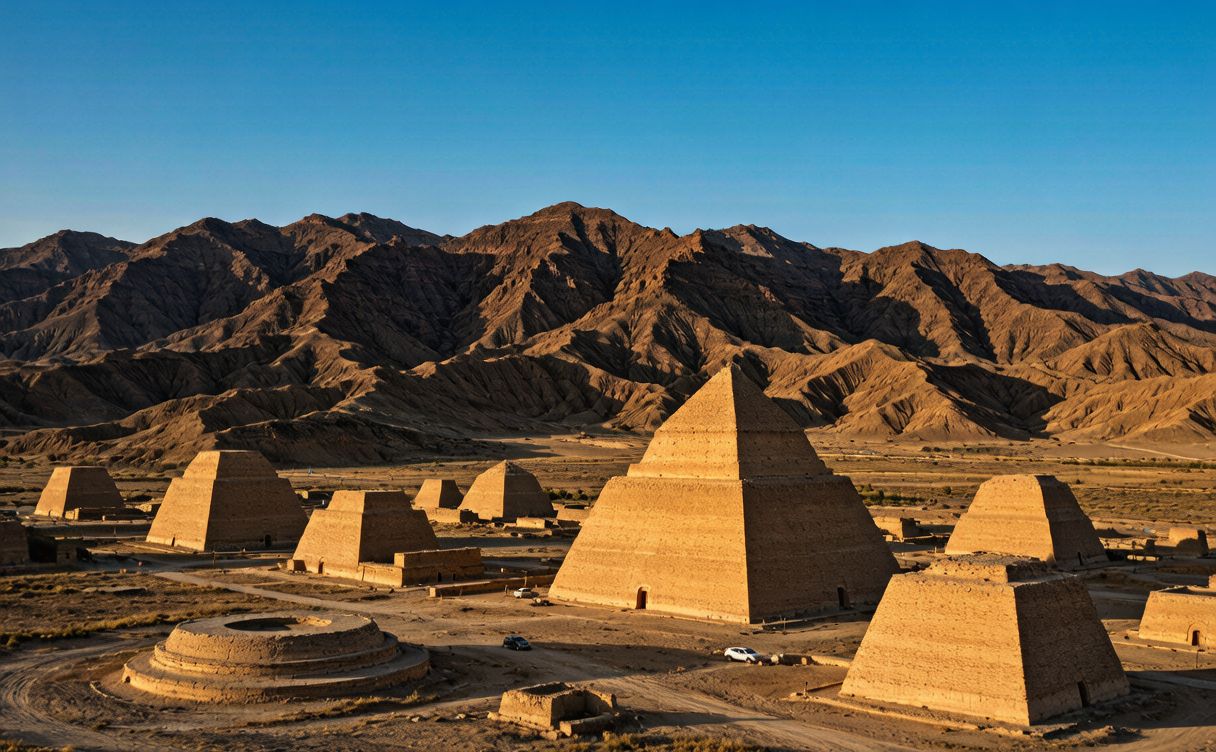
I still remember the first time I stood at the foot of the Helan Mountains, squinting into the low northern sun. I had come to Ningxia expecting little more than a stopover on the way to somewhere louder — Xi’an, maybe, or the desert trains west. Instead, I found myself alone in a silence so vast it felt sacred. In front of me rose a cluster of weathered, earthen mounds — not sharp Egyptian pyramids, but softer, sun-baked shapes that the Chinese call the “Pyramids of the East.” These are the Western Xia Tombs, the ruined imperial cemetery of a dynasty almost nobody in the West has heard of. And that, for me, was exactly the point.
Getting There
Reaching the Western Xia Tombs is easier than you might expect, and I want to be honest about the small logistics because they matter. The site sits about 30 kilometers west of Yinchuan, the capital of Ningxia Hui Autonomous Region, tucked against the eastern foothills of the Helan Mountains. Most foreign tourists arrive in Yinchuan by air — there are direct flights from Beijing, Xi’an, and a handful of other hubs — and the city itself makes a pleasant, low-key base.
From Yinchuan, I took a taxi to the tomb complex, which took roughly 40 minutes and cost a reasonable flat fare arranged through my hotel. Public buses also run out this way, but the schedule is loose and the signage is mostly in Chinese, so for a first visit I’d recommend a taxi, a ride-hailing app, or a half-day tour that includes hotel pickup. The approach is part of the experience: the city thins into farmland, then into gravel plain, and finally you catch your first glimpse of those strange mounds on the horizon. If you’re planning a broader China trip, our China Travel Guide for First-Timers has practical advice on SIM cards, payments, and getting around that I wish I’d read before my first trip.
What to See
The Western Xia Tombs, known in Chinese as Xixia Wangling, stretch across roughly 50 square kilometers and contain the remains of nine imperial mausoleums plus more than 200 satellite tombs of nobles, officials, and generals. Walking the site feels less like visiting a monument and more like exploring a lost city that the desert is slowly reclaiming.
The centerpiece is the museum at the entrance, which I spent a surprising amount of time in. It holds Tangut stele fragments, glazed roof tiles shaped like fierce guardian beasts, and — most hauntingly — examples of the Tangut script, a written language so complex that scholars call it one of the hardest ever devised. Outside, a raised boardwalk loops past the great mounds themselves. You can’t enter them, but standing beneath a 20-meter-tall earthen pyramid, its stepped sides eroded into soft curves, is genuinely humbling. A small replica of one tomb chamber shows what the interiors once looked like, with murals and painted ceilings.
I found the observation tower, built to look like a Tangut watchtower, to be the best vantage point. From the top you see the whole necropolis laid out in solemn rows, the Helan Mountains a jagged blue wall behind it, and the plain stretching empty to the east. It’s the kind of view that makes you feel small in the best way.
The Lost Dynasty
Here’s the story that hooked me. The Western Xia — or Xi Xia — was a Tangut-led dynasty that ruled parts of northwestern China from 1038 to 1227, roughly the territory of modern Ningxia, Gansu, and parts of Qinghai and Inner Mongolia. For nearly two centuries it sat as a power between the Song, the Liao, and later the Jin, playing them off one another with a skill that kept a small, mountainous kingdom independent far longer than its size deserved.
The Tangut people had their own language, their own Buddhist art, and a military reputation fierce enough that Genghis Khan reportedly died on campaign against them. When the Mongols finally conquered Western Xia, they destroyed its records and cities so thoroughly that the dynasty nearly vanished from history. For centuries the Tangut script was unreadable; only in the last hundred years have scholars begun to piece it back together. That erasure is why, standing among these tombs, I felt I was looking at a civilization the world was supposed to forget — and hadn’t quite.
If the Silk Road and its border kingdoms fascinate you the way they fascinate me, our Turpan Silk Road Guide follows another desert crossroads, and the Dunhuang Mogao Caves Guide covers the cave temples that preserved so much of the art this region once produced.
Tips
A few things I learned the hard way, so you don’t have to. First, the site is exposed and windy — the Helan foothills funnel gusts across the plain, and there is almost no shade between the museum and the mounds. Bring a hat, sunglasses, and water, even in spring. Second, hire the audio guide or a local guide if you can; the tomb labels are sparse, and without context these mounds are just mounds. The audio tour gave me the dynasty’s timeline in plain English and made the whole visit click.
Third, give yourself at least half a day. I arrived thinking two hours would do it and ended up staying nearly four, partly because the museum deserved it and partly because the silence was addictive. Fourth, combine the tombs with a stop at the nearby Helan Mountain rock art or a Ningxia winery if you have a car — the region’s unexpected vineyards produce some genuinely good bottles. And finally, photography is unrestricted in the open areas, so go early or late for the low light that turns the earthen pyramids gold.
Best Time
Ningxia sits deep in the continental interior, which means big temperature swings and four sharply different seasons. I visited in late spring and found it close to ideal: warm days, cool mornings, and clear skies. Autumn, from September to early October, is widely considered the best window — the air is crisp, the light is soft, and the grape harvest brings the vineyards to life.
Summer gets hot and can be crowded with domestic tourists, though the long daylight is good for photography. Winter is brutally cold and quiet, with a stark beauty that I’d only recommend to photographers who don’t mind numb fingers. Because timing matters so much across this huge country, our Best Time to Visit China guide breaks the seasons down region by region, and it’s worth a look before you book.
Good to Know
Before you go, a few practical notes. The Western Xia Tombs are a designated major historical and cultural site and are on China’s tentative list for UNESCO recognition, so facilities are well maintained and English signage at the museum is decent. Tickets cover the museum, the boardwalk, and the observation tower; check the official regional tourism site for current opening hours and any seasonal closures before you travel.
The on-site museum café is basic, so eat in Yinchuan beforehand or pack a snack. Yinchuan itself has good halal food thanks to the region’s Hui Muslim community, and I ate some of the best hand-pulled lamb noodles of my trip there. If you want authoritative local information in English and Chinese, the regional tourism authority publishes updates here: Ningxia Culture and Tourism.
For a wider sense of what the country offers beyond Ningxia, our Beijing First-Time Travel Guide is the natural next stop, and our Best Things to Do in China pulls together the headline sights if you’re still shaping your itinerary.