

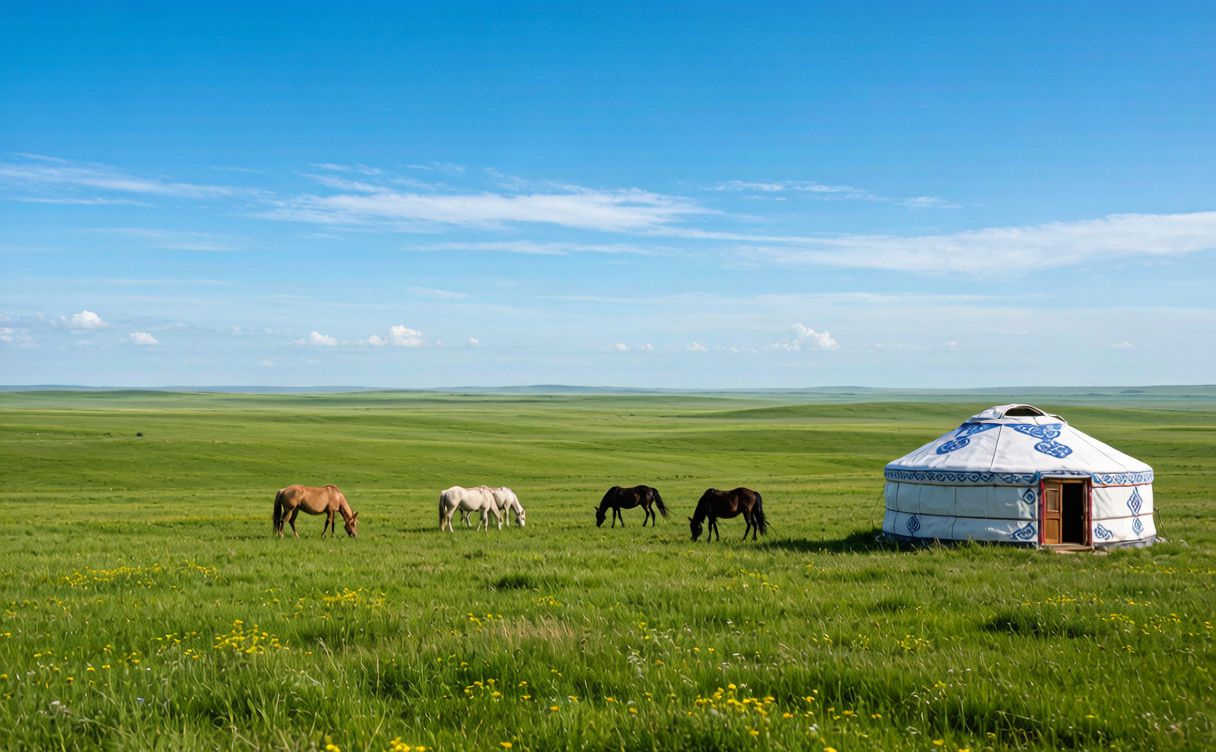
The first time I stood on the Hulunbuir Grassland, I stopped talking. There was simply nothing to say. A wind rolled in from somewhere past the horizon, bent the grass into silver waves, and I realized I was looking at a green ocean with no far shore. Hulunbuir sits in the far northeast of Inner Mongolia, pressed up against the borders of Russia and Mongolia, and it is the closest thing China has to the untouched steppe of legend. If you want to understand why travelers fall in love with the north of this country, this is where you start.
Getting There
I flew into Hailar (now called Hulunbuir City), the regional hub, on a direct flight from Beijing. From there it is about an hour’s drive to the open grassland. Trains also run from Harbin and from Beijing, though the ride is long and the scenery only gets good once you cross into Inner Mongolia. If you are already building a northern China trip, it pairs beautifully with a winter stop in the northeast — see our Harbin Ice Festival travel guide for that contrast.
The smartest move is to rent a car with a driver for two or three days. Distances between pastures, lakes, and ethnic villages are large, and public transport barely exists once you leave the city. I arranged mine through my hotel and paid a flat daily rate that included fuel. English is rare out here, so download an offline map and have your destinations written in Chinese characters before you go.
The drive out of Hailar is its own pleasure. Within twenty minutes the last apartment blocks give way to low hills, then to open pasture where the road seems to aim at the sky. My driver, a quiet man named Old Zhou, pulled over without warning so I could stand in a field of wildflowers taller than my knees. “People come to see the grass,” he said, “but they remember the silence.” He was right. Out here the loudest sound is often your own breathing.
What to See
Hulunbuir is not a single attraction; it is a region the size of a small country. The headline sight is the grassland itself, but a few places stuck with me.
Erguna Wetland, near the Russian border, is the largest wetland in Asia and turns gold in autumn. The Morigele River twists through the meadows like a dropped ribbon — I spent an entire afternoon just watching it from a hilltop, the water catching light in a hundred shades of blue. Then there is Lake Hulun, a vast freshwater lake where you can watch the sun melt into the water, and Beiji Village, the northernmost settlement in China, where wooden houses and birch forests feel more Siberian than Chinese.
I reached the lakeshore at dusk and hired a small fishing boat the next morning. The captain tossed a net while I drank in the stillness; a single crane lifted off the reeds and carved a slow line across the pink sky. These are not sights you tick off a list. They are places you arrive at and then wonder why you ever rushed through anything.
For a different flavor of the north, the Xinjiang grasslands offer a similar soul with a different accent. Our Xinjiang Nalati Grassland guide covers that western cousin if you want to compare the two.
Nomad Life
This was the part I came for. I stayed two nights in a yurt camp run by a Mongolian family. Mornings began with milk tea and the low whistle of wind through the felt walls. By day I rode a patient horse across the meadow, learned to throw a lasso (badly), and watched a herder named Bater move three hundred sheep with nothing but a whistle and a dog.
Evenings meant a bonfire, grilled lamb, and throat-singing that seemed to come from the ground itself. Nobody hurried. When I mentioned I had a train to catch, Bater just laughed and said the grass would still be there. That is the gift of nomad life: time slows until you remember what it feels like.
The rhythm here is very different from China’s cities. Out on the steppe, the day is shaped by light and animals, not clocks. I found that contrast refreshing, and it made the quiet up north feel like a reward rather than a shock.
One night Bater’s grandmother taught me to make milk tea the proper way, simmering it with salt and a pinch of fried millet until it turned the color of weak tea. It tasted of the land itself — grassy, warm, a little strange at first, then comforting. We sat cross-legged on the felt floor while the wind worked at the yurt seams, and I understood why nomads speak of the grassland as a mother. You do not visit her so much as return.
Tips
A few things I wish I had known. Bring a windbreaker even in summer — the steppe wind cuts cold after sunset. Pack sunscreen and sunglasses; the UV on open grassland is brutal and there is no shade. Cash is still useful in small yurt camps where phone payment fails.
Respect the herders’ space. Ask before photographing people, and never walk through a flock or a herd. Tipping is not expected but a small gift or shared meal goes a long way. Learn two phrases: “hello” (sain baina uu) and “thank you” (bayarlalaa) — they opened more smiles than my Chinese did.
Traveling with kids? The wide-open space is a dream for families, and the yurt stays become stories they tell for years. Keep younger travelers layered for the wind and bring snacks for the long drives between pastures.
The best practical tip of all is to slow your itinerary. I met travelers who tried to “do” Hulunbuir in a single day from Hailar and saw nothing but the highway. Give it at least two full days, ideally three. The grassland rewards patience: a sudden rain shower that smells of earth, a herd crossing the road at walking pace, a sunset that goes on for an hour. None of it appears on a tight schedule.
Best Time
The grassland is alive from roughly June to early September. July and August are peak season: warm days, wildflower carpets, and the famous Nadam festival with horse racing and wrestling. I went in mid-July and the meadows were at their greenest, though the mosquitoes were fierce — bring repellent.
Late August into September is my secret pick. The crowds thin, the light turns golden, and the first hints of autumn color appear. Avoid winter unless you love extreme cold; the land goes silent and white, beautiful but harsh. If you are planning around the broader calendar, the seasonal swing up north is worth checking against our national timing advice before you book.
One more note: the grassland weather turns fast. I started a July morning in a t-shirt and ended the same day in my jacket as a front rolled through within minutes. Pack for two seasons in one bag, and you will never be caught out. The local saying is that Hulunbuir has “one year of spring and the rest of the wind” — an exaggeration, but only just.
Good to Know
Hulunbuir is remote, and that is exactly the point. Mobile signal fades on the open steppe, so tell someone your plan and carry a power bank. Border areas near Russia and Mongolia may require you to stay on marked roads — carry your passport. Altitude is low, so no acclimation needed, but the dryness will surprise you; drink more water than feels necessary.
If Beijing is your entry point, our Beijing first-time travel guide will help you fly in smoothly before heading north by train or plane.
Food deserves a mention too. Beyond the famous roast lamb, try the hand-pulled noodles, the fried milk curds, and the wild mushrooms that appear after rain. Meals on the steppe are generous and shared, and refusing a second helping can be taken as an insult. Eat slowly, praise the cook, and you will be fed like family.
For official seasonal events, permits, and regional updates, check Inner Mongolia Culture and Tourism.
I left Hulunbuir with grass in my shoes and no real desire to brush it off. If China’s cities are its loud heartbeat, this grassland is its slow, steady breath — and you should hear it at least once.