

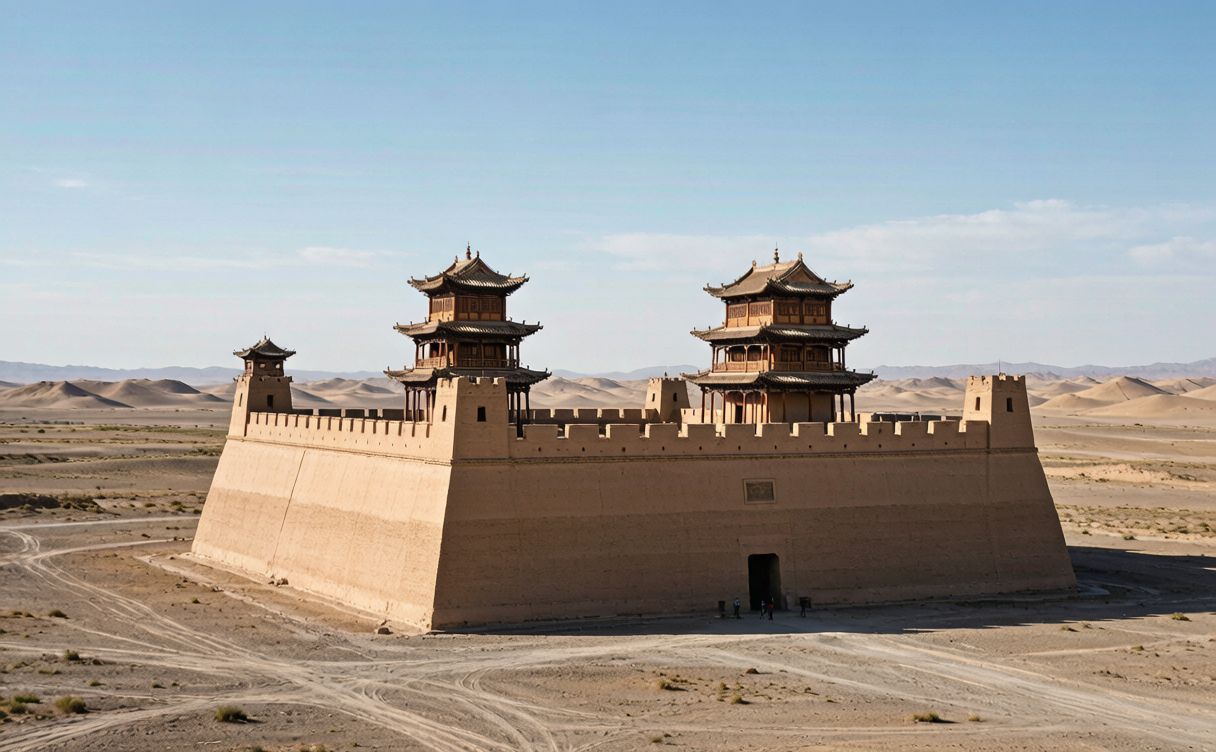
I still remember the moment I first stepped through the arched gateway of Jiayuguan Fort. The wind hit me sideways, dry and metallic, and for a second I understood why travelers on the ancient Silk Road called this place the edge of the known world. I had come all the way from Xi’an by train, chasing the Great Wall to where it finally surrenders to the desert, and standing on that rampart I felt the full weight of eight hundred years of frontier history pressing down on my shoulders. If you are a foreign traveler planning a trip through northwestern China, Jiayuguan is not just another stop on the map — it is the dramatic full stop at the western terminus of the Ming Great Wall, and one of the most atmospheric ruins you will ever walk through.
Often hailed as “the First and Greatest Pass Under Heaven” (天下第一雄关), Jiayuguan Fort guarded the narrowest point of the Hexi Corridor, the strategic throat through which all trade, armies, and ideas flowed between China and Central Asia. Today it stands as a beautifully preserved fortress town, surrounded by nothing but barren mountains, drifting sand, and an enormous, silent sky.
Getting There
Reaching Jiayuguan is easier than you might expect, and that is half the appeal for independent travelers. The city of Jiayuguan sits in central Gansu province, roughly halfway between Lanzhou and Dunhuang, and it is well connected by China’s high-speed rail network.
The most comfortable option is the train. The Lanzhou–Xinjiang high-speed line stops at Jiayuguan South Railway Station, with frequent services from Lanzhou (about 4–5 hours) and from Xi’an via Lanzhou (around 8–9 hours total). From the station, a taxi or Didi ride to the fort takes about 30 minutes and costs very little. If you are coming from the east after exploring the Terracotta Army, our Xi’an travel guide will help you plan that leg of the journey.
Flying is another choice. Jiayuguan Jiuquan Airport has direct flights from major hubs like Xi’an, Beijing, and Urumqi, though schedules can be limited. Once in town, most travelers base themselves in Jiayuguan city and visit the fort as a half-day trip, often combining it with the nearby Overhanging Great Wall and the First Beacon Tower of the Ming Wall.
What to See
The fort itself is a compact, rectangular walled town, about 730 meters around its perimeter, built in 1372 during the Ming dynasty. Unlike the open ruins you may have seen elsewhere, Jiayuguan is a fully enclosed castle with thick rammed-earth walls capped in brick, corner towers, and a moat on the outer side.
Start at the main south gate and climb the steep internal staircase to the battlements. From the top you can look in two directions at once: inward toward the green oasis of the city, and outward toward the brown immensity of the Gobi. The symmetry is striking — this was a place designed to control who came in and who went out.
Inside the walls you will find a small museum, reconstructed barracks, and a charming old temple dedicated to the God of War. Do not miss the famous story of the “last brick,” a local legend claiming the builders calculated their materials so precisely that exactly one brick was left over — you can still see it placed above a gate arch. Whether or not the tale is true, it captures the engineering pride of the people who raised this fortress in a place with no timber, no water, and no mercy from the climate.
Just outside the fort, the Overhanging Great Wall (悬壁长城) climbs a steep ridge like a staircase to the sky, while the First Beacon Tower (天下第一墩) marks the literal western starting point of the Ming Wall where it meets the shifting sands of the Talagram River. Together these three sites form the classic Jiayuguan circuit, and a combined ticket saves you money.
The Wall & The Desert
What makes Jiayuguan unforgettable is not any single building but the relationship between the Wall and the desert. Stand on the rampart at golden hour and you will see the Ming Wall trace a thin line across the dunes before dissolving into the haze of the Gobi. This is where the Great Wall stops being a tourist backdrop and becomes a frontier statement: a human line drawn against an indifferent landscape.
I spent a long time that evening just watching the light move. The Gobi has a way of making time feel elastic — the same wind that rattled my jacket may have rattled a Tang dynasty merchant or a Ming dynasty sentry. The desert here is not empty; it is layered with the memory of every caravan that passed, every messenger who galloped for his life, every soldier who stared west and wondered what was out there.
For travelers continuing west, Jiayuguan is the natural gateway. From here the road (and the ancient trade route) leads to Dunhuang and its Buddhist caves, then onward to the oasis towns of Xinjiang. Our Dunhuang Mogao Caves guide covers the next unmissable stop, and the Turpan Silk Road guide explains what awaits deeper into the corridor.
Tips
A few practical pointers from my own visit will make your day smoother:
- Buy the combined ticket. The fort, Overhanging Wall, and First Beacon Tower are sold together at a discount, and you really want all three.
- Arrive early or late. Midday sun on the Gobi is brutal in summer. The fort opens around 8 a.m., and the light is best for photos in the first two hours and the last two.
- Wear real shoes. The battlements and the Overhanging Wall involve steep, uneven steps. Sneakers, not sandals.
- Bring water and a hat. There is almost no shade outside the gate towers, and the dry heat dehydrates you faster than you expect.
- Hire the audio guide or a local guide. The legends and defensive engineering make far more sense with context. English signage is decent but limited.
- Allow half a day. Rushing through in an hour does the place no justice; three to four hours lets you climb, photograph, and simply absorb the silence.
Best Time
The best seasons to visit Jiayuguan are late spring (May to early June) and early autumn (September to October). During these windows the temperatures are mild, the sky is reliably clear, and the Gobi light is spectacular for photography.
Summer (July and August) is hot, with daytime highs often above 30°C, though it is also when trains and flights are most frequent. Winter is freezing, with biting winds, but the fort dusted in snow is genuinely magical and you will have the place almost to yourself. For a broader look at seasonal planning across the country, see our best time to visit China guide.
Good to Know
Jiayuguan Fort is open year-round, typically from 8:00 a.m. to 6:00 p.m. in summer and slightly shorter hours in winter. Tickets can be bought at the gate or online, and foreign visitors should carry their passport, which is needed for ticket verification at many Chinese scenic sites. The fort has basic facilities — restrooms, a souvenir shop, and a small café — but for a proper meal you will want to return to Jiayuguan city, where hand-pulled noodles and Gansu lamb dishes are excellent and cheap.
The nearby city is compact and easy to navigate, with budget and mid-range hotels within a short taxi ride of the station. If you are building a longer northwestern itinerary, Jiayuguan fits naturally between Xi’an and Dunhuang, and it pairs well with a deeper Xinjiang exploration such as our Xinjiang 7-day itinerary. For first-time visitors to the country, our China travel guide for first timers covers visas, payment apps, and train booking in plain language.
For official regional tourism information, opening schedules, and seasonal events, check Gansu Culture and Tourism.