

I’ll be honest: when I first planned my Xi’an trip, the Big Wild Goose Pagoda was the one on my list. Everybody goes there. Then a local friend dragged me to the Small Wild Goose Pagoda (Xiaoyan Ta) on a slow Tuesday morning, and I’ve been telling every visitor since that this is the better half of the pair. It is quieter, it is free to enter, and the Tang-era pagoda sits inside a real, living park where Xi’an residents actually spend their mornings.
If you want the postcard with the crowds and the music fountain, go to the big one. If you want to understand why Xi’an was the heart of the Tang dynasty and the eastern end of the Silk Road, come here.
Getting There
The Small Wild Goose Pagoda lives inside the Jianfu Temple compound, in the southern part of Xi’an’s old city, about 3 km south of the Bell Tower. I found the easiest way by far is the metro.
Take Line 2 to Nanshaomen Station (南稍门). Use Exit B or C, and it is a flat 10-minute walk west along the tree-lined streets to the north gate. You will see the park walls before you see the pagoda.
A few practical notes from my own trips:
– From the Xi’an North Railway Station (the high-speed hub), Line 2 runs straight to Nanshaomen with no transfer. Around 35 minutes.
– From the airport, take the metro to Beidajie and change to Line 2 south — or just use a DiDi/taxi, which is what I do when I land with luggage.
– If you are already visiting the Xi’an Big Wild Goose Pagoda, a taxi between the two takes about 20 minutes and costs very little. Doing both in one day is easy and makes for a nice compare-and-contrast.
What to See
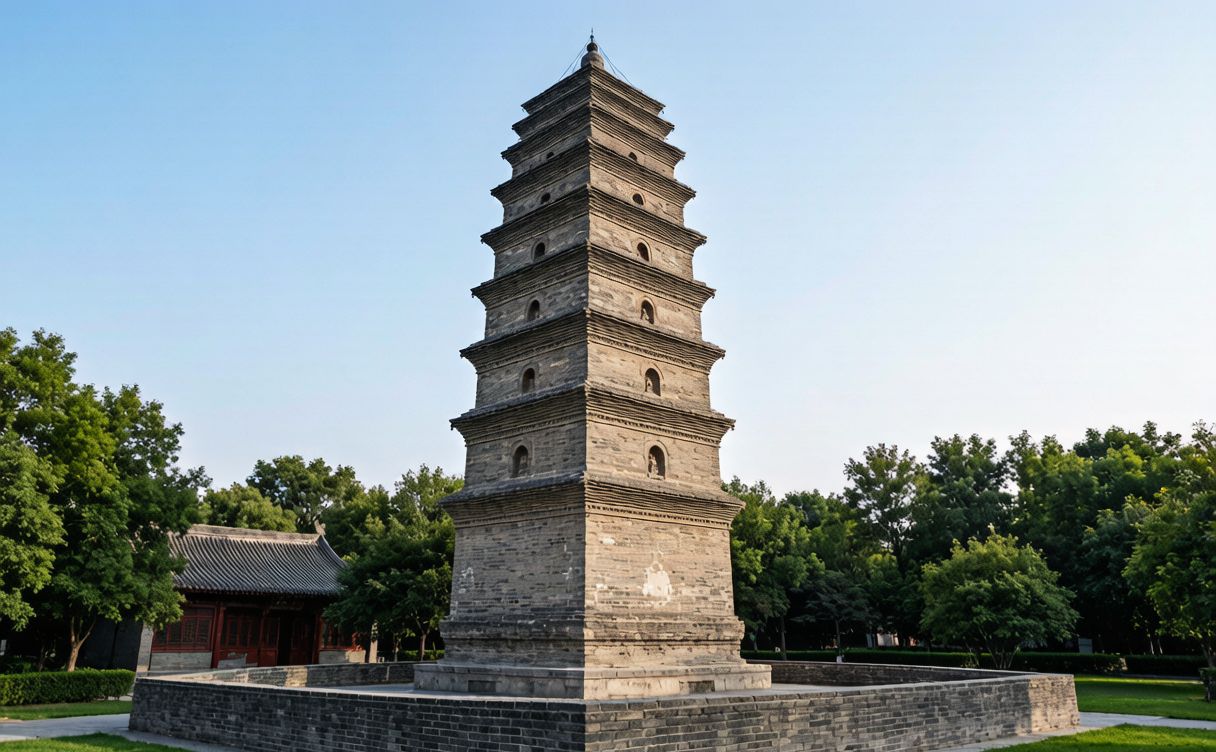
The pagoda itself is the headline. It was built around 707–709 AD, during the Tang dynasty, to store Buddhist scriptures brought back from India by the monk Yijing. The original structure had 15 tiers of grey brick; today 13 remain after centuries of earthquakes. One of those quakes actually split the pagoda clean down the middle, and a later one closed the crack again — locals still talk about the “magical heal.” I stood there staring at the seam for a long time.
A few things I think are worth your attention:
– The brick body has no internal staircase open to visitors. Unlike the Big Wild Goose Pagoda, you cannot climb it. What you get instead is the chance to walk right up to the base and read the weathered Tang masonry up close.
– The two stone steles in front, from the Tang and the Ming periods, are genuinely old and rarely crowded.
– The bell tower nearby holds a massive Ming-dynasty bell. On quiet mornings you can sometimes hear it.
The whole site is part of the “Silk Roads: the Routes Network of Chang’an-Tianshan Corridor” UNESCO inscription, which tells you how seriously this place matters to world history — not just Chinese history.
Jianfu Temple
Jianfu Temple (荐福寺) is the working monastery the pagoda was built for, and it is still active. I liked this more than I expected. You can hear monks chanting at certain hours, and the smell of incense is real, not staged for tourists.
Inside the temple grounds:
– The Mahavira Hall (Da Xiong Bao Dian) sits on the central axis, restored but dignified.
– Side halls hold small statues and quiet corners where locals pray. I watched an old woman trace the same bow three times and then sit in silence for ten minutes. That is the atmosphere here —devotional, not performative.
– The temple connects directly to the Xi’an Museum at the back, and your ticket (free, but you still reserve one) covers both. The museum is small compared with the Shaanxi History Museum, but it has excellent local ceramics and a calm rooftop view of the pagoda that I rate as one of the best photo angles in the city.
If you only have an hour, spend twenty minutes at the pagoda, twenty at the temple, and the rest at the museum rooftop.
The Park
This is the part most guidebooks skip, and it is my favorite. The pagoda sits inside a free public park, and every morning it fills with Xi’an residents doing exactly what you would hope: tai chi under the trees, middle-aged couples practicing ballroom dancing to a portable speaker, old men with songbirds in cages, kids chasing each other around the lotus pond.
I came here at 7:30 one morning just to watch, bought a sesame cake from a cart near the gate, and sat on a bench for an hour. Nobody bothered me. It was the most “normal China” moment of my whole trip, and I value it more than any single monument.
Practical park tips:
– The north gate is the main entrance and the one the metro walk brings you to.
– The west gate puts you closer to the museum and is handier if you are coming from the Shuyuanmen antique street.
– There are clean public toilets and a couple of small tea stalls. Bring water in summer; the shade is good but the heat is real.
Tips
A few things I wish someone had told me before my first visit:
- Entry is free, but you must book. Reserve a timed slot on the official WeChat account or through the Xi’an Museum system. Walk-ups are sometimes possible on weekdays but never count on it during holidays. I book two days ahead.
- Come early. The park is loveliest before 9 am, and the light on the pagoda is soft and warm then. By late morning the tour groups arrive.
- Give it 2 to 3 hours if you include the museum; an hour is enough if you only want the pagoda and a park stroll.
- Wear comfortable shoes. The ground is flat but you will walk a lot if you loop the whole park.
- Pair it smartly. It is an easy half-day with the Xi’an city wall guide — the South Gate is only about 15 minutes north by taxi — or as a calm counterpoint to a busy Xi’an travel guide day of Terracotta Warriors.
- No climbing the pagoda, so manage expectations if that is why you came. The reward here is the setting and the stillness, not a view from the top.
Good to know: The Small Wild Goose Pagoda and Jianfu Temple are included on the UNESCO World Heritage List as part of the Chang’an-Tianshan corridor of the Silk Roads, documented at UNESCO. That status is why the conservation is careful and the grounds stay so well kept.
Why I Keep Coming Back
I have now been three times, in different seasons, and it has never felt like a repeat. In spring the park’s apricot trees bloom pink against the grey brick. In winter the bare branches frame the pagoda like ink painting. It is the rare historic site in China where I leave feeling rested rather than processed.
If your Xi’an list is the Terracotta Army, the city wall, and the Big Wild Goose Pagoda, do yourself a favor and swap one of them for this. The Small Wild Goose Pagoda asks nothing of you — no ticket, no climb, no crowd — and gives back a genuine sense of the city’s Tang heartbeat.