

When I first caught sight of Songzanlin Monastery rising above the golden plains outside Shangri-La town, I understood instantly why people call it “Yunnan’s Potala.” The cluster of white walls and gilded roofs climbing the hillside looked like a miniature Lhasa transplanted onto the southeastern edge of the Tibetan Plateau. I had come all the way from Lijiang, and after two days of winding mountain roads, this was the moment the trip clicked into place.
Ganden Sumtseling, as the locals call it (you’ll also see it spelled Sumtseling), is the largest Tibetan Buddhist monastery in Yunnan and the spiritual heart of the Diqing Tibetan Autonomous Prefecture. Founded in 1679 under the Fifth Dalai Lama’s blessing, it once housed over 2,000 monks and remains a living, breathing place of worship today. It is not a museum piece. Monks in maroon robes walk the courtyards, butter lamps flicker in the chapels, and the air carries the smell of incense and woodsmoke.
I spent a full morning there, and it was easily the highlight of my Yunnan trip. Here is everything I wish I had known before I went.
Getting There from Lijiang
Most foreign travelers reach Songzanlin Monastery via Shangri-La town (formerly Zhongdian), which is the regional hub. If you are starting from Lijiang, you have three realistic options.
The simplest is the train. The Lijiang–Shangri-La railway opened in 2023 and cut what used to be a four-hour bus slog to roughly one and a half hours. I took the morning service, booked through 12306, and watched the landscape shift from Naxi farmland to high alpine valleys. Tickets cost around 60–80 RMB in second class and sell out on weekends, so book ahead.
If the train does not suit your schedule, long-distance buses still run from Lijiang bus station to Shangri-La. They take three to four hours and cost about 70 RMB. The road follows the Yangtze and climbs over several high passes, so pack motion-sickness remedies if you need them.
From Shangri-La town center to the monastery itself is only about 5 kilometers. Bus 3 leaves from the town bus station and drops you near the entrance for a few RMB. A taxi or Didi is around 20–30 RMB and takes ten minutes. I walked part of the way back downhill and enjoyed the views over Napahai Lake, but going up, take a vehicle.
The monastery sits at roughly 3,300 meters (10,800 feet) above sea level. Even if you felt fine in Lijiang at 2,400 meters, the extra altitude here is real. I took the first day easy and drank a lot of water.
What to See
The first thing you notice is the setting. Songzanlin is built on a gentle slope, with the main halls stacked upward and the whole complex wrapped by a high white wall. Two small hills flank it, shaped, locals say, like a sleeping guardian. On a clear morning the gold rooftops catch the sun and the surrounding grassland glows.
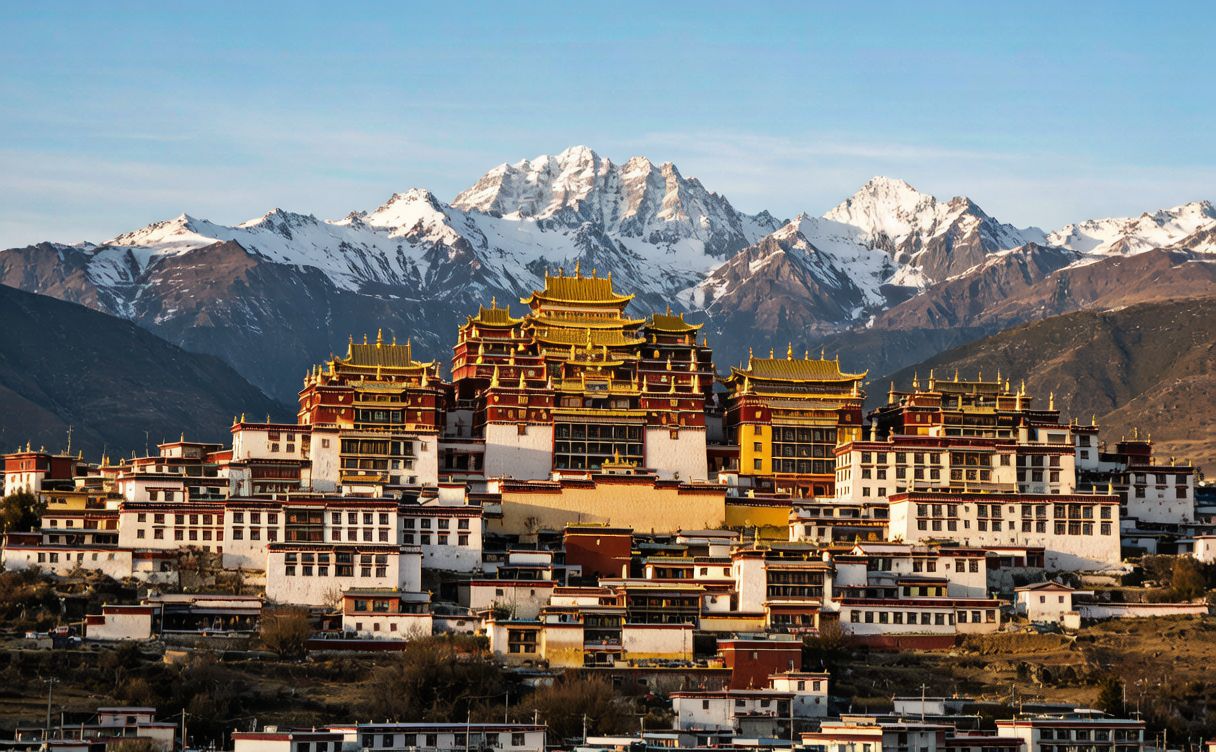
After you pass the entrance gate, you cross a stone bridge and climb a wide flight of steps to the central courtyard. This is where the two main halls stand: the Zha Can Tang and the Jikang Tang. Before the steps, there is usually a row of prayer wheels. Spinning them clockwise is the local custom, and I joined in—it is a small gesture that immediately makes you feel welcome rather than like an intruder.
Inside the central courtyard, monks and visitors mingle. I watched a group of young novices laughing while sweeping the stone, then fall silent the moment they stepped into a chapel. That contrast stuck with me more than any postcard view.
Give yourself at least two to three hours. The grounds are larger than they look, and the walk between the lower village and the upper halls is uphill. Pace yourself for the altitude.
Monastery Halls
The main assembly hall, Zha Can Tang, is the centerpiece. Step inside and the light drops to a warm amber glow from hundreds of butter lamps. The hall holds columns thick enough that two people can barely wrap their arms around them, and the ceiling is painted with vivid mandalas. At the far end sit large gilded statues of the Buddha, flanked by protective deities with fierce, painted faces. Photography is forbidden inside the chapels, and I respected that—no photo is worth disrupting a space where people are praying.
Upstairs, the Jikang Tang houses an enormous statue of Maitreya, the future Buddha, several stories tall. You approach it up a dark wooden staircase, and when you round the corner the scale is genuinely humbling. Around the base, devotees leave offerings of barley, butter, and cash.
What surprised me most was the living quarters. Unlike many famous monasteries that feel staged, here the monks’ residential blocks are still in use. You can peek into open doorways and see tiny rooms with a bed, a desk, and a single window onto the mountains. The human scale of it made the grandeur of the halls mean more.
I also visited a smaller side chapel where an elderly monk was chanting softly. He nodded at me to sit, and for five minutes I just listened. No guide, no ticket, no explanation needed. Those unscripted moments are why I recommend going early, before the tour groups arrive around 10 a.m.
Tips
Dress respectfully. Shoulders and knees should be covered, and you will be removing your hat indoors. I wore long trousers and a light long-sleeve layer, which also helped with the sun and the chill.
Carry cash. The entrance ticket is around 90 RMB for the monastery plus the shuttle, and small donations, toilet fees, and the occasional offering box prefer notes. Cards and Alipay work at the main gate, but not everywhere.
Hire a guide or download one. The on-site guides speak some English and explain the meaning of the statues and murals, which transformed my visit. Without context, the halls are beautiful but baffling. A 90-minute guided walk cost me about 100 RMB shared with another couple.
Be mindful of altitude. Walk slowly, especially on the steps. If you feel light-headed, sit on a bench and breathe. The town has oxygen bars if you really struggle, but most people are fine with a calm pace and hydration.
Photograph the exterior freely, but never point your camera at a monk without a smile and a gesture of permission. Most are happy to be photographed from a distance; a few decline, and that is their right.
Best Time
I went in late September and had bright skies and golden grasslands ringed with autumn color. That is, honestly, the sweet spot.
Spring (April to May) brings fresh green and fewer crowds, though it can be windy and dusty. Summer (June to August) is lush and rainy; mornings are usually clear, afternoons bring showers. Autumn (September to October) is the most reliable for blue skies and the famous golden plains—and it is peak season, so arrive early. Winter (November to March) is cold, sometimes below freezing at night, but crystal clear and nearly empty. If you can handle the chill, winter gave me the most peaceful visit and the best photos of the snow-dusted rooftops.
Avoid the week-long Chinese public holidays—May Day (early May) and National Day (early October)—unless you enjoy crowds. Shangri-La gets busy then, and the monastery path turns into a slow shuffle.
Good to Know
Songzanlin Monastery is managed as part of Diqing’s cultural and tourism network, and the official Diqing Shangri-La tourism information is the best source for current opening hours, ticket prices, and seasonal events: Diqing Shangri-La Tourism. I checked it the night before my visit to confirm the gate opened at 8 a.m., which let me beat the buses and have the upper courtyard almost to myself.
If you are building a Yunnan itinerary, pair this stop with the town’s old quarter, a half-day at nearby Napahai Lake, and the dramatic gorge country to the south.