

I arrived at Lugu Lake at 2 a.m. after a four-hour bus from Lijiang, stumbled out into air so cold and thin it slapped the sleep off my face, and stood on the shore of a lake I could not see. When the sun came up, I understood why the Mosuo people call this place “the mother lake.” Lugu Lake is a high alpine mirror straddling the border of Yunnan and Sichuan, ringed by snow peaks and wooden canoes, and quietly run by women who have ignored patriarchy for about a thousand years. I came for one photo and stayed for three nights I still can’t fully explain.
Why Lugu Lake Is Not Like Any Other Lake in China
Lugu Lake sits at about 2,685 meters (8,810 feet) above sea level, wedged into a remote corner where Yunnan tips into Sichuan. About two-thirds of the shoreline belongs to Yunnan, the rest to Sichuan, which is why it is billed as both lugu lake yunnan and lugu lake sichuan depending on the side you enter. Geologically it is a tectonic fault lake, deep and cold, fed by snowmelt rather than rivers, which is why the water stays that impossible cobalt blue instead of turning murky green like a lowland reservoir.
What makes it strange in the best way is the people. The lake is the heartland of the Mosuo, a Tibetan-Burmese ethnic group famous for a social system anthropologists describe as “walking marriage” (azu). Women own the home, manage the money, and raise the children. Men stay in their mother’s household and visit their partners after dark, then walk back to their own family at sunrise. There is no word for “husband” in the way the West uses it, and no pressure to get one. I am not saying it is utopia — every culture has its friction — but after a week of answering “so when are you getting married?” from relatives back home, sitting in a Mosuo grandmother’s kitchen felt like exhaling.
Meeting the Mosuo: A Culture That Forgot to Be Patriarchal
The matriarchal thing is not a museum exhibit here; it is Tuesday. In the village of Luoshui, on the Yunnan shore, I was invited to help sort yak butter and dried corn by a woman everyone called “Ama,” the Mosuo term for a senior female relative. Her brother’s grandson ran past; when I asked where the boy’s father was, she laughed and said, roughly, “Which one?” In a Mosuo home, the head of the household is the oldest woman, and property passes down the female line. The grandmother decides where money goes, who marries (no one is forced), and which fields get planted.
I stayed in a traditional wooden compound called a “shuizo” — a courtyard house with carved beams and a central hearth that is never allowed to go out. At dinner a young woman sang a folk song in Mosuo while her uncles played a stringed instrument. Nobody performed any of this for me; a Dutch couple and I were simply folded into the evening. That, more than any viewpoint, is the real souvenir from Lugu Lake. If you want context before you go, our Lijiang Old Town travel guide explains the Naxi and Mosuo cultural belt you are driving through.
Getting Out on the Water: The Wooden Canoes
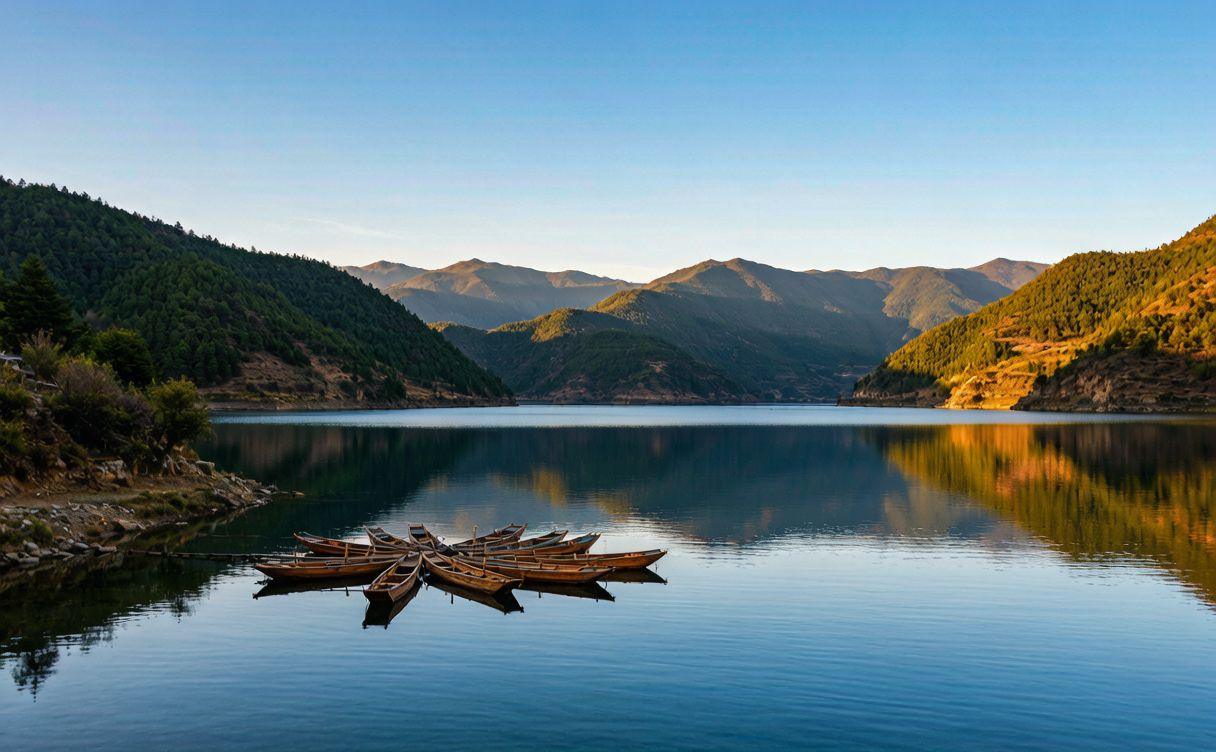
You cannot come to this mosuo lake and not get in a boat. The traditional vessel is a slender, hand-carved wooden canoe called a “zhucao chuan” — literally a “pig-trough boat” because of its shape, though I promise it is more elegant than it sounds. A local woman in a pleated skirt and a wide straw hat poles you outpast the reeds, and the only sound is the dip of the oar and the occasional flap of a gull.
My boatwoman, who introduced herself only as “the lake’s daughter,” paddled us to a tiny island with a temple where Mosuo families leave offerings for the water spirit. Halfway across, she stopped, let the boat drift, and pointed at the reflection of the mountains on the surface. “On a windless morning,” she said, “the lake shows you the sky better than the sky does.” I have been in a lot of pretty places; very few have made me shut up mid-sentence. This was one.
Sunset at Caohai and the Walking Marriage Bridge
The western shore holds Caohai, a shallow “grass sea” where the water is choked with drifting reeds and lily pads that turn gold at dusk. A long wooden footbridge — the Walking Marriage Bridge (Zouhun Qiao) — runs straight out into the reeds. This is the romantic heart of the place: traditionally, Mosuo youths used the bridge and the surrounding paths to meet after dark. Today it is where every traveler on the lake comes to watch the sun go down.
I timed my visit for late September, when the reeds were the color of strong tea and the light went from white to amber to a deep bruise-purple in about twenty minutes. An old man was fishing off the bridge with a bamboo rod and zero urgency. A couple of kids raced across the planks shrieking. The mountains on the far shore swallowed the sun, and the whole grass sea lit up orange for a heartbeat before going silver. Bring a jacket — the temperature drops fast once the sun is gone, and the wind off the water has a sharp edge even in summer.
How to Reach Lugu Lake from Lijiang
Most foreign travelers approach from the Yunnan side, and Lijiang is the natural launch pad. The drive is roughly 200 kilometers and takes about four hours on a winding mountain road that climbs over a 3,000-meter pass. Buses leave Lijiang bus station daily; expect to pay a modest fare and to question your life choices on the switchbacks. I took a shared van arranged through my guesthouse, which was slower but let me stop for photos of terraced valleys I will never see again.
There is also a smaller airport, Ninglang Luguhu Airport, with flights from Kunming and a few other cities — handy if you are short on time and long on budget. If you are building a bigger Yunnan loop, our Kunming travel guide covers flights into the province’s main gateway, and our Dali Yunnan travel guide links Dali, Lijiang, and Shangri-La into one logical train-and-bus route. Lugu Lake slots in neatly north of Lijiang.
Where to Stay: Lakeside Villages
You have two main choices, and they set a different tone for the trip. Luoshui Village, on the Yunnan side, is the developed hub — boardwalks, cafes, and the easiest access to boats and the main viewpoints. It is convenient and a little touristy, which I did not mind because the lake dwarfs the gift shops. Farther around the shore, Lige Village is smaller and prettier, built on a peninsula that juts into the water; the sunrises there are absurd. On the Sichuan side, Zuosuo and the town of Jiangjiaba are quieter and cheaper, with fewer English signs and more authentic nightlife in the form of impromptu Mosuo singing.
I split my stay: two nights in Lige for the views, one in Luoshui for the convenience. Guesthouses are mostly timber lodges with thick quilts and electric blankets — essential, because even in July the night air bites. Book ahead for the October National Day holiday and the summer peak; the lake is small and rooms vanish. For a broader Yunnan sleep strategy, our Shangri-La Yunnan travel guide has high-altitude lodging tips that apply here too, since both towns sit above 3,000 meters in thin air.
Best Season to Visit Lugu Lake
Spring (April to May) and autumn (September to November) are the sweet spots. Spring brings apple blossoms and green reeds; autumn gives you the gold grass sea and the clearest reflections. Summer (June to August) is lush and warm but rainy, with afternoon clouds that soften the famous mirror effect — though the lake is crowd-free and the surrounding hills are at their greenest. Winter is brutally cold and some guesthouses close, but if you pack properly you get empty shores and a chance of snow on the peaks.
I went in late September and would do it again without hesitation. The mosuo lake at that hour, with no wind and a sky so clean it felt edited, is the version postcards are trying and failing to capture. Avoid the first week of October unless you like sharing your sunrise with ten thousand other cameras.
A Few Practical Notes Before You Go
Altitude is real here at 2,685 meters; if you are coming straight from the lowlands, take the first day easy and skip the hike up Gemu Mountain (a cable car saves your lungs and rewards you with a full-lake panorama). Cash is useful in the smaller villages, though Alipay and WeChat Pay are creeping in — our China travel guide for first-timers walks through payment apps if you have not set them up. Respect the culture: ask before photographing people, and remember the matriarchal customs are a living tradition, not a show. Treat Ama’s kitchen like the private home it is.
For official opening hours, ferry schedules, and any permit or border quirks between the Yunnan and Sichuan sides, confirm details with a reputable source such as the Yunnan Provincial Tourism portal before you travel, since mountain weather and local rules shift from season to season.
My Honest Take
Lugu Lake is not the easiest place to reach, and that is precisely the point. The road is long, the air is thin, and the lake does not perform for you — it just sits there, ancient and unbothered, while a culture that the rest of the world keeps insisting is “unusual” goes quietly about its business. I left with cold fingers, a phone full of reed-sunset photos I will never post well enough, and a stubborn fondness for a grandmother I met for one evening. If you are already in Yunnan, do not skip it. Few places in China let you watch a thousand-year-old way of life reflected back at you from a single still surface of water.