

The first time I stood under the Xi’an Bell Tower at dusk, I made a classic rookie mistake: I thought it was just a pretty building to photograph and move on. I was wrong. The Xi’an Bell Tower is the literal and symbolic heart of the old capital, the point from which every road in the Ming-era city was measured. Get here right, and you unlock the best views, the best photos, and the easiest path into the Muslim Quarter’s food chaos. This guide is everything I wish someone had told me before my first night in Shaanxi’s capital.
When most travelers plan their trip around the Terracotta Warriors, they treat the Xi’an Bell Tower as a drive-by photo stop. Don’t. The two towers — the bell to the west, the drum to the east — are the twin guardians of the xian city center, and together they tell you more about how a Chinese walled city actually worked than any museum plaque. I’ve now passed through this junction at least a dozen times, in blazing August heat and in freezing January smoke, and it never gets old.
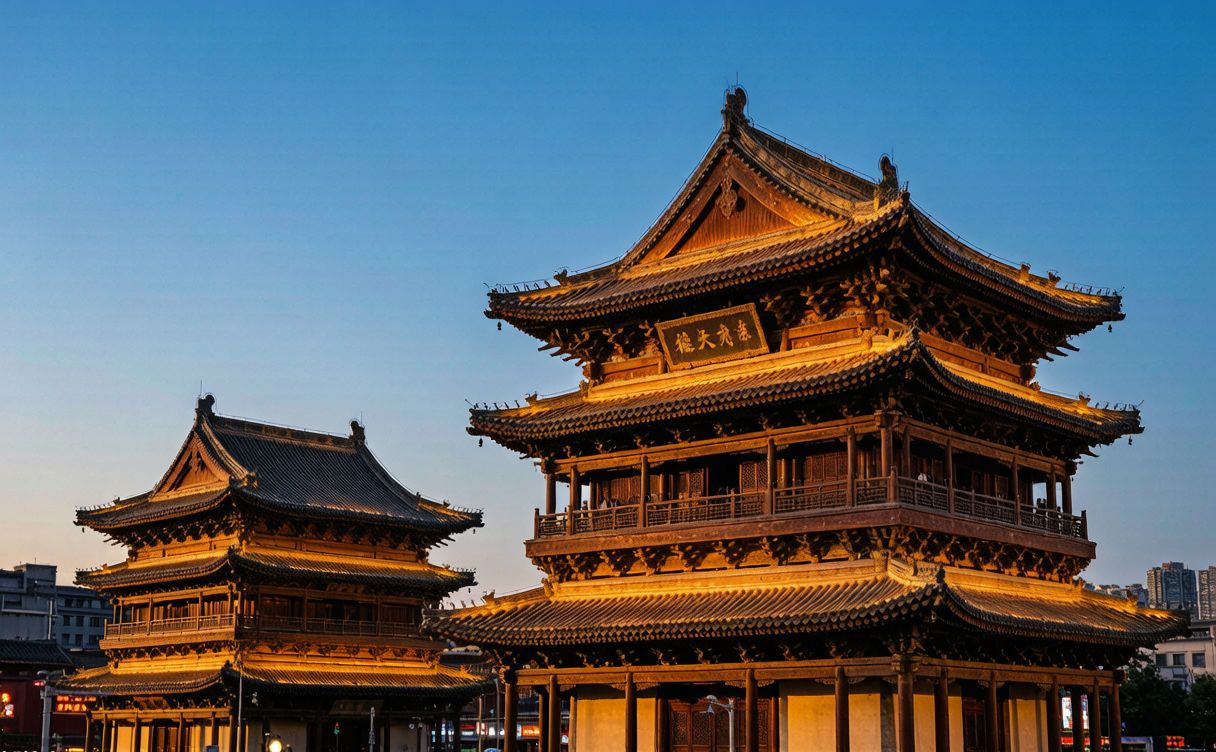
Why the Xi’an Bell Tower Matters
Here’s the thing about the Xi’an Bell Tower: it wasn’t built to be admired. It was built in 1384, during the early Ming dynasty, to tell time. Before clocks and phones, the bell rang at dawn and the drum at dusk, a sound that organized the entire city’s day. The tower sits exactly on the north–south and east–west axis of the old city, which means it was — and still is — the geographic zero point of Xi’an.
The structure is a brick-and-timber pavilion, about 36 meters tall, with a blue-tiled double-eaves roof that looks like something straight out of a period drama. Walk inside and you’ll find the original iron-cast bell, massive and dark, plus exhibits on the tower’s history. Climb to the upper balcony and you get a 360-degree panorama: the four main avenues radiating out, the city wall in the distance, and the forest of modern high-rises pressing in around the ancient core.
My favorite detail? The tower has been moved. Well, sort of. The original stood a bit northwest of where it is now, and in 1582 it was physically relocated to its current spot at the intersection — they dismantled it and rebuilt it on the central axis. I love telling people that, because it makes the whole “center of the city” claim feel earned rather than arbitrary.
The Drum Tower and Bell Tower Square
A few hundred meters east sits its companion, the xian drum tower. Built just four years after the bell tower, it’s slightly shorter but in my opinion more photogenic, with a longer, lower silhouette and a row of giant drums inside that you can actually see up close. The drum tower also marks the western gateway to the Muslim Quarter, so it pulls double duty as both a monument and a landmark you’ll walk through to eat.
Between the two monuments lies bell tower square, the open plaza where half of Xi’an seems to gather in the evenings. It’s where the subway pours people out, where buskers set up, and where the neon of the surrounding malls reflects off the ancient roofs. On my second visit I made the mistake of trying to cross bell tower square on foot at 7 p.m. during a summer weekend — it took me nearly twenty minutes of human traffic to get across. Lesson learned: use the underground pass, don’t fight the surface crowd.
The underground pedestrian passage is the secret weapon here. It connects the Bell Tower and Drum Tower metro stations and lets you pop up right at the entrance of either monument without dodging six lanes of traffic. I now treat that tunnel as the main artery of my Xi’an days — it’s air-conditioned, it has snack stalls, and it drops you exactly where you need to be.
Climbing for the View
Both towers charge a separate entry ticket, and both let you climb. If you only pay for one, climb the Bell Tower for the cleaner axial view of the city and the wall beyond. If you buy the combined ticket (cheaper than two singles, and I’d argue worth it), you get both balconies and a fuller sense of how the old city was laid out.
From the top of the Xi’an Bell Tower you can trace the rectangular city wall, and on a clear day spot the corners of the old gates. At night the view flips entirely: the avenues become rivers of red taillights, the surrounding malls glow, and the tower itself becomes a jewel box. I once timed my climb for the blue-hour window just after sunset, and the photos I got needed zero editing. That’s the move.
One practical note from experience: the staircases are steep and the upper balconies get crowded. Go up about 40 minutes before the sunset close if you want photos without a hundred phones in frame. The staff does shoo people down at closing, so don’t dawdle.
Best Time for the Night Lights
The towers are beautiful by day, but they were made for night. The external lighting switches on around sunset (roughly 6:30 p.m. in summer, 5:30 p.m. in winter), and the xian city center transforms. My honest recommendation: arrive in the late afternoon, climb the Bell Tower for the transition from day to night, come down, and then walk bell tower square while it’s fully lit. You get two completely different monuments for the price of one evening.
Avoid Chinese public holidays if you can — the square becomes shoulder-to-shoulder and the climb turns into a slow shuffle. If your dates are fixed, go on a weekday. I made the holiday mistake once, during the May Labor Day break, and spent more time apologizing to strangers than looking at architecture.
Pairing It With the Muslim Quarter
The Drum Tower’s back door essentially opens into the Muslim Quarter, Xi’an’s most famous food street. This is the natural combo: climb the drum tower, then descend straight into a maze of lamb skewers, persimmon cakes, and cold noodles. I’ve written a full breakdown of where to actually eat there, and I’d plan your tower visit so it ends right as you get hungry.
The walk from the Bell Tower to the Drum Tower and into the Quarter takes maybe fifteen minutes above ground, or five through the tunnel. Either way, it’s flat, well-lit, and impossible to get lost. First time I did it I followed my nose to a stall selling 镜糕 (jing gao, a sticky rice cake) and ended up chatting with the vendor for half an hour — that’s the real reward of starting your evening at the towers.
Tickets, Hours, and How to Get There
Both towers sit directly above Metro Line 2’s Bell Tower station (钟楼站) — use Exits B or C for the Bell Tower, and follow signs for the Drum Tower on the east side. A taxi will drop you at bell tower square, but the traffic circle around the monument is a headache; the subway is faster and cheaper.
- Bell Tower ticket: around ¥30; combined Bell + Drum ticket around ¥50
- Hours: roughly 8:30 a.m. to 9:30 p.m. (last entry ~45 min before close); times shift seasonally
- Time needed: 1.5–2 hours for both towers plus the square
- Tip: buy the combined ticket at the first tower you enter
I once arrived ten minutes before closing, thinking I’d just peek — the guard waved me in anyway and I got the entire upper balcony to myself for a few quiet minutes of city lights. Not something to rely on, but a nice reminder that Chinese attractions are often more relaxed about the edges of their hours than the posted times suggest.
A Bit of Context Worth Knowing
The bells and drums here are part of a much older Chinese tradition of timekeeping by sound. Nearly every major historical city had them, but Xi’an’s pair survives as one of the most complete and central examples. For deeper background on the region’s history, the Shaanxi History Museum is a short hop away and explains the dynasties that built all this. If you’re connecting the towers to the wider old city, walking the city wall at sunrise the next morning is the perfect bookend.
For official visitor information, opening schedules, and any holiday adjustments, check the Xi’an Tourism official portal: Travel China Guide – Xi’an Bell Tower, a reputable English-language resource I use to double-check hours before each trip.
My Honest Take
If you have one evening in Xi’an, spend it here. Climb the Xi’an Bell Tower for the view, walk the square as the lights come on, slip through the underground pass to the xian drum tower, then lose yourself in the Muslim Quarter. It’s the single most efficient way to feel the city’s layers — ancient timber above, subway below, sizzling street food just beyond. I’ve done it solo, with friends, and with jet-lagged relatives, and it works every time.
For food specifics, see my Xi’an Muslim Quarter food guide, and if you’re building a full Shaanxi itinerary, the Terracotta Warriors visit guide pairs naturally with a city-center evening like this one.