

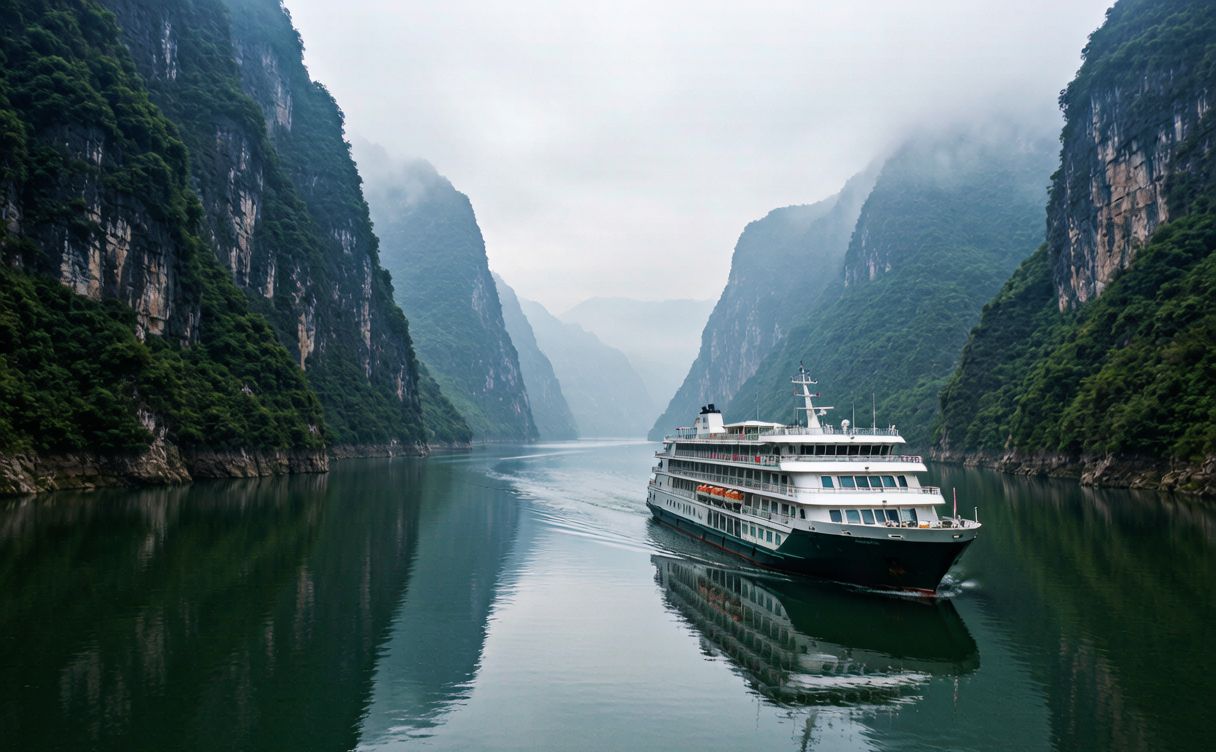
The first time I watched the Yangtze swallow a mountain whole, I was holding a thermos of jasmine tea on the top deck at 6:40 a.m., half-asleep, and the fog was doing that thing where it turns a 1,000-meter cliff into a floating ink painting. A Yangtze river cruise is the only way I know to eat your body weight in dumplings while a billion-year-old gorge slides past your window. People picture China as bullet trains and neon, but four days on this river is the country at its slowest, oldest, and most humbling. If you’re a foreign traveler trying to decide whether a 3 gorges cruise is worth the money and the luggage hassle, this is the guide I wish someone had handed me before I boarded.
Why the Yangtze Is China’s Greatest Slow-Motion Show
There are longer rivers and wider ones, but none tell China’s story like the Yangtze. It runs 6,300 km from the Tibetan plateau to the East China Sea, and the stretch between Chongqing and Yichang is the headline act. When I boarded my ship in Chongqing, a fellow passenger told me he’d done the Nile and the Douro and still called this “the one that shut him up.” He wasn’t wrong. The combination of vertical limestone walls, working cargo junks, and the impossible engineering of the Three Gorges Dam makes you feel small in the best way.
This isn’t a party boat. It’s a floating hotel with a buffet, a sunrise tai chi class, and a English-speaking guide who will, at some point, gently correct your pronunciation of “Qutang.” A yangtze cruise from chongqing typically runs three nights and four days downstream, or four nights and five days in reverse. Both directions see the same gorges — the difference is the rhythm.
Chongqing to Yichang vs. The Reverse Route
Most foreign travelers do the cruise downstream: Chongqing → Yichang. Here’s the honest breakdown.
Downstream (Chongqing → Yichang, 4 days / 3 nights): You sail with the current, so the ship moves faster and you spend less time in transit. You board in the evening in Chongqing, a city that looks like it was designed by a caffeinated architect, and wake up already inside the gorges. The big finale is the ship locks at the Three Gorges Dam on the last morning. I liked this direction because the trip builds — the gorges get progressively more dramatic, and you end on the engineering spectacle rather than starting with it.
Upstream (Yichang → Chongqing, 5 days / 4 nights): Slower, slightly cheaper per night, and you hit the dam first. Some people prefer it because you “climb” into the mountains gradually. A fellow passenger told me she chose upstream specifically to avoid the chaos of boarding in a mega-city; Yichang’s port is calmer. Either works. Just know that a china river cruise in reverse costs you an extra day you might rather spend in a city.
If Chongqing is your starting point, spend two days there first — the hotpot alone justifies it. Our Chongqing travel guide covers where to eat and how to survive the staircase geography.
The Three Gorges: Qutang, Wu, and Xiling
The name “Three Gorges” isn’t marketing — it’s three distinct canyons, each with its own personality.
Qutang Gorge is the shortest and the most theatrical. It’s only 8 km long but the walls close in to a canyon so narrow your ship looks oversized. The entrance, Kuimen, is the gate on the back of the old 10-yuan note. When I stood at the bow here, the cliffs were close enough that I could hear water dripping off moss.
Wu Gorge is the elegant one — twelve peaks, often wrapped in cloud, and the famous “Twelve Peaks of Wushan.” This is where the small tributary excursions happen: the Goddess Stream or the Shennv (Goddess) Peak depending on water levels. The mist here is constant enough that I stopped trying to photograph it and just watched.
Xiling Gorge is the longest and, historically, the most dangerous — before the dam, this stretch drowned ships regularly. Today it’s calmer water and the gateway to the locks. The scenery is gentler but the scale is enormous.
The Dam and the Ship Locks: The Part You Can’t Fake
The Three Gorges Dam is the largest hydroelectric project on the planet, and you’ll either find it awe-inspiring or slightly dystopian — probably both. The real thrill is the ship lock system. Your cruise ship gets lowered (or raised) about 113 meters through a series of locks, a process that takes three to four hours. You’re tied up next to a 3,000-ton freighter, the water drops, and the walls rise above your railing. A fellow passenger described it as “a bathtub with the plug pulled,” which is funnier when you’re 20 meters below the roadway.
Some premium ships also offer the ship lift — a giant elevator that drops the vessel in about 40 minutes. Ask your operator which you’ll get; the lift is faster but the locks are stranger and more memorable.
Cabin Classes: Where You Sleep Matters
Ships on the Yangtze range from renovated state-run vessels to five-star international operators. The cabin tiers:
- Standard inside/outside: Small, functional, often no balcony. Fine if you live on the top deck anyway.
- Executive deck / balcony: Bigger window or private balcony, better location near the restaurant and lounge. This is the sweet spot for most foreigners.
- Suites: Private butler, top-deck priority, sometimes a separate dining room. Worth it only if the budget allows.
When I boarded, I’d booked the cheapest outside cabin and immediately regretted not paying the small difference for a balcony — by night two I was out there at midnight watching the navigation lights of passing freighters. That balcony became my favorite room in China.
Best Season to Go
Spring (April–May) and autumn (September–October) are the gold standard — comfortable temperatures, less fog blanketing the peaks, and good water levels. Summer is hot, humid, and crowded with domestic tourists, though the gorges are lush. Winter is cold but eerily empty and cheap. I went in late October and the weather was perfect; a fellow passenger who’d come in July said she spent the afternoons hiding in the air-conditioned lounge. For broader planning context, our best time to visit China guide lines up the seasons nationally.
How to Book and What’s Included
Book directly through the cruise line or, more realistically for foreigners, through a China-based agency that handles the English booking and port transfers. Prices for a 3 gorges cruise run roughly $400–$900 per person for four days including meals, depending on ship class and season. The ticket usually covers:
- Your cabin and three nights’ accommodation
- All main meals (buffet, sometimes a captain’s dinner)
- Scheduled shore excursions (the tributary gorge, the dam, Fengdu Ghost City or Shibaozhai depending on route)
- Onboard lectures and entertainment
- An English-speaking guide
Not included: drinks beyond water/tea, tips for the crew (expected, around $10–15/day), and optional excursions like the cable car at Fengdu. Bring small cash or set up mobile pay — our Alipay and WeChat pay guide for foreigners walks you through it.
One practical warning: the “cruise” you see advertised for $99 is a day boat, not the multi-day experience. Confirm the night count and the ship name before paying.
If you want to bolt this onto a bigger trip, a yangtze cruise from chongqing pairs naturally with Chengdu, Xi’an, and Shanghai. Our 10-day China itinerary shows one way to sequence it without backtracking.
My Verdict After Four Days Afloat
A Yangtze river cruise won’t be the cheapest line item on your China trip, and the onboard Wi-Fi is gloriously bad — which is the point. You read a book, you watch the mountains change color, you eat too much, and you come home with a phone full of fog photos that don’t do it justice. For a first-time visitor chasing the “real China,” this is the single most relaxing, most scenic chunk of country you can see without hiking a mountain yourself.
External authority: The Three Gorges region and the dam are covered in depth by UNESCO’s broader documentation of the Yangtze basin; for verified background on the waterway and its management, see the UNESCO Yangtze resources.