

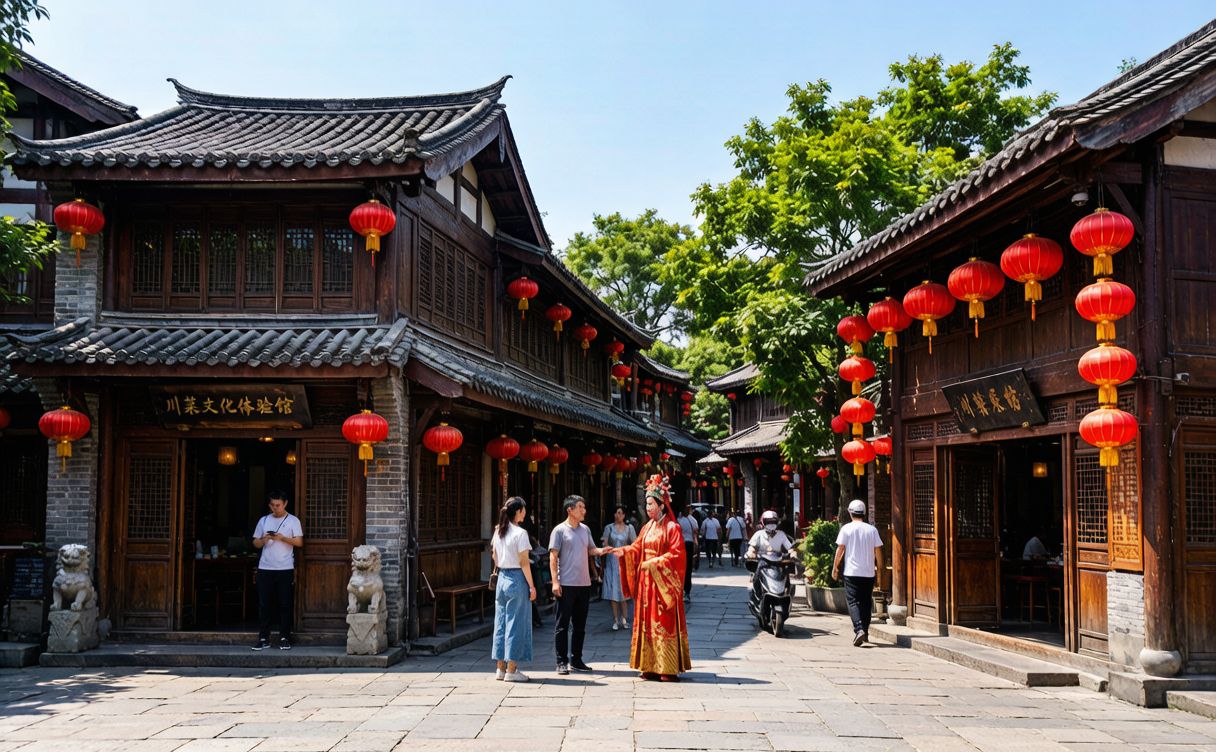
The first time I walked into Chengdu Jinli at night, I honestly wasn’t expecting much. Another reconstructed “old street” for tourists, I assumed. Then the smell of chili oil and roasting chestnuts hit me, a man in a padded jacket flipped a teacup upside down on its saucer without spilling a drop, and somewhere behind a red lantern a string of firecrackers popped. I stood there for a second, grinning like an idiot, and realized I wasn’t going to leave for hours. Jinli and the nearby Kuanzhai Alleys are the two streets nearly every visitor to Chengdu ends up on — and for good reason. They’re the easiest, most delicious place in the city to feel what Sichuan slow living actually tastes and sounds like.
If you only have a couple of evenings in Chengdu, skip the shopping malls and go here. This guide is built from my own wandering: what to eat, where to sit with a tea, when the face-changing show starts, and how to decide between the two streets if your time is short.
Two streets, two different moods
People lump Jinli and Kuanzhai together, but they’re not the same experience. I made the mistake early on of treating them as interchangeable, then learned the hard way that they reward different plans.
Jinli sits right against the wall of the Wuhou Shrine (the temple complex dedicated to Zhuge Liang and the Shu-Han kingdom). It’s narrower, busier, and more overtly “spectacle” — snack stalls packed shoulder to shoulder, performers in the lanes, and a carnival energy after dark. It feels like a night market that happens to be beautiful.
Kuanzhai Alleys (宽窄巷子, literally the Wide, Narrow, and Well alleys) is a preserved Qing-dynasty neighborhood of grey-brick courtyards a few kilometers north. It’s calmer and more spread out, built for lingering: boutique tea houses, craft bars, and quiet courtyards where you can actually hear the birds. If Jinli is a party, Kuanzhai is a long Sunday afternoon.
Both are free to enter. Both are touristy. And both, done right, are worth your time.
Jinli: the temple-side lane
I usually start at Jinli in the late afternoon, partly because the light on the wooden facades is gorgeous and partly because I want to eat my way down the lane before the evening crush. The lane is shaped like a loop, so you can’t really get lost — just follow the food.
What to eat in Jinli
The snack game here is the main event. A few things I kept going back for:
- Chuanchuanxiang (串串香) — skewers of meat and veg cooked in a shared pot of numbingly spicy broth. You pick from a cooler, they cook it, you pay by the stick. Cheap, social, and addictive.
- San da pao (三大炮) — “three big bangs,” sticky rice balls flung onto a drum where they make three loud thuds before being rolled in soybean flour and brown sugar. The show is half the fun.
- Longhua longchi (龙抄手) — Chengdu-style wontons in a clear, peppery broth. A gentler option if your tongue is already waving the white flag.
- Sugar-pulled figures and roasted sweet potato — not Sichuan-specific, but the street vendors here do them with real flair, and they’re a welcome break from the heat.
Don’t try to be brave on every stall. My rule: pick three things max per visit and actually taste them. If you want a broader primer on the regional dishes before you go, our Chinese food guide to the eight cuisines breaks down what makes Sichuan food tick — the málà (numbing-spicy) balance in particular.
One practical note: street snacks are part of the charm, but raw or undercooked items from any stall can upset a traveler’s stomach. I run through the basics in our street food safety guide for China so you can enjoy the lane without spending the next day in your hotel bathroom.
Tea houses and the face-changing show
About two-thirds of the way down Jinli, tucked off the main drag, are the open tea houses where older locals play mahjong and pour tea from long-spouted kettles with theatrical flicks of the wrist. Order a bowl of jasmine or gǒuqi (wolfberry) tea for a few yuan, and no one will rush you. I’ve spent entire rainy afternoons there doing nothing, which is exactly the point.
The other thing Jinli is famous for is biànliǎn (变脸) — Sichuan opera’s face-changing, where performers swap painted masks in a blink, sometimes right in front of your table. There are short shows in the lane’s small theaters most evenings; ask at the entrance for the next start time, because schedules shift by season. It’s tourist-friendly, lasts maybe 20 minutes, and is wild the first time you see it. Sit close if you can.
Kuanzhai Alleys: the Qing-era courtyards
I came to Kuanzhai expecting to breeze through in an hour and ended up staying until the lanterns came on. The layout is three parallel lanes — Kuan (Wide) Alley for bars and lively cafés, Zhai (Narrow) Alley for boutiques and smaller courtyard restaurants, and Jing (Well) Alley, the quietest, with the old well that gives it its name.
What to do in Kuanzhai
- Sit in a courtyard tea house. This is where Kuanzhai beats Jinli for relaxation. Order a gāiwan chá (lidded bowl tea), and you’ve bought the right to a chair, shade, and people-watching for as long as you like. Some places offer ear-cleaning (cǎi’ěr) with the long-handled tools — a very Chengdu ritual that’s oddly soothing if you’re brave enough to try.
- Wander the boutiques. Not my usual thing, but the alley’s shops lean crafty — hand-pulled noodles made in the window, shadow-puppet stalls, indigo dyeing. Even just looking is pleasant.
- Catch live music or a small bar. Kuan Alley has low-key bars with acoustic sets later in the evening. A mellow contrast to Jinli’s noise.
- Photograph the grey brick and carved doors. Early morning, before the crowds, the lanes are almost empty and gorgeous. I got my best shots between 8 and 9 a.m.
Jinli vs Kuanzhai: which should you choose?
If you genuinely only have one free evening, here’s how I’d decide:
- Pick Jinli if you want energy, maximum snack variety, and the face-changing show in one concentrated, walkable loop. It’s also the better choice if you’re already visiting the Wuhou Shrine — they share an entrance plaza.
- Pick Kuanzhai if you want to slow down, drink good tea in a real courtyard, and avoid the thickest crowds. Better for couples, photographers, and anyone who finds night markets overwhelming.
- Do both if you have two evenings, or one long afternoon-into-night. They’re about a 15-minute cab apart, and the contrast is the whole point.
I’d argue you shouldn’t skip either. Jinli shows you Chengdu’s appetite; Kuanzhai shows you its patience.
How to visit both in one day
On my last trip I did exactly this, and it worked smoothly:
- 3:00 p.m. — Arrive at Kuanzhai, start in Jing (Well) Alley for photos while it’s quiet, then loop through Zhai and Kuan.
- 5:00 p.m. — Tea break in a Kuanzhai courtyard.
- 6:30 p.m. — Cab to Jinli (or metro to the Wuhou Shrine stop).
- 7:00–9:30 p.m. — Dinner of skewers, wander the lit lane, catch the face-changing show.
That order puts the calm first and the chaos last, which suited me. Reverse it if you’d rather end mellow.
Practical tips that actually matter
- Getting there. Both are central and easy by metro or Didi (China’s ride app). Jinli is at the Wuhou Shrine area; Kuanzhai is near the People’s Park / Wide and Narrow Alley metro stops. You’ll want a working map app set up before you land — our guide to using the internet in China covers the essentials.
- Best time to go. Spring and autumn are kindest weather-wise, and our national best-time-to-visit-China overview lines up the bigger picture. For these two streets specifically, weekdays beat weekends, and after 6 p.m. is when they come alive — just expect crowds.
- Money. Most stalls take Alipay/WeChat Pay; some take cash. Foreign cards on those apps can be finicky, so carry some yuan. Our Alipay and WeChat Pay guide for foreigners walks through binding a card.
- Ordering food. Menus are often Chinese-only with pictures. The how to order food in China by app guide saved me more than once with translation and scan-to-order.
- Crowds and pickpockets. Both lanes get packed. Keep your phone and wallet front-pocketed. Standard city caution applies; our China travel safety tips guide covers the rest.
Where to stay nearby
Staying within walking distance changes the experience — you can drift in at 9 p.m., eat one thing, and drift out without a plan. The areas around Wuhou Shrine (for Jinli) and around People’s Park / Kuanzhai (for the alleys) both have solid hotel picks across budgets. I compared the reliable options in our best hotels in Chengdu guide, with notes on which neighborhoods suit different trip styles.
If Chengdu is one stop on a bigger route, these two streets also slot neatly into a first-time outline — our China travel guide for first-timers shows where Sichuan fits among the classic stops.
The part I keep coming back for
I’ve done Jinli and Kuanzhai maybe six times now, and I still find something new — a different skewer, a teahouse I’d missed, a busker playing a two-stringed erhu under the lanterns. That’s the real draw. These aren’t “authentic” in the museum sense; they’re polished, commercial, and crowded. But they’re also genuinely Chengdu: food first, hurry never, and a seat with tea always waiting. Go hungry, go curious, and let the lane set the pace.
For official opening hours, event schedules, and transit details, the Chengdu Municipal Culture and Tourism Bureau is the most reliable English-language source I’ve found — worth a check before you head out, since show times shift with the seasons.