

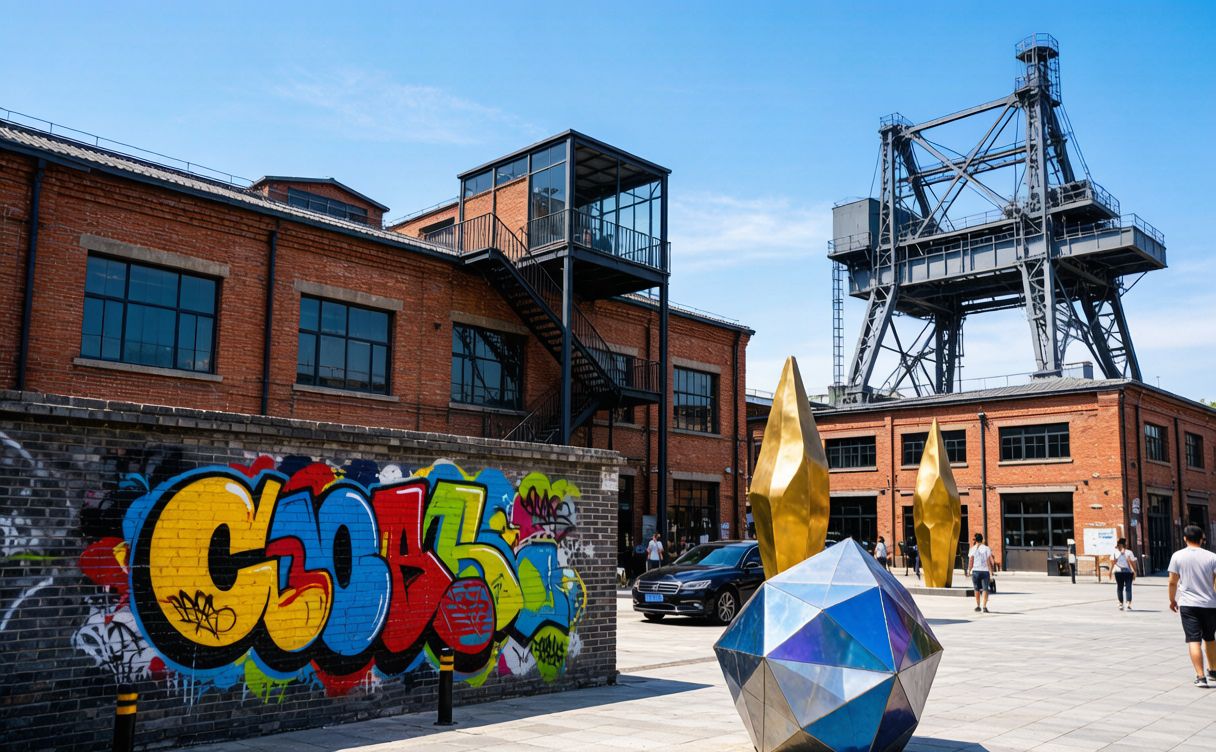
I’ll be honest: the first time I went to Beijing 798, I almost turned back at the entrance. A gray factory gate, a smell of machine oil, and a wall of red propaganda-style slogans didn’t exactly scream “world-class art.” Then I walked past a rusted boiler repurposed into a coffee bar, ducked into a warehouse showing video art from a Mongolian collective, and spent three hours I hadn’t budgeted for. Beijing 798 — also called Dashanzi or the 798 Art Zone — is the city’s former military electronics factory complex reborn as China’s most photographed contemporary art district. If your image of Beijing stops at the Forbidden City and the Great Wall, this is where the other half of the city lives: raw, weird, and gloriously alive.
How a Cold-War Factory Became Beijing’s Art Heart
The story matters, because it explains why 798 feels different from any gallery district you’ve visited. In the 1950s, the site was built as Factory 798, part of a Sino-Soviet joint project producing electronic components. Tilt your head at the architecture and you’ll still see it: those soaring sawtooth roofs, the north-facing windows engineered to flood workshops with even light, the stubborn red-brick facades. After the plant declined in the 1990s, artists moving out of cramped studios in the city center discovered the cheap, cavernous spaces in the early 2000s. They came for the rent and stayed for the light. Galleries, then cafes, then design shops followed, and within a decade 798 had become a stop on nearly every things to do in Beijing list.
What I love is that the industrial bones weren’t erased. The pipes still run along the ceilings. Old slogans peel on the walls next to a Banksy-esque stencil. That collision — socialist factory meets global contemporary art — is the whole point, and it’s why your photos here look like nowhere else in the capital.
Getting There (and When to Go)
798 sits in the northeast of the city, in the Dashanzi area of Chaoyang District, not far from the more polished shopping of Sanlitun. The easiest public route is the subway: take Line 14 to Wangjing South, then a 15-minute walk, or Line 10 to Taiyanggong and a short taxi hop. If you’re staying central, a Didi (Chinese Uber) from Gulou or Sanlitun runs about 25–40 minutes depending on traffic and costs roughly ¥30–50.
Timing is the one thing people get wrong. Go on a weekday morning if you can. Weekends fill with domestic tour groups and influencer shoots, and by early afternoon the main lanes get congested. I prefer arriving around 10:30 a.m. — early enough to catch galleries just opening, late enough that the breakfast crowd has thinned. Late autumn afternoons, when the low sun rakes across the brick, are magic for photography. If you’re planning the wider trip around weather, our best time to visit Beijing guide breaks down the seasons.
What to Actually See
The district sprawls across a few connected blocks, and there’s no single ticket — most galleries are free, a handful of major museums charge ¥20–60. Here’s how I’d spend a half-day.
The Big Galleries: UCCA and Beyond
The anchor is UCCA Center for Contemporary Art (Ullens Center for Contemporary Art), housed in a converted factory hall with a dramatic steel-and-glass entrance. It rotates serious international shows — think Ai Weiwei-adjacent conceptual work, African photography, retrospectives of Chinese avant-garde painters. Tickets run around ¥60–150 depending on the exhibition, and it’s worth checking what’s on before you come. Even if you skip the paid show, the UCCA lobby and bookshop are free and a good orientation point.
Nearby, 798 Art Gallery (the district’s own space) and a cluster of smaller venues — Platform China, Tang Contemporary, Pace Beijing — mount cutting-edge shows. Don’t try to see everything; pick two or three that pull you in. Art here leans conceptual and political-adjacent, so some pieces will baffle you. That’s fine. I once stood for twenty minutes in front of an installation of hanging chairs and left understanding nothing, and somehow it was a good afternoon.
Street Art and the Industrial Backdrop
This is the part no indoor gallery captures. The lanes between buildings are an open-air canvas: massive murals of pandas in space helmets, a giant pink rabbit, Mao-era lettering repainted as pop art, and stencils that change every few months. The most famous spot is the “Fantasy 798” sign and the rainbow staircase near the east gate — both magnets for photos, so shoot them early.
Wander the side alleys too, not just the main drag. I found my favorite piece — a welded scrap-metal dragon coiled around a transformer — by getting lost behind the pastry shops. The industrial chic isn’t a theme; it’s the literal structure you’re standing inside.
Cafes, Bookstores, and Slow Moments
798 is as much about lingering as looking. The factory conversion spawned a cafe culture that’s genuinely good, not tourist-trappy. Sculpting in Time is a bookstore-cafe with floor-to-ceiling art books and a quiet courtyard — my default rest stop. Countless indie roasters pour proper flat whites (a pleasant surprise for coffee snobs). For a meal, the area has everything from Italian to Yunnan rice noodles; prices run a notch above the rest of Beijing but the setting justifies it.
If you want a souvenir with actual meaning, skip the mass-produced fridge magnets on the main street and browse the small design studios selling screen-printed posters and ceramic ware. I came home with a hand-thrown tea cup that I still use daily.
A Half-Day Walking Route I Actually Use
Here’s the loop I send friends on — about 3–4 hours, easy pace:
- Enter at the south gate and head straight to UCCA to anchor your visit with one major show.
- Loop the central lanes (797, 706, and the D-Park area), hitting two or three smaller galleries.
- Detour to the east mural wall for photos before the crowds peak.
- Coffee break at Sculpting in Time or a side-alley roaster.
- Exit northwest toward the design shops and a late lunch.
That’s enough without museum fatigue. If you’ve got energy left, the adjacent 751 D-Park — another converted factory zone, this one themed around design and tech — is a five-minute walk and far less crowded.
Pairing 798 With the Rest of Beijing
798 works best as a counterweight to the imperial sights. After days of Forbidden City gold and Great Wall stone, the district’s gritty creativity is a relief — and a reminder that Beijing is a living, arguing, making-itself-up kind of city. I usually slot it into a trip like this:
- Day with the classics via our Beijing 3-day itinerary
- A half-day at 798 when you want a break from temples
- Evening back in the hutongs or a Peking duck dinner — our where to eat Peking duck guide has the bookable picks
If you’re new to the city entirely, start with our Beijing first-time travel guide to sort logistics like subway cards and neighborhoods before you dive into the art.
Practical Tips I Wish I’d Known
- Cashless is king. Stalls and cafes take Alipay or WeChat Pay; some bigger museums take foreign cards, but don’t count on it. Set up payments before you land.
- Free vs. paid. Most spaces are free; only the headline museums charge. Don’t feel pressured to “see it all.”
- Wear comfortable shoes. It’s a walking district with uneven factory floors in places.
- Photography etiquette. Street art is fair game; inside galleries, look for the no-flash / no-photo signs and respect them.
- Combine with food. The nearby Wangjing area is Beijing’s best-kept secret for Korean and Northeastern Chinese food if you want dinner after.
For official exhibition listings, opening hours, and district news, the Beijing Municipal Culture and Tourism Bureau is the authoritative source I check before each visit.
Why 798 Stays With You
I’ve dragged skeptical friends through 798 who expected a tourist trap and left talking about a single painting for the rest of the trip. That’s the district’s trick: it doesn’t perform for you, it just is — concrete, contradictory, and creative. Come for the Instagram shot of the rainbow stairs; stay for the quiet hour in a converted boiler room watching light move across a sculpture. Beijing 798 is where China’s capital argues with its own past and paints over it, weekly. You’re welcome to walk the fresh coat.
Written by Karl, who has wandered 798’s factory lanes on three separate trips since 2019 and still finds a new mural every time.
Internal Links Used
- things to do in Beijing → https://www.chinatravelplaces.com/things-to-do-in-beijing/
- best time to visit Beijing → https://www.chinatravelplaces.com/best-time-to-visit-beijing/
- Beijing 3-day itinerary → https://www.chinatravelplaces.com/beijing-3-day-itinerary/
- where to eat Peking duck guide → https://www.chinatravelplaces.com/beijing-duck-where-to-eat/
- Beijing first-time travel guide → https://www.chinatravelplaces.com/beijing-first-time-travel-guide/
External Link Used
- Beijing Municipal Culture and Tourism Bureau — official source for exhibition listings and district hours.
Word Count: ~1,540 (body)