

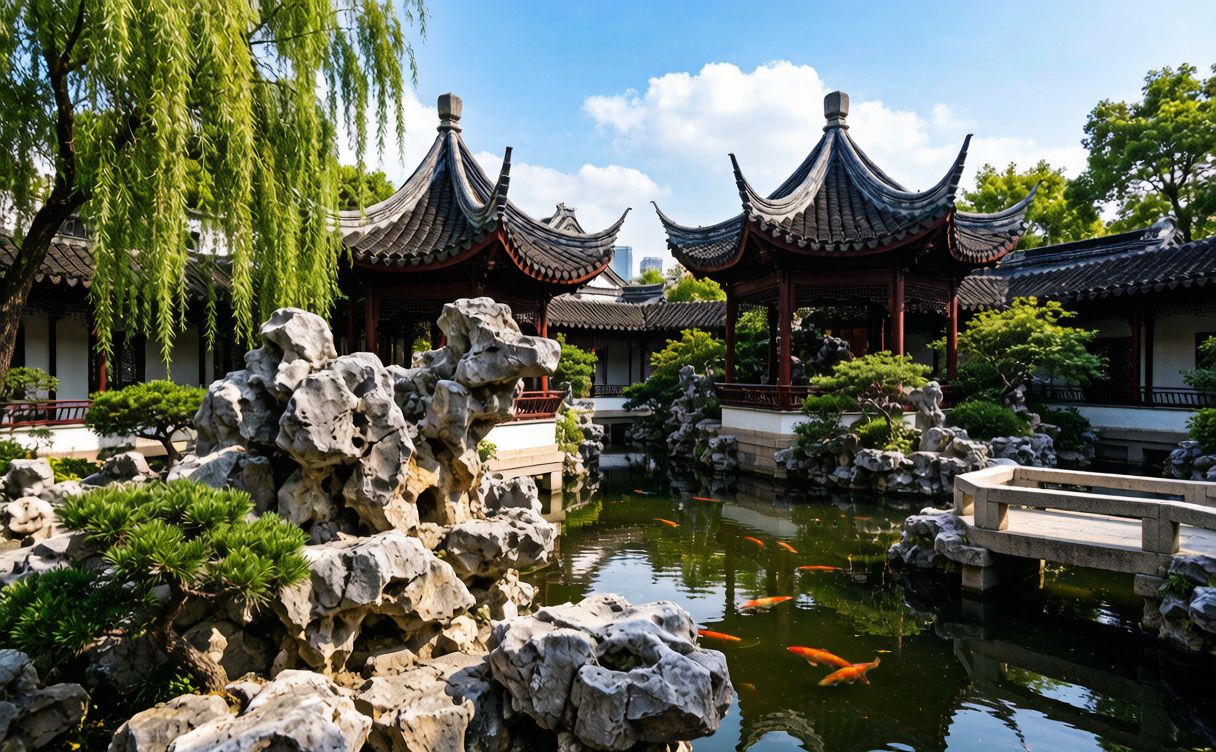
I still remember the moment I stepped through the moon-gate entrance of Shanghai Yu Garden on a foggy spring morning. One second I was in the chaos of the Old City — touts waving jade bracelets, the smell of fried dumplings, the screech of scooters — and the next I was standing in front of a 400-year-old rockery, completely alone, listening to koi splash in a still pond. That contrast is the whole magic of Yu Garden. It is the only place in hyper-modern Shanghai where you can touch the city’s pre-colonial soul, and if you time it right, it is one of the most peaceful hours you can spend in this metropolis.
This guide is built from three separate visits I made across different seasons and crowd levels. I’ll walk you through what the garden actually contains, how to tour the surrounding Old City and Chenghuangmiao (the City God Temple) without getting ripped off, and the mistakes I watched other travelers make so you don’t have to.
What Exactly Is Yu Garden?
Yu Garden (豫园, Yù Yuán — literally “Garden of Happiness”) was built in 1559 during the Ming Dynasty by a wealthy official named Pan Yunduan. He spent nearly 20 years and most of his family fortune constructing it as a retirement retreat for his aging parents. The garden changed hands many times, was damaged in the Opium Wars, and was restored by the city in the 20th century. Despite all that history, what you walk into today feels intentional and intact.
Covering about two hectares, Yu Garden is a classic Jiangnan (south of the Yangtze) scholar’s garden. The design philosophy is “borrowed scenery” — every window frame, every corridor turn reveals a composed view, like a living scroll painting. There are six main scenic sections, and the famous Exquisite Jade Rock (Yu Ling Long) is the centerpiece. It’s a porous taihu limestone boulder said to have been intended for the imperial court, and it has over 70 holes that make it whistle when the wind passes through.
Why Visit the Old City Around It
Yu Garden is not a standalone attraction you pop into for ten minutes. It sits inside Shanghai’s only surviving piece of the old walled city, the Old City or Laochengxiang. Before the 1840s, this was Shanghai — a muddy fishing town, not a global financial hub. Walking the lanes here, you get a sense of what the place was before the Bund and the skyscrapers.
Right beside the garden is Chenghuangmiao (城隍庙), the City God Temple. This isn’t one temple but a warren of connected halls, shops, and teahouses dedicated to the local guardian deity. For centuries it was the religious and commercial heart of old Shanghai, and it still functions as a living neighborhood, not a museum. Locals come here to burn incense, eat famous snacks, and meet friends at the riverside teahouses.
The two are ticketed separately, but they belong together in your visit. In my opinion, the temple area is best enjoyed as a food-and-people-watching experience, while the garden itself is the quiet, contemplative half.
How to Get There
Yu Garden sits in Huangpu District, and it’s genuinely easy to reach on the metro. Take Line 10 to Yuyuan Garden Station (豫园站) — exit 1 or 4 puts you within a five-minute walk of the entrance. If you’re coming from the Bund or Nanjing Road, it’s a flat 20-minute walk south, or a short taxi ride.
I’d avoid driving. The Old City’s streets are narrow, one-way, and permanently congested, and parking is a nightmare. The metro is faster and drops you closer than any car can.
If you’re planning a broader Shanghai trip, this stop pairs naturally with the riverfront. Many travelers do Yu Garden in the morning, then cross to the Shanghai Bund guide for the night view once the lights come on — the contrast between 400-year-old garden and 1920s colonial skyline in a single day is unforgettable.
My Suggested Walking Route (Half Day)
Here’s the loop I’d actually recommend, based on what flows best and what avoids the worst crowds:
1. Arrive at opening (8:30 am in summer). Buy your ticket online or at the gate, and head straight to the Exquisite Jade Rock before the tour groups arrive around 9:30.
2. The Big Rockery (Huge Rockery, 大假山). Climb the stone staircase to the small pavilion on top. It’s the highest point in the garden and gives you a bird’s-eye layout of the whole place — useful for orienting yourself before you wander.
3. The Inner Garden (Nei Yuan). At the back, this smaller, later-added section is the most serene. I spent a long time on the bench by the chessboard-paved courtyard just listening to the birds.
4. Exit into Chenghuangmiao. By late morning the temple bazaar is lively but not yet overwhelming. Wander the halls, then refuel at the snack street (more on food below).
5. Circle the Nine-Turn Bridge. The bridge over the pond is pure photo-op theater, and at dusk the red lanterns reflecting in the water are genuinely pretty.
If you want this folded into a bigger plan, my Shanghai 2-day itinerary slots Yu Garden into the perfect morning slot.
Tickets, Hours, and Avoiding the Crowds
- Opening hours: roughly 8:30 am – 5:00 pm (last entry 4:30 pm). The garden closes on rare maintenance days — check ahead.
- Ticket price: around ¥40–¥50 for the garden; the Chenghuangmiao halls are a separate small fee, and the adjoining Yuyuan Bazaar streets are free to walk.
- Best time: Weekday mornings, especially outside Chinese public holidays. Avoid the week of National Day (early October) and the Spring Festival entirely if you can.
The single biggest mistake I see is arriving at noon on a Saturday. You will be shoulder-to-shoulder with selfie sticks and hear nothing but tour-guide megaphones. Go early, or go on a weekday, and the garden transforms.
Where to Eat Nearby (Without Getting Scammed)
The food scene around Yu Garden is legendary, but it’s also the easiest place in Shanghai to overpay for mediocre food. Here’s my honest take.
Do try:
– Nanxiang Steamed Bun Restaurant (南翔馒头店) — the original xiaolongbao (soup dumplings) shop, right by the garden’s south gate. The top floor is the proper sit-down experience; the ground floor is a chaotic takeaway window. Both are worth it. A basket of crab-roe xiaolongbao is the local specialty.
– Snack street inside Chenghuangmiao — cheap, fun, and genuinely local: stinky tofu, fried glutinous rice balls, and sweet seaweed. Great for grazing.
– Huxinting Teahouse (湖心亭茶楼) — the teahouse on the island in the pond, dating to 1784. Overpriced for tea, but the setting is unmatched. I treated myself once and don’t regret it.
Skip:
– Any “silk” or “jade” shop that pulls you in off the street with a “today only” discount. The bazaar is full of these. Walk past.
– Rickshaw drivers offering “secret garden tours” for ¥200. There is no secret garden.
For a wider sense of what Shanghai eats beyond the Old City, our things to do in Shanghai guide covers neighborhoods where the food is better value and less touristy.
Common Pitfalls I Watched Travelers Hit
- Confusing the garden with the bazaar. The walled Yu Garden is small and quiet; the Yuyuan Bazaar outside is a giant shopping mall dressed in fake-old architecture. Both are fine, but know which you’re paying for.
- Wearing the wrong shoes. The garden has uneven stone paths, narrow bridges, and steps. Flats or trainers, not heels.
- Rushing. This is a garden built for slowness. Give it at least 90 minutes. If you bolt through in 20 minutes, you’ve missed the point.
- Assuming it’s “just a park.” It’s a protected piece of Ming-dynasty design. The rocks, the windows, the angled sightlines are all deliberate. Slow down and look.
Pairing Yu Garden With Nearby Classical Gardens
If Yu Garden whets your appetite for Chinese garden design, you’re in luck — the Yangtze Delta is the world’s heartland for it. Suzhou, just 30 minutes away by high-speed train, has nine gardens inscribed as UNESCO World Heritage sites, and they’re older and larger than Yu Garden. Our Suzhou travel guide explains exactly how to do a day trip that combines perfectly with your Shanghai stay.
For me, Yu Garden is the appetizer and Suzhou is the banquet — but the appetizer is the one you can reach on a whim, before breakfast, with no planning. That’s its real gift.
Where to Stay
The Old City itself is atmospheric but not the most convenient base — it’s a bit far from thetrendy districts and the metro links are thinner. Most visitors stay around People’s Square, the Bund, or Jing’an and day-trip here. Our where to stay in Shanghai breakdown compares the neighborhoods by budget and vibe so you can pick a base that suits you.
If you’re landing in Shanghai as one stop on a bigger China trip, a dedicated China travel guide for first-timers will cover visas, payments, and the logistics that actually trip people up.
Final Thoughts
Yu Garden won’t take your whole day, and it isn’t the most spectacular garden in China — but it might be the most accessible moment of classical Chinese aesthetics you’ll find inside a major city. For a first-time visitor to Shanghai, it’s the fastest way to understand that this city has always been a meeting point of commerce and beauty, of temple incense and trading ships.
Go early, bring comfortable shoes, eat a basket of xiaolongbao, and let yourself get a little lost in the rockery. The Old City will still be loud when you step back out — but you’ll have seen the quiet version first.
For the most current opening hours, ticket prices, and seasonal events, always confirm with the official Shanghai tourism board before you go, since schedules shift around holidays.