

The first time I got properly lost in Beijing, it wasn’t in a museum or subway — it was down a grey-brick alley barely wide enough for two bicycles. A woman was hanging drying chili peppers outside a wooden gate painted with faded red couplets; a man was tending a pot of stew on a stool; somewhere an erhu was wheezing a tune I couldn’t name. Nobody was performing for anyone. That was just Tuesday, and the afternoon I fell for the Beijing hutongs, the narrow lanes that still hold the everyday soul of a capital better known for palaces and skyscrapers.
Most visitors fly in for the Forbidden City and the Great Wall, tick both boxes, and leave thinking they’ve seen Beijing. They haven’t. The hutongs — a word meaning “alley” in Mongolian, now the name for the whole maze of courtyard neighborhoods — are where the city actually breathes. If you want to understand how ordinary Beijingers have lived for seven centuries, you walk the lanes on foot, get a little lost on purpose, and let the smell of breakfast oil and the clack of mahjong tiles be your guide.
What Exactly Is a Hutong?
A hutong is the space between siheyuan — the single-story courtyard homes built around a central square, rooms arranged north, south, east, and west by old principles of balance. Pack a few hundred of these courtyards shoulder to shoulder and the gaps between them become lanes; string the lanes together and you get a neighborhood grid that has barely changed since the Yuan dynasty laid out the city in the 1200s.
I love explaining this to first-timers because it flips the usual assumption. The hutongs aren’t a tourist attraction built to be looked at. They’re a living residential fabric. People still live here — cooking, arguing, hanging laundry, renting spare rooms to students. That’s why a walk here feels different from any temple or ticketed sight: no rope line, no audio guide, no “do not touch.” Just a city going about its business, and you’re invited to wander through it.
Where to Walk: My Three Favorite Hutong Routes
You could wander almost anywhere inside the old city walls and find something good. But after a dozen visits I keep coming back to three routes, each with its own personality.
1. The Classic Loop: Gulou, Nanluoguxiang & Around the Drum Tower
Start at the Drum Tower (Gulou), climb it if you like a view, then drift south. The area between the Drum and Bell Towers and the southern edge of Nanluoguxiang is my default recommendation for a first hutong walk. It’s busy enough that you’ll never feel uneasy, but step one lane east or west of the main drag and the crowds thin out completely.
Nanluoguxiang itself is the famous one — a straight, 800-meter lane lined with cafés, craft shops, and the occasional excellent dumpling stall. It’s touristy, yes, but it’s touristy because it’s genuinely pretty, with its eight parallel side-hutongs (the “eight alleys”) branching off like ribs. My trick: walk Nanluoguxiang once for the energy, then immediately disappear into Yandai Byway or Mao’er Hutong beside it, where the courtyards are quieter and the doors are real.
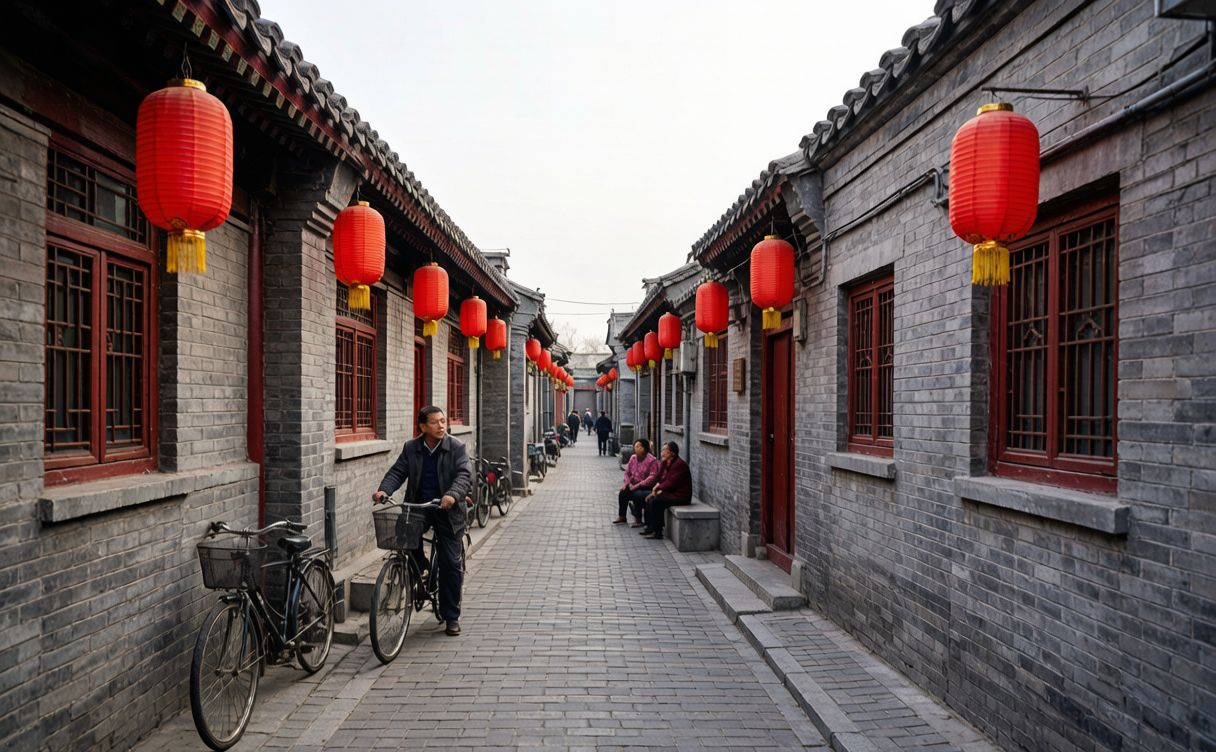
2. The Literary Quiet: Shichahai & the Prince’s Courtyards
Northwest of the center, the Shichahai lakes (Qianhai, Houhai, Xihai) are ringed by waterfront hutongs that once housed Qing-dynasty princes and officials. This is my favorite route for a slow morning. The lanes here are wider, the trees older, the courtyards behind the walls genuinely grand. Rent nothing, buy nothing — just walk the loop around Houhai, peek through gates left ajar, and watch old men practice tai chi at the water’s edge.
Come back at night and it’s a different place: lakeside bars with live music, but also the same quiet lanes five steps inland where nothing has changed in fifty years. I prefer the daytime version. The morning light on the lake makes you slow down without meaning to.
3. The Working-Class Heart: Baochao Hutong & the Eastern Grid
If you want the least polished and most authentic slice, head east of the Lama Temple into the grid around Baochao Hutong and Beixinqiao. This is where I’ve had my best unplanned encounters — a grandfather teaching a kid to ride a bike, a hole-in-the-wall noodle shop with three stools and a line out the door, a courtyard pomegranate tree dropping fruit onto the bricks. It’s less “instagram,” more “real life,” and for a traveler who’s already seen the postcard sights, that’s worth more.
Reading the Details: What to Look For
A hutong walk rewards the curious eye. A few things I’ve learned to notice:
- The gate ornaments. Those stone drums flanking a doorway (menshixuan) once signaled a family’s rank. The rings on a gate’s nails were a coat of arms.
- The brickwork. Look up at the grey qingzhuan bricks in geometric patterns — some lanes bake “cash coin” motifs right into the wall.
- The courtyard glimpses. Most siheyuan are private, but gates are often open. A polite glance inward shows the pomegranate and jujube trees, grape arbors, bicycles — the vertical life of the lane.
- The soundscape. Listen for the hutong mix: a squeaky bike bell, a kettle whistle, a vendor’s call, the thwack of a badminton shuttle against a wall.
What to Eat Along the Way
You don’t need a restaurant reservation to eat well in the hutongs — you need a nose and a little courage. My repeated stops:
- Jianbing (savory crepe) from a morning cart, folded around a crisp fried cracker. The best ones have a queue of locals, not an English menu.
- Lüzhu huoshao — a fantastically unfancy Beijing stew of wheat cakes, tofu, and pork offal, beloved by old-timers. Try it once.
- Douzhi — fermented mung-bean milk, an acquired taste I have not yet acquired. Order a small bowl, commit to the story, and move on.
- Zha Jiang Mian — noodles with fried soybean paste and a mountain of raw vegetable strips. Comfort food of the lanes.
- Want the famous roast duck without the tourist markup? Our separate guide to Beijing’s roast-duck spots pairs perfectly with a hutong afternoon.
For ordering from vendors who only take mobile payment, a quick read of our food-ordering app guide is genuinely useful before you go.
How to Get Around (and Not Get Eaten by Maps)
The hutongs sit mostly inside the Second Ring Road, walkable from several subway stops. I usually arrive via Nanluoguxiang or Shichahai station on Line 8, or Beixinqiao on Line 5, then walk everything. A few notes from hard experience:
- Download an offline map. The lanes confuse Google Maps, and data can be patchy. I rely on a saved map plus our internet-in-China tips before I land.
- Go on foot, not by rickshaw. The pedicab “hutong tours” near the lakes are fun for ten minutes but overpriced and scripted. Walk yourself; you’ll see and meet more.
- Wear real shoes. Brick alleys are uneven and occasionally slippery after rain. Trainers, not sandals.
- Time it right. Early morning (7–9am) for daily life and empty lanes; golden hour for the best light on grey brick. Avoid the weekend noon crush on Nanluoguxiang.
If you’re building a wider Beijing plan around this walk, the Beijing first-time travel guide and the 3-day Beijing itinerary both slot a hutong afternoon in neatly — and the things to do in Beijing list has the neighboring sights like the Forbidden City ticket guide and the Summer Palace to round out your days.
A Note on Preservation (and Why It Matters)
Here’s something I didn’t appreciate on visit one: the hutongs are disappearing. Decades of redevelopment flattened huge swaths, and the surviving lanes are a fraction of what stood in the 1950s. The lanes that remain are protected, and in 2024 Beijing’s historic Central Axis — the north–south spine the hutongs were built around — was inscribed on the UNESCO World Heritage List, formal recognition of the very fabric you’re walking through. The Beijing Municipal Government’s tourism portal covers the protected historic areas in detail.
That inscription means the lanes you walk today are more likely to survive a decade. Walk them now, and walk them respectfully — keep your voice down near open gates, ask before photographing people, don’t treat residents like exhibits.
My Practical Hutong Walking Plan
If you have a single free afternoon, here’s the loop I’d give a friend:
- Arrive at Shichahai station around 3pm. Walk north along Houhai’s east bank.
- Cut east into the quiet lanes behind the bars — try Ya’er Hutong — and wander 40 minutes with no destination.
- Circle south to the Drum Tower, climb it if the light’s good, then walk toward Nanluoguxiang but peel off into Mao’er Hutong instead of the main street.
- End at a jianbing cart or small noodle shop around 6pm as the lane lamps click on.
It’s not a route you can “complete.” That’s the point. The best hutong walk is the one where you surrender the map and let the next red gate decide.
When to Go
Season changes everything here. Spring (April–May) is my favorite — the alley trees leaf out and the light is soft. Autumn (September–October) is crisp and clear, courtyard pomegranates ripening red against the grey brick. Summer is lush but hot and mosquitoes love the lakes; winter is brutally cold but magical after a snowfall, the lanes silent and white. Whenever you come, our seasonal Beijing planning breakdown will help you pack and plan.
Staying Near the Lanes
One last tip from someone who’s made the mistake of staying too far out: book inside or next to the old city. Waking up and stepping straight into a hutong for your morning jianbing is a completely different trip from a generic tower hotel near the Third Ring Road. Our where to stay in Beijing guide maps the best neighborhoods, including which hutong-adjacent areas are walkable and which are not.
The Beijing hutongs taught me the single most useful travel lesson I know: the famous sights tell you what a place is for, but the back lanes tell you what it’s like. Go see the palaces. Then go get lost on purpose.