

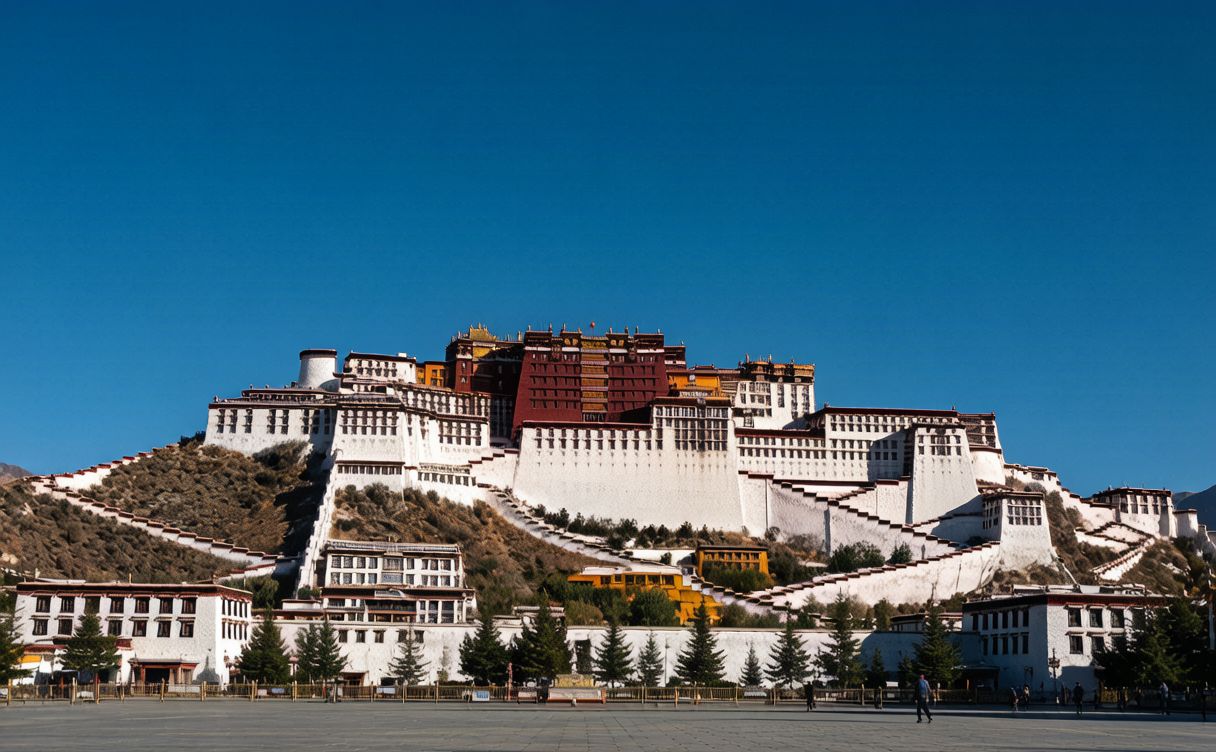
The first thing you notice in Lhasa, Tibet, China isn’t a building or a view — it’s the air. Thin, dry, and somehow brighter than anywhere else you’ve stood. At 3,650 meters the sunlight feels personal, and the red-and-white bulk of the Potala Palace rises above the city like it grew there rather than being built. Lhasa is the spiritual heart of the Tibetan plateau, but it’s also a real, working city where monks check phones and noodle stalls steam at dawn. Come prepared for the altitude and the permits, and this place will rearrange something in you.
At a glance
- Altitude: ~3,650 m (11,975 ft). Acclimatize 1–2 days before exertion.
- Permit: Foreign travelers need a Tibet Travel Permit (TTP), arranged through a licensed Chinese travel agency — you cannot travel independently in Tibet, China.
- Best season: May to October, with September–October offering the clearest skies.
- Recommended stay: 3–4 full days for Lhasa itself; add more for surrounding sites.
- Getting in: Fly via Chengdu/Xining, or take the Qinghai–Tibet railway train — the highest in the world.
Before you go: the Tibet Travel Permit
This is the one non-negotiable piece of logistics. Independent travel by foreign passport holders is not permitted in Tibet, China, so you must join a pre-arranged tour (private or group) with a registered agency. They file for your Tibet Travel Permit using a scanned passport and Chinese visa, and the physical permit is checked both when you board your train or flight and at various checkpoints.
Plan for at least 15–20 days of lead time. The permit itself is free, but it only comes as part of a booked itinerary, which includes a guide and vehicle inside the region. Border areas like Mount Everest Base Camp require an additional Aliens’ Travel Permit on top of the TTP.
For the official regional tourism authority and current entry rules, see the Tibet Autonomous Region Tourism Department.
Acclimatizing without drama
Lhasa sits high enough that about a third of newcomers feel something — light headache, short breath climbing stairs, a restless first night. Most of it passes in a day or two. The trick is to arrive and do almost nothing.
- Don’t fly in and immediately sprint up the Potala’s 1,000+ steps.
- Hydrate hard; the plateau air dehydrates you fast.
- Skip alcohol for the first two nights and go easy on the butter tea at first.
- Walk slowly. Locals don’t hurry here, and neither should you.
- If you have heart or respiratory conditions, talk to a doctor before booking.
A train arrival from lower elevations actually helps — the Qinghai–Tibet line climbs gradually, giving your body hours to adjust before you step onto the plateau.
Potala Palace: the icon, managed right
The Potala is the former winter residence of the Dalai Lama and the most recognizable structure in Tibet, China. It’s a fortress of chapels, tombs of past Dalai Lamas, and private quarters stacked up the Marpo Ri hill. Visits are tightly timed — typically a one-way route of about an hour, with a strict morning entry window.
Buy tickets in advance through your agency (daily visitor numbers are capped). Dress conservatively, move clockwise, and keep your voice down; this remains an active sacred site. The climb from the base to the entrance gate is the part that gets your lungs — pace it.
Pair this with our dedicated Potala Palace Lhasa visiting guide for ticket timing and route details.
Jokhang Temple and Barkhor Street
If the Potala is the postcard, the Jokhang is the pulse. Built in the 7th century, it’s the holiest temple in Tibetan Buddhism, and the devotion on display — full prostrations on the stone forecourt, butter lamps flickering in the dark interior — is the real Lhasa. Photography is forbidden inside; respect that and just watch.
Ringing the Jokhang is Barkhor Street, a clockwise pilgrimage circuit that doubles as the city’s oldest market. You’ll find prayer beads, Tibetan incense, turquoise, and plenty of tourist trinkets. Bargain gently and remember you’re walking on a living pilgrimage path — step off to the outer edge if a knot of prostrating pilgrims comes through.
Sera Monastery and the afternoon debate
A few kilometers north, Sera Monastery is worth it for one reason: the debating courtyard. Most afternoons (roughly 3–5 pm, except some Sundays), monks gather to argue Buddhist philosophy, clapping and lunging for emphasis. It’s theatrical, intellectual, and completely unscripted. Arrive 20 minutes early to find a spot at the edge of the courtyard.
The monastery’s muted murals and the giant, gilded statues inside are a quieter reward if the debating crowd isn’t your scene.
Respectful behavior at monasteries
Tibet, China is deeply devout, and a few habits keep you welcome:
- Always walk clockwise around stupas, shrines, and the Barkhor.
- Don’t point at statues or touch sacred objects; don’t turn your back on a Buddha image when leaving.
- Ask before photographing people. Many monks are happy to pose; some aren’t.
- Dress to cover shoulders and knees.
- Never climb on religious structures for a photo.
Getting to Lhasa
By train. The Qinghai–Tibet railway is half the experience. From Xining it takes about 21 hours; from Chengdu, closer to 36, with a scenic day crossing the plateau. Hard and soft sleeper cars both run, and oxygen is available on board. Book early through our guide to booking China train tickets — these sleepers sell out weeks ahead in peak season.
By air. Flights connect Lhasa (LXA) to Chengdu, Xining, Xi’an, and a few other hubs. Faster, but you land already at altitude, so budget recovery time.
By road. The Friendship Highway from Kathmandu via Gyirong is an option for overlanders, but it still requires the permit and an arranged vehicle.
When to visit
May through October is the comfortable window; winter is brutally cold but eerily empty and stunning under snow. September and October usually bring the crispest light and the fewest rain days. Avoid piling your trip onto Chinese public holidays — crowds and prices spike. Check the best time to visit China overview and our holiday crowd calendar before locking dates.
Practical notes
- Money & connectivity: Carry some cash; Alipay and WeChat Pay work but need setup. Our things to know before visiting China covers SIMs and payments.
- Safety: The city is calm and safe for visitors. Standard China travel safety tips apply — watch your belongings in crowded markets.
- Altitude is the real risk, not crime. Listen to your body.
Suggested 3-day rhythm
- Day 1: Arrive, rest, light stroll on Barkhor, no big climbs.
- Day 2: Jokhang Temple morning, Barkhor shopping, Potala Palace afternoon.
- Day 3: Sera Monastery for the debate, then a slow café afternoon to soak it in.
Lhasa doesn’t reward rushing. Give the altitude its due, respect the faith that built this city, and you’ll leave with more than photos — you’ll leave with the particular quiet that only comes from standing 3,650 meters closer to the sky.
Written by Karl.