

If you’re planning China travel for the first time, there’s one small detail that can quietly derail your first night: keeping your phone, camera, and laptop alive. I learned this the hard way on my second evening in Beijing, when my American laptop brick refused to seat in the wall and my phone hit 4% with no way to charge. The short version is this — the plug adapter in China is a hybrid you won’t find at home, and getting it wrong means a scramble through convenience stores at 10 p.m. After a dozen trips and a lot of trial and error, here’s everything I wish someone had told me before I plugged in.
What kind of sockets does China use?
China’s outlets look deceptively familiar, but they’re a hybrid of two international standards. Officially the country uses Type I sockets (the three flat pins in a V-shape, like Australia), but the vast majority of wall outlets you’ll actually meet are Type A / Type I hybrids — a single faceplate with both the two vertical Type A slots (US-style) and the three angled Type I holes. That hybrid design is the reason many travelers get confused: your two-prong US or Japanese devices often slot straight in, but your three-prong laptop plug won’t, and neither will a UK or European plug without an adapter.
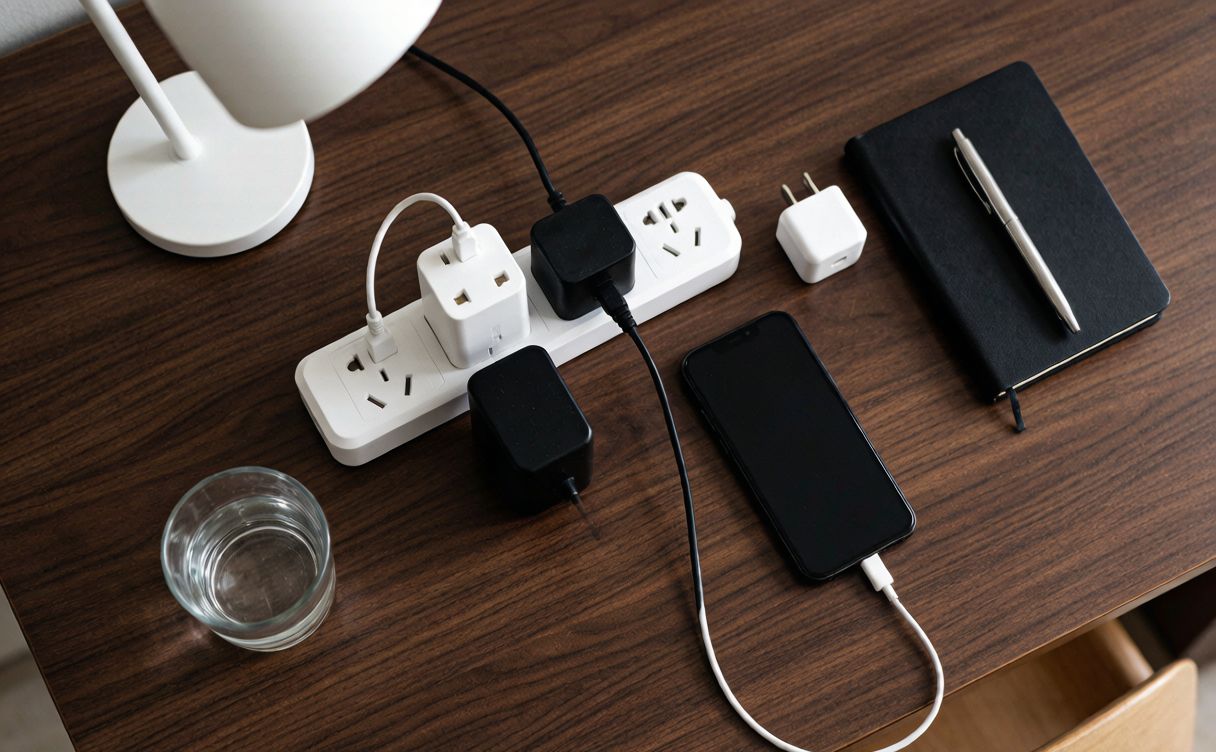
Here’s the practical breakdown:
- Type A (two flat vertical pins): Found on the hybrid faceplates. Two-prong chargers from the US, Canada, Japan, and much of the Americas usually fit directly.
- Type I (three flat angled pins): The “official” Chinese standard. Australian and New Zealand plugs fit; most others need an adapter.
- Type C / Type F / Type G (Europe & UK): Almost never found in a standard Chinese room. You’ll need a physical adapter for any round-pin or three-rectangular-pin plug.
My rule of thumb: assume you need at least one universal adapter, even if your phone charger technically “might” fit. The hybrid plates vary by hotel and age of building, and betting your only charging option on a maybe is a bad plan. If you’re still mapping out the rest of your kit, our China packing list for first-timers covers adapters alongside the other small things people forget.
Voltage and frequency: 220V, 50Hz
China runs on 220 volts at 50 Hz. That’s the same voltage as most of Europe, Asia, and Australia — but double the 110–120V used in the US, Canada, and Japan (with some exceptions). The good news is that almost every modern traveler device is “dual voltage” and handles this automatically. Look closely at your chargers; you’ll see a label reading something like Input: 100–240V, 50/60Hz. Phone chargers, laptop bricks, camera battery chargers, and tablet chargers all fall into this category, so you only need a plug-shape adapter, not a voltage converter.
The exception — and it’s an important one — is anything with a heating element or a motor that isn’t explicitly rated for 100–240V. That brings us to hair tools.
The hair-tool trap
This is the single most common way travelers fry their gear. A US hair dryer, straightener, or curling iron built for 110V will pull double power on a 220V Chinese circuit. Unless it specifically says 100–240V (rare for cheap hair tools), plugging it in will, at best, burn it out and, at worst, trip the breaker or start to smell. I watched a fellow traveler’s expensive straightener die in a Shanghai hotel room in about three seconds.
My advice: don’t bring a 110V hair tool. Either buy a dual-voltage travel dryer, or — far simpler — use the one provided by your hotel. Mid-range and upscale hotels almost always supply a hair dryer in the bathroom. If you’re deciding where to stay, our guide to where to stay in Shanghai points you toward hotels that reliably include the basics. Also worth a read before you go: our things to know before visiting China roundup, which covers a lot of these “small but annoying” surprises.
What to actually pack
Let me make this concrete. Here’s what I travel with now, after years of getting it wrong:
- One good universal travel adapter with multiple USB ports. I prefer one that accepts Type A, I, C, G, and F plugs so I’m covered anywhere in the country, including Hong Kong and Macao where the standards differ.
- A short USB-C–to–USB-C cable and a USB-A cable. Cables fail; walls don’t.
- A small power bank (more on that below).
- Your normal device chargers — they’re dual voltage, so no converter needed.
- A backup: a second cheap adapter. They’re light, and losing one in a hotel drawer is surprisingly easy.
If you’re coming from North America, the one non-negotiable is the adapter itself. Your plugs will not fit a pure Type I socket, and many hybrid plates are loose enough that a US plug sits awkwardly and falls out halfway through the night.
USB and USB-C are everywhere
One genuinely pleasant surprise about traveling in China: you rarely actually need a wall adapter for your phone. USB ports are ubiquitous. Most modern hotel rooms have USB-A or USB-C sockets built right into the desk or bedside panel, and high-speed rail trains (and many airport lounges) offer both USB and 220V outlets at every seat. I’ve charged my phone off a train-seat USB port for the entire Beijing–Xi’an journey without touching my adapter.
That said, don’t assume. Older budget hotels and some hostels still offer only bare wall sockets, and a dead phone in a city where you’re navigating by map app is a real problem. Keep one adapter in your daypack even on day trips. For staying connected more broadly, our how to use the internet in China guide explains the connectivity side of keeping your devices useful on the road.
Power banks: your best friend
China is a mobile-payment, mobile-mapping, mobile-everything society. Your phone is your wallet, your map, and your translator. When it dies, you’re stranded. I now treat a power bank as essential kit, not optional.
A 10,000mAh bank gives me roughly two full phone charges; a 20,000mAh covers a long travel day plus a backup for a friend. Note one practical rule: if you fly in, carry your power bank in your hand luggage — lithium batteries are banned from checked baggage on most airlines, and Chinese airport security enforces this strictly. On my last trip, a fellow passenger had a 30,000mAh unit confiscated at check-in because it exceeded the watt-hour limit and was in a checked bag.
Shared portable chargers (the “power bank rental” kiosks) are common in malls and stations, but they require a local app and payment method, so for a foreign traveler a personal bank is far simpler. If safety and gear protection is on your mind generally, our China travel safety tips cover a lot more than just electronics.
A note on Hong Kong, Macao, and Tibet
Since China includes Hong Kong, Macao, and the Tibet Autonomous Region, it’s worth knowing the sockets aren’t identical everywhere. Hong Kong and Macao use Type G (the UK three-rectangular-pin plug) at 220V — completely different from the mainland hybrid. If your itinerary crosses the border, pack an adapter that covers Type G too. Tibet and the rest of the mainland use the same Type A/I hybrid and 220V, so no extra gear needed once you’re on the mainland.
I found this out the memorable way: after a smooth week on the mainland with my hybrid adapter, I landed in Hong Kong and none of my plugs fit. A five-minute stop at a convenience store solved it, but it’s an easy thing to pre-empt. Budget-wise, factoring adapters and a power bank into your loadout is trivial next to your overall China travel budget per day.
Mini-stories from the road
A few quick real examples, because the theory only lands once you’ve lived it:
- The 10 p.m. scramble (Beijing): My first trip, I arrived late, my laptop died, and the hotel’s one adapter was checked out. Twenty minutes of pantomime at a 24-hour convenience store later, I had a ¥25 universal adapter. Now I pack two.
- The fried straightener (Shanghai): A travel companion plugged her 110V US straightener into a 220V outlet. Three seconds of ozone smell, one ruined tool, zero apology from the wall. Hotel dryers exist for a reason.
- The train-seat trick (Xi’an line): I stopped carrying an adapter on day trips entirely after discovering the USB port at every high-speed rail seat. My phone charged faster there than at some hotels.
For authoritative reference on plug shapes and voltage worldwide, I keep the World Standards plug and voltage guide bookmarked — it’s the clearest single source I’ve found, and it confirms China’s 220V/50Hz Type A-I setup.
The short version
You don’t need to overthink power in China, but you do need to prepare. Pack a universal adapter that covers Type A, I, and ideally G; trust that your dual-voltage phone and laptop chargers will work fine at 220V; leave single-voltage hair tools at home; and carry a power bank like it’s part of your passport. Do those four things and the only charging surprise you’ll get is how often you don’t need the adapter at all. For a fuller pre-departure checklist, circle back to our China packing list for first-timers — it’s the companion piece to everything above.