

Few crafts capture the patience of traditional China like needle and silk. A single peony petal or the whisker of a cat can occupy an artisan for half a day, yet the finished surface looks as effortless as a brushstroke. For travelers, this is one of the most rewarding living traditions to seek out, because the finest pieces are still made slowly, by hand, in small studios. The four great embroidery styles China is known for each come from a different region, with their own palette, favored subjects, and signature stitches. This Chinese embroidery guide introduces those traditions, explains how to tell them apart, and points you toward the studios where you can watch the work happen.
Chinese Embroidery History: Threads Along the Silk Roads
Embroidery in China is old, but its exact beginnings are hard to pin down. Fragments preserved in dry tombs show that stitched decoration was already sophisticated more than two thousand years ago, during the Han dynasty. The craft later moved from court workshops into monasteries, merchant households, and the studios that still operate today.
Trade mattered enormously. The caravans that carried silk westward also brought new dyestuffs, motifs, and ideas back toward the interior, and embroidery absorbed these influences greedily. You can trace that exchange by following a Silk Road itinerary through the northwestern corridors, where textiles appear again and again in museum cases. By the Ming and Qing periods, distinct local schools had crystallized and patrons began to collect embroidery as art. Understanding this Chinese embroidery history makes the visual differences far easier to read when you finally stand in front of the originals.
The Four Great Embroidery Styles of China
Travelers often hear the four styles grouped together, as if they were variations on a single theme. In practice they are closer to four dialects, each shaped by a particular city and local demand. The sections below give you the practical differences worth noticing in a shop or museum.
Su Embroidery: Fine, Pale, and Almost Photographic
Su embroidery, centered on Suzhou in Jiangsu province, is the most famous of the four abroad. Its reputation rests on astonishing fineness: threads are split into hair-thin strands, and a needleworker may use dozens of shades of a single color to build a gradient. Subjects lean toward nature, especially cats, goldfish, birds, and flowers, rendered with a soft realism that can resemble a painting. The palette is restrained, favoring pale silks and delicate transitions over bold contrast.
The best place to understand Su work is in Suzhou itself. A visit pairs naturally with the classical gardens of Suzhou, since the same taste for delicate detail shapes both the landscapes and the needlework. Look especially for double-sided pieces, in which the reverse shows a complete and often slightly different image.
Xiang Embroidery: Bold Color and Lifelike Animals
Xiang, or Hunan embroidery, takes the opposite approach. It is famous for vigorous, high-contrast imagery, above all tigers and other animals whose fur is built up from short, directional stitches. The colors are richer and the effects more theatrical than in Su work, with a deliberate emphasis on texture and movement. Large hanging panels are common, designed to be read across a room rather than studied up close.
Xiang needleworkers also mix hair and silk to create unusually lifelike fur. If you enjoy the dramatic staging of traditional performance, you may notice a similar love of bold silhouette in a Peking opera guide to the region’s visual arts. The style rewards visitors who like their craft full of presence.
Shu Embroidery: Chengdu’s Bright, Lively Tradition
Shu embroidery comes from Sichuan, with Chengdu as its modern center. It is the oldest of the four styles in terms of documented continuity and has a cheerful, decorative character. Common subjects include pandas, fish, flowers, and birds, arranged with a strong sense of symmetry and a clean outline. The stitch work is even and tight, and the colors tend to be clear and bright rather than heavily blended.
Shu pieces are often smaller and more affordable than their Su counterparts, which makes them popular with travelers who want an authentic piece without a museum budget.
Yue Embroidery: Guangdong’s Glitter and Gold
Yue, or Guangdong embroidery, is the most ornate of the four. It favors saturated color, metallic gold thread, and dense, decorative surfaces, with phoenixes, peonies, and birds among the most frequent subjects. The effect is celebratory and a little opulent, designed for festival clothing, theatrical costumes, and display panels. Look for the distinctive raised texture created by layering stitches over a padded ground.
Suzhou Embroidery vs Shu Embroidery: How to Tell Them Apart
This comparison is the one visitors ask about most, and the differences are fairly easy to spot once you know them. In Suzhou work, look for soft gradients, pale tones, and an almost photographic softness; the thread is split so finely that edges seem to dissolve. In Shu work, expect cleaner outlines, brighter flat colors, and a more graphic, symmetrical arrangement. If a piece depicts a panda with crisp black-and-white shapes, it is very likely Shu. If it shows a cat whose fur shifts through dozens of quiet gray shades, it is probably Su.
Price is another practical clue. Su pieces generally demand more labor for the same size, and the finest double-sided works can be surprisingly expensive.
Stitches and Techniques Worth Recognizing
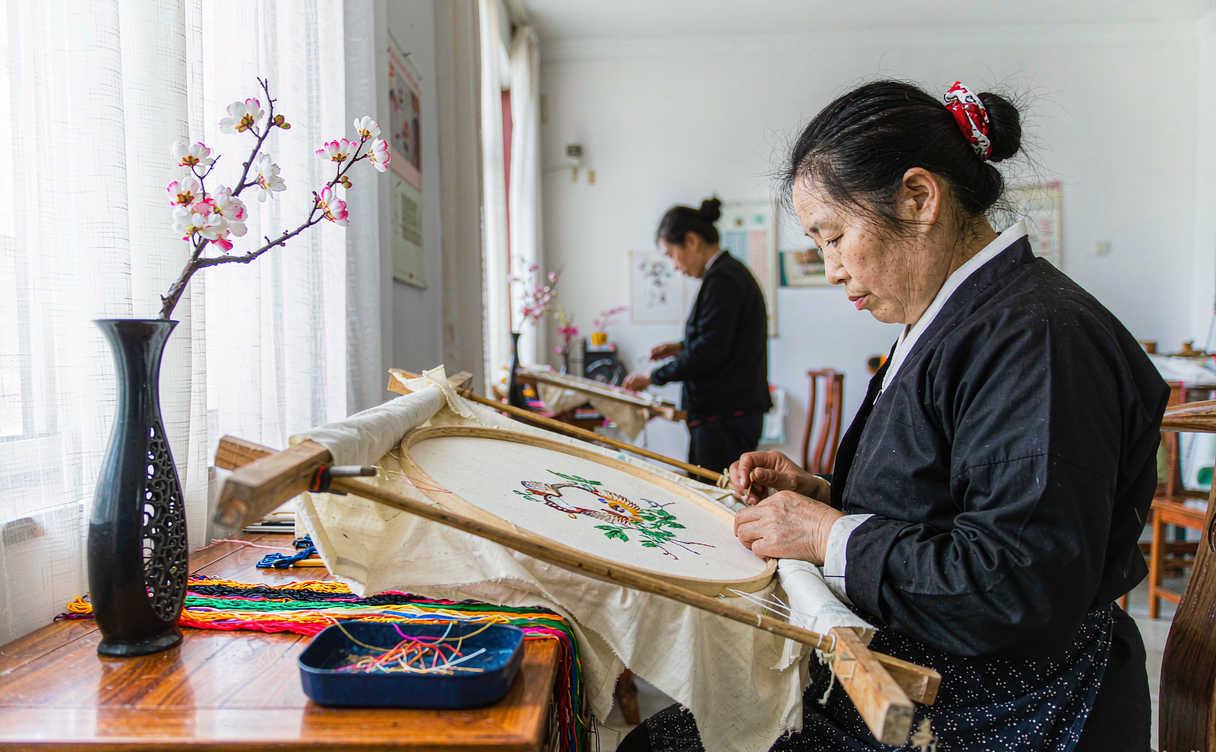
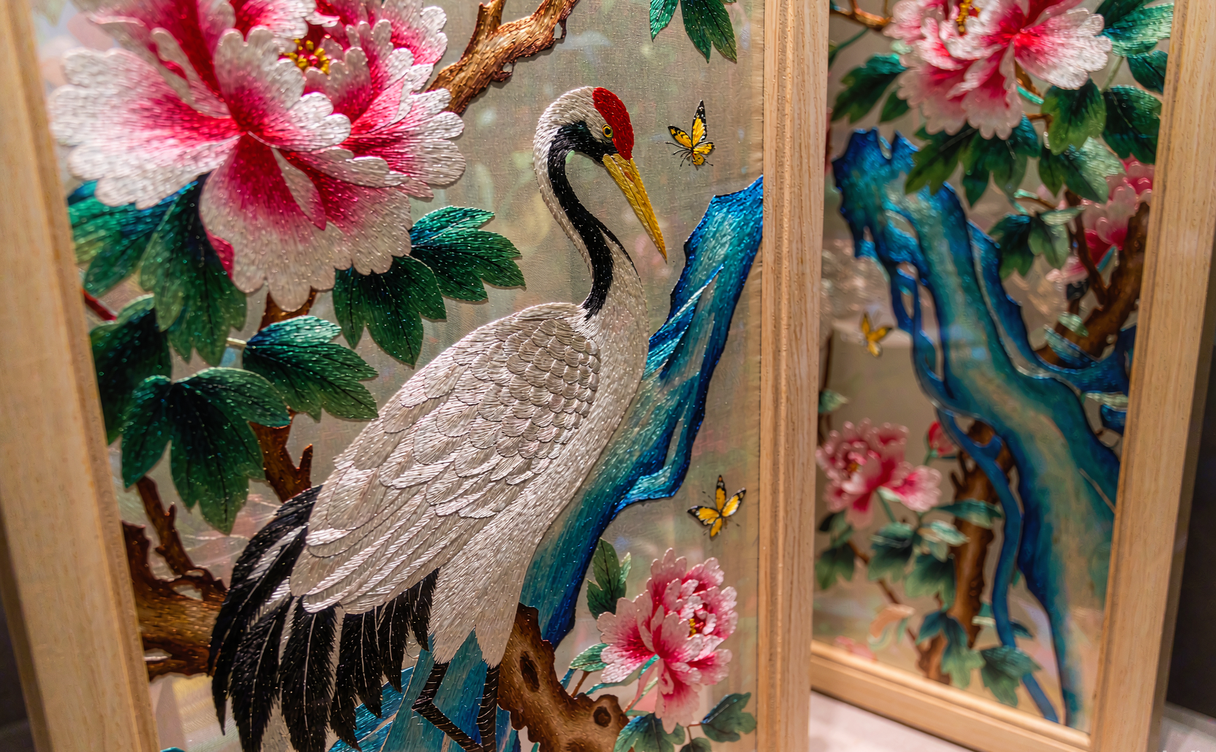
You do not need to master the vocabulary, but a few terms will make a studio visit more interesting. Flat stitch is the basic building block, with parallel threads laid neatly side by side. Random short stitch uses short overlapping strokes to create naturalistic texture, especially in animal fur. Double-sided embroidery is the showstopper: the artisan works on a transparent silk ground so that both faces display a finished image, sometimes with different compositions on each side.
Watching a demonstrator split a single strand of silk into finer filaments is often the highlight of a visit. It explains why a small panel can take weeks and why the best pieces feel lit from within.
Where to See Embroidery in China
Knowing where to see embroidery in China saves you from wasting time on shops that sell machine-made imitations. The strongest options combine a collection with a working studio, so you can see masterpieces and the process behind them.
In Suzhou, the Suzhou Museum and the city’s embroidery research institutes are the essential stops; the institutes often have demonstration rooms. In Chengdu, look for the Sichuan embroidery museum and workshops near the old streets. Changsha is the home of Xiang embroidery, and its dedicated museum gives the bold style proper context. In Guangzhou, the Guangdong embroidery museum and nearby craft workshops cover the Yue tradition, including its costume connections.
If your trip includes several cities, weave these stops into a broader museum route through China so you can compare regional textile traditions side by side.
Chinese Embroidery Workshops: Learning by Doing
For a more memorable experience, join one of the many Chinese embroidery workshops now open to foreign visitors. Most are beginner-friendly and last between one and three hours. You will typically be given a small frame, a needle, a few colors of silk, and a simple pattern such as a flower or a fish. An instructor demonstrates the basic stitches, then guides you as you fill in your own design.
The goal is not to produce a masterpiece. It is to understand, in your own hands, why the craft demands such patience. Sessions are widely available in Suzhou and Chengdu, and many can be booked through your hotel or a local travel desk. If you enjoy hands-on cultural learning, the same approach works well in a calligraphy experience guide to the region’s other contemplative arts.
Buying and Authenticating Embroidery
Be cautious of very large, highly detailed panels offered at surprisingly low prices, since these are often machine-embroidered or printed. A close look at the reverse side is the quickest test: on a true hand-embroidered piece, the back shows the small knots and thread ends where the work began and ended, while a machine-made surface looks nearly identical on both sides.
Ask the seller which of the four styles the piece represents and what stitches were used. A knowledgeable vendor will answer easily. For a reliable introduction to the cultural background of Chinese textile arts, the overview on China.org.cn is a useful reference before you shop. Buy from established studios or museum shops where possible, as these are more likely to stand behind the authenticity of what they sell.
Frequently Asked Questions
What is the difference between Suzhou embroidery vs Shu embroidery?
Suzhou embroidery favors soft, pale gradients and photographic realism, often showing cats or flowers in finely split thread. Shu embroidery uses brighter, flatter colors, cleaner outlines, and symmetrical compositions such as pandas and birds. The choice between them is largely a matter of taste and budget.
Are there good Chinese embroidery workshops for beginners?
Yes. Most studios in Suzhou and Chengdu offer short introductory sessions designed for travelers with no prior experience. You will learn a handful of basic stitches and leave with a small finished piece.
How many of the four great styles can I see in one trip?
All four appear in major city museums that rotate textile exhibitions, but seeing each in its home city is far more rewarding. A route through Suzhou, Changsha, Chengdu, and Guangzhou would cover all four.
Is this a good souvenir to bring home?
Small hand-embroidered pieces are light, durable, and easy to pack, and they carry a story that mass-produced souvenirs lack. Ask for a receipt from a reputable studio if you are spending a significant amount.
Final Thoughts
Chinese embroidery rewards the traveler who slows down. The four great styles offer four distinct ways of seeing the same world through thread, from the quiet realism of Suzhou to the brilliant ornament of Guangdong. Visit a studio, watch a demonstration, and try a few stitches yourself, and a decorative object becomes something far more meaningful.