

The moment the sun dips behind the city skyline, Nanjing’s oldest quarter wakes up in lantern light. At the heart of it all stands the Nanjing Confucius Temple, a riverside complex that has drawn scholars, merchants, and travelers for more than a thousand years. Known locally as Fuzimiao, this is the kind of place where history and appetite meet after dark. If you are looking for things to do at Fuzimiao Nanjing beyond the usual photo stop, the answer is simple: arrive before sunset, follow the water, and let the night unfold.
The temple itself was first built in 1034 during the Song dynasty and repeatedly rebuilt after fires and war. It honors Confucius, the philosopher whose teachings shaped Chinese education for centuries. Today the restored halls sit beside a lively commercial street, and the contrast is part of the charm. You can bow quietly before an ancient tablet and then step straight into a crowd laughing over skewers of grilled tofu. That blend of reverence and revelry is what makes the Nanjing Fuzimiao history feel alive rather than frozen in a museum case.
Begin your evening at the temple’s main gate on the north bank of the Qinhuai River. The stone archway and the reflection pond set a calm tone. Inside, the Dacheng Hall houses a towering statue of Confucius and a wall of musical bells you can sometimes hear played at scheduled demonstrations. Spend twenty minutes here to understand the place before the streets pull you outward. Then cross toward the riverfront, where the real show begins.
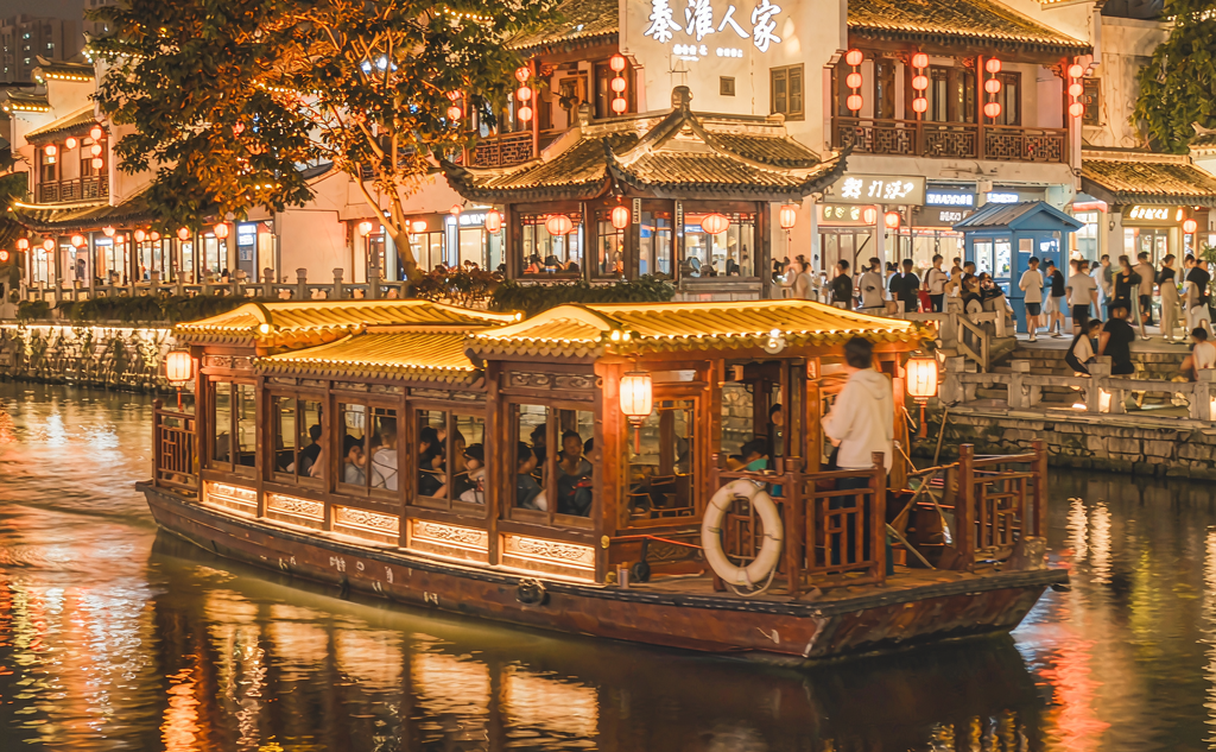
The Qinhuai River is the soul of this neighborhood. For generations it was the entertainment district of Nanjing, lined with painted boats and the homes of celebrated courtesans and poets. A Qinhuai River boat ride Nanjing visitors can take today follows roughly the same channel, gliding past rebuilt teahouses and glowing bridges. Boats usually run from late afternoon until around ten at night, and the after-dark trip is the one to choose. Seated on the open deck with a warm breeze and a cup of tea, you watch the lanterns double themselves in the black water. It is the single most romantic thing to do in the quarter, and it frames the whole walk that follows.
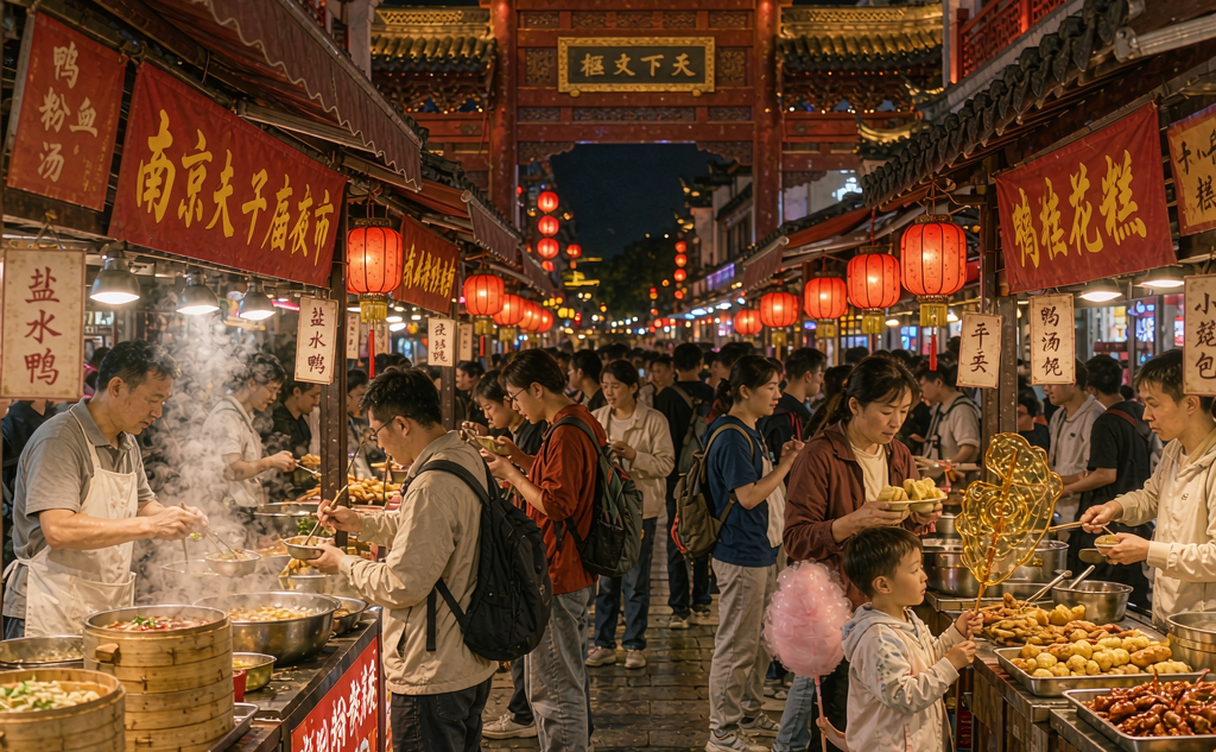
Step off the boat and you are immediately inside the night market. The Nanjing Confucius Temple night market spills across both banks, a dense ribbon of stalls selling snacks, trinkets, and small handicrafts. The air smells of sesame, caramelized sugar, and river fish. Vendors call out specials, children wave glowing balloon wands, and troupes of amateur singers perform on makeshift stages. This is not a sanitized tourist zone; it is a working pleasure street that local families visit on weekends.
Food is the obvious draw. For the best street food near Confucius Temple, work your way methodically rather than grabbing the first thing you see. Start with salted duck, Nanjing’s signature dish, thinly sliced and served cold. Move on to tangbao, soup dumplings you sip carefully from the top. Try the stinky tofu if you are brave, the candied hawthorn if you are not, and the eight-treasure porridge if you want something sweet and warm. Around festival times the stalls add mooncakes or rice balls, so the menu quietly shifts with the calendar.
If you want a deeper dive into the local kitchen, pair this visit with our Nanjing food guide, which maps the city’s signature dishes street by street. It is the natural companion to an evening here, because once you taste the Qinhuai snacks you will want to know where else in the city to find them.
Plan your evening around the lanterns and let a local expert handle the details — explore our custom Nanjing itineraries and book a guided night walk along the Qinhuai River tonight.
Beyond eating, the quarter rewards slow wandering. The Confucius Temple area connects to Jiangnan Examination Hall, where imperial China tested its would-be officials for centuries. Walking its narrow lanes, you can almost hear the scratch of brush on paper. Nearby, the former residences of historical figures have been turned into small museums, and the riverside promenade offers benches if your feet need a rest. The architecture is a careful pastiche of Ming and Qing styles, with upturned eaves and vermilion beams that glow against the night sky.
For travelers using Nanjing as a base, the temple makes an easy anchor. Trains and the metro line bring you to the district in under half an hour from most hotels, and the area is pedestrianized after a certain hour, so you can stroll without watching for traffic. Give yourself at least three hours from first lantern to last snack. Four is better if you want the boat, a temple visit, and a leisurely dinner.
History buffs will appreciate that this corner of Nanjing is tightly bound to the city’s larger story. The Qinhuai River marked the southern edge of the old walled capital, and the temple district was the cultural heart of a city that served as the seat of several dynasties. To Place the quarter in context, the Britannica entry on Nanjing offers a concise overview of the city’s long trajectory from regional hub to modern metropolis. Reading it before you go turns a pleasant stroll into a layered experience.
If your trip extends beyond the city, the surrounding Jiangsu province is rich with comparable water-town and mountain excursions. Our Yangzhou travel guide covers the slow canals and gardens just north of here, while the Slender West Lake Yangzhou guide details one of the most graceful walks in the region. Both make elegant add-ons to a Nanjing-centered trip.
Come back to Nanjing itself and you will find more than the river. The Qixia Mountain Nanjing guide is ideal in autumn when the maples turn, and the Niushou Mountain Nanjing guide pairs spiritual architecture with cool forest trails. Yet for a single unforgettable evening, nothing beats the temple district after dark.
A practical note on timing and etiquette. Weekends and public holidays are crowded to the point of shoulder-to-shoulder density; weekdays feel almost intimate by comparison. Bring small cash and a mobile payment app, since some stalls do not take cards. Photography is welcome, but ask before snapping portraits of vendors. And wear comfortable shoes, because the joy here is in walking, not arriving.
Many visitors combine the temple with a wider sweep of the province. If you are building a Jiangsu route, our Taizhou Jiangsu travel guide describes a quieter river city that balances the bustle of Fuzimiao nicely. Stringing these stops together gives you both the spectacle and the calm that the region does so well.
Ready to see the lanterns for yourself? Build a two-city Jiangsu route with our Yangzhou travel guide and reserve your Qinhuai boat ride before the evening slots sell out.
The enduring magic of the Nanjing Confucius Temple is that it refuses to be only one thing. It is a place of study and a place of celebration, a relic and a marketplace, a quiet hall of philosophy and a roaring street of sizzling woks. The Qinhuai River ties it all together, reflecting every lantern and every face that leans over its rail. When you finally leave, walking back toward the metro with the noise fading behind you, you carry the particular glow that only an old Chinese night market can give. Come for the history, stay for the food, and remember the river — because that is the part you will miss the moment you are gone.
Don’t just read about it — stand on the Qinhuai bridge at night and feel the lanterns ripple on the water. Start planning your Nanjing Confucius Temple evening now and turn a layover into the best night of your trip.