

About 22 kilometers northeast of Nanjing’s Confucius Temple quarter, where the city thins into farmland and the Yangtze bends eastward, a wooded hill rises barely 280 meters above the plain. Most of the year Qixia Mountain Nanjing is a pleasant, mildly popular day hike. For roughly four weeks each late autumn, however, it becomes one of the most photographed landscapes in Jiangsu, when more than 10,000 maple, sweet gum, and Siberian elm trees ignite the slopes in red and gold. The draw is not only the color but the setting: a 1,500-year-old temple, Nanjing Qixia Temple, sits in the valley, its gray tiles and red lacquer gates framed by flame-colored canopy.
We’ve sent travelers to Qixia Mountain Nanjing specifically for the maple season, and the timing is everything. On our last November visit the maples peaked around the 20th, a week later than the year before, which is why we now tell clients to build flexibility into a fall trip rather than lock a single date. The best light is the first two hours after the 07:00 opening, before tour buses from the city arrive and when the mist still sits in the gullies.
A temple older than the city walls
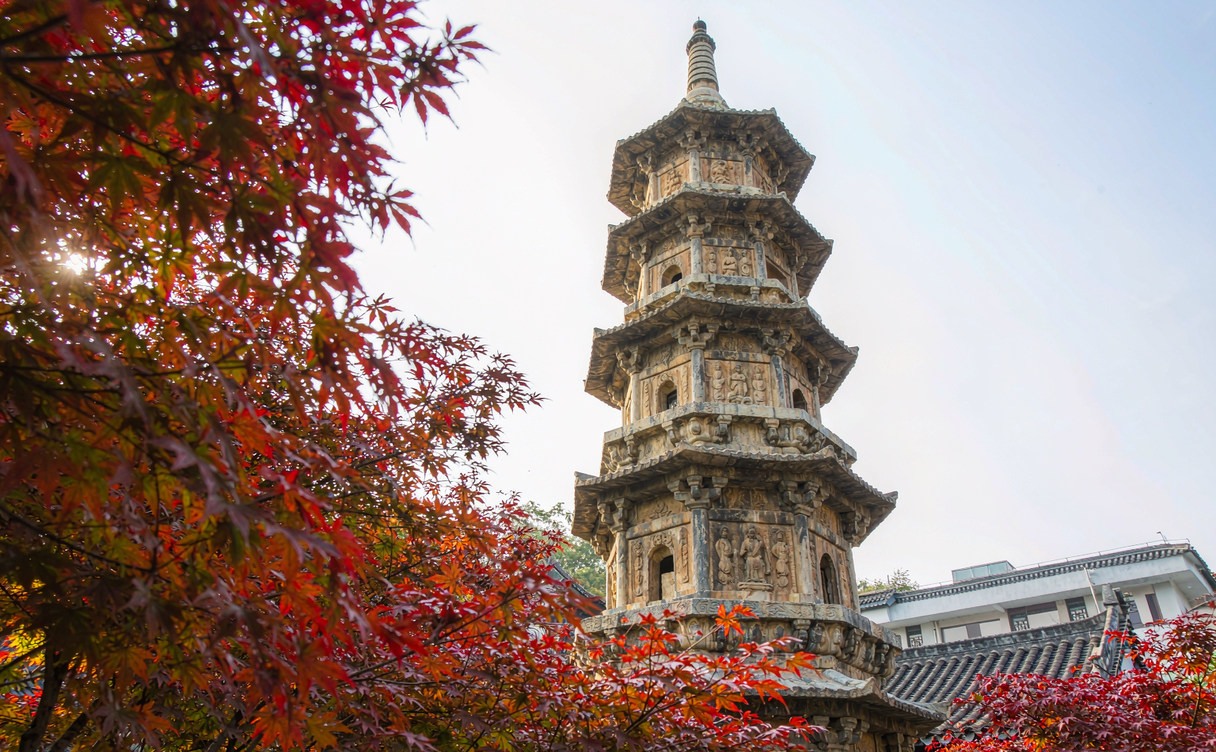
Qixia Temple was founded in 489 CE during the Southern Qi dynasty, making it one of the oldest Buddhist foundations in the lower Yangtze. The monk Ming Sengshao is credited with establishing the first hermitage here, and within a century the site had grown into a significant monastic center. What survives today is a reconstruction, but the setting — backed into the hill, screened by old trees — preserves the original intent. The nearby Thousand-Buddha Cliff (Qianfo Ya) contains carved Buddhist images from the Southern Dynasties, some of the earliest such rock carvings in the region, and the octagonal Sarira Stupa from the Sui–Tang period stands in the temple yard as a quiet counterpoint to the autumn crowds.
Things to do at Qixia Mountain
Things to do at Qixia Mountain go well beyond leaf-peeping. The main temple circuit — Hall of Heavenly Kings, Mahavira Hall, and the Sarira Stupa — takes about an hour at a calm pace. Behind the temple, a stone path climbs to the cliff carvings; we always point travelers to the less-visited western trail, which loops past a small spring and a Ming-era pavilion with a view back over the canopy. In maple season the higher viewpoints (the “Peak of Flying Lizards” and the Red Leaf Terrace) are crowded but worth it for the valley panorama.
Off-season, the mountain is a gentle hike with almost no one on the trails, and the temple’s morning bell ceremony (around 06:30) is open to respectful visitors. We’ve arranged for two travelers to join that ceremony, and both said it was the calmest hour of their two weeks in China.
Best time to visit Qixia Mountain
The best time to visit Qixia Mountain for color is mid-November to early December, with the exact peak shifting by one to two weeks depending on that autumn’s first cold snap. The temple publishes a rough “red leaf index” each year on its social channels, and we monitor it for clients booking fall trips. Spring (April) is a soft alternative, with azaleas and new green rather than fire, and far fewer people. Summer is lush but hot; winter is bare and quiet. For a broader picture of where the season peaks across the country, our guide to the best autumn destinations in China ranks the top maple and ginkgo spots.
How to get to Qixia Mountain
Knowing how to get to Qixia Mountain saves real frustration, because the site is not on a Metro line. From central Nanjing, take Metro Line 2 to Xueze Lu Station, then transfer to bus 138 or 206 to the Qixia Mountain north gate (total 60–80 minutes, fare under RMB 10 / USD 1.5). A more direct option in maple season is the tourist shuttle that runs from the Nanjing Tourism Distribution Center near the Confucius Temple; we book this for groups because it drops you at the west gate and spares the bus change. A taxi or ride-hail from the city center runs RMB 80–120 (USD 11–17) and is the choice we recommend for families or photographers carrying gear.
Tickets and practical costs
Admission is RMB 25 (about USD 4) in the off-season and rises to RMB 40–50 (USD 6–7) during the maple festival, when the temple restricts numbers and sells timed tickets. The cliff carvings and stupa are included. Opening hours are 07:00–17:00. We budget travelers about half a day including transit; photographers should plan a full day to catch both morning and late-afternoon light. An English audio guide costs RMB 20 (USD 3).
A natural pairing is the Nanjing travel guide, which links Qixia with the city’s other sites, and many visitors combine the trip with a relaxed afternoon at Xuanwu Lake, a short ride back toward the center. Those arriving by rail can review our China high-speed train guide for foreigners to plan the Nanjing leg.
Food around the mountain
The temple sells vegetarian buns and soybean milk at the gate, but for a proper meal we send clients to the Qixia street just outside the north gate, where small restaurants serve Nanjing salted duck, tangbao soup dumplings, and seasonal maple-themed desserts in November. Expect RMB 40–70 (USD 6–10) per person. Our Huaiyang cuisine guide explains how to spot the good duck houses and what to order.
Building a Qixia day into your Nanjing trip
Because the mountain is a half-day commitment with transit, we usually slot it on a day when you are not also doing the city wall or the Presidential Palace. A workable plan: leave the city by 08:00, photograph the temple at opening, hike the western trail, have lunch at the north gate, and be back downtown by 15:00 with time for Xuanwu Lake at golden hour. We’ve run this exact loop for small groups and it rarely feels rushed.
Accessibility and comfort
The temple yard and lower paths are step-free and manageable for most mobility levels, though the cliff-carving trail has uneven stone and a few steep pitches — we steer travelers with knee issues to the flat lakeside circuit instead. Wear grippy shoes; November leaves make the stone slippery after rain. The site has clean public toilets near both gates and a small medical post during festival weeks.
Photography and crowd strategy
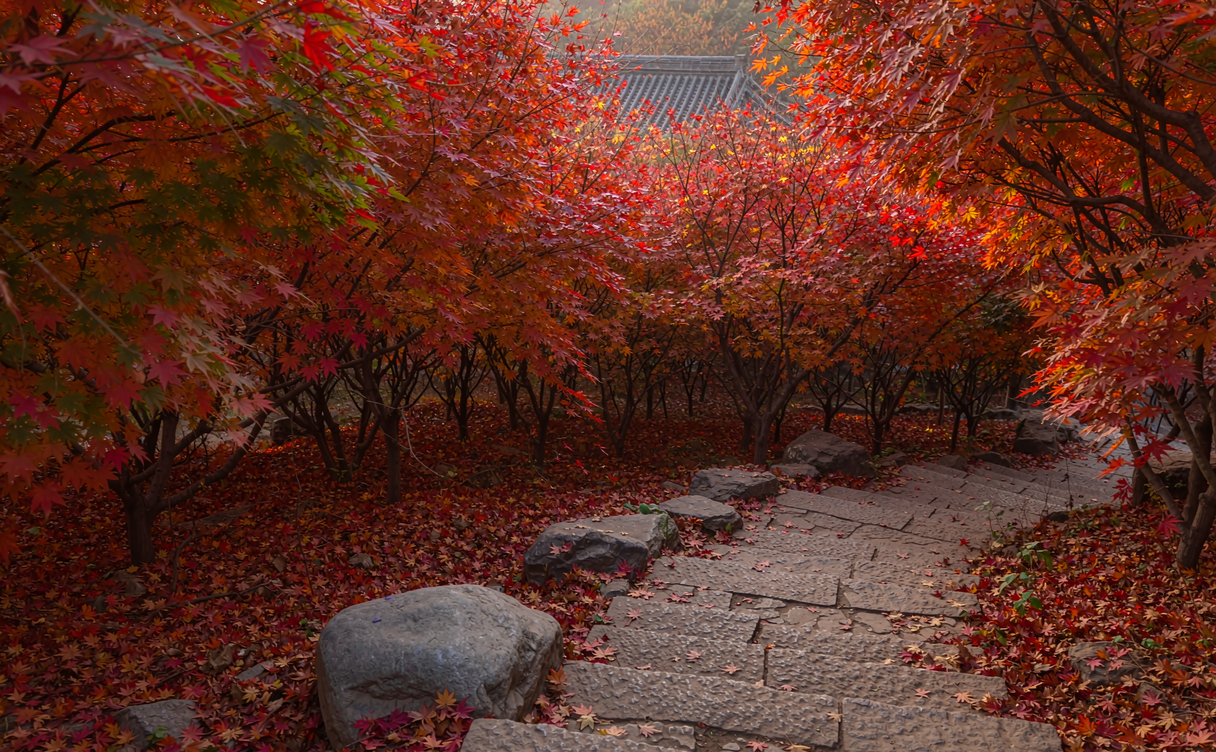
The Red Leaf Terrace and the main temple gates are the classic shots, but they are also where buses unload. We advise clients to photograph the temple at opening, hike up to the western trail by 09:30, and return to the lower maple tunnel around 15:30 when the light comes through the canopy from the west. A polarizing filter helps cut the glare on wet leaves after rain.
A note on crowd-free visits
If your schedule allows, visit on a weekday in late November rather than a weekend, when local photography clubs fill the terraces. We’ve found Tuesdays and Wednesdays noticeably calmer, and the temple’s morning bell is easier to hear without the chatter. Carry water and a snack, because the gate stalls sell out of the maple desserts by midday on busy weekends.
The historical depth of the site is well documented; you can read the background on Qixia Temple at Wikipedia.