

I flew into Chengdu and left out of Guilin on a three-week loop through Sichuan, Yunnan, Guizhou and Guangxi, and the thing that surprised me was how little these four provinces have in common. Chengdu eats chilies and queues for pandas at dawn. Lijiang plays old drum music under a cobbled roofline. Libo drops you into an emerald karst ravine where the water is cold enough to hurt. Guilin puts a river and a thousand limestone towers in front of you. This Southwest China travel guide is written from that loop plus two later return trips, with the trains, distances and prices I actually paid, for people who want the best of Southwest China without burning two days on a bus. The Sichuan Yunnan Guizhou core of that loop is what people mean when they say the southwest, and Guangxi is the coastal hinge bolted on at the end. What follows are the Southwest China highlights that survived on my list, in the order I would actually do them.
How to travel Southwest China
The single decision that shapes everything else is direction. Southwest China itineraries fail in one of two ways: you either try to see all four provinces in ten days and spend half of it on the wrong side of a mountain, or you drop one entirely and regret it. My advice is to run the loop clockwise, Chengdu to Jiuzhaigou, south into Yunnan, east through Guizhou, then down into Guangxi and out by Guilin, because the high-speed network now lets you travel Southwest China in roughly one leg per province.
Transport is better than most guides admit. Trains are the default: Chengdu to Kunming is about 3 hours on the new line (second class roughly RMB 210 to 290), Kunming to Dali around 2 hours (RMB 145 to 180), Dali to Lijiang 1.5 to 2 hours (RMB 80 to 120), and Lijiang north to Shangri-La about 3.5 hours (RMB 220 to 260). For the booking mechanics, passport rules, seat classes and which app to use, our China high-speed train guide for foreigners does the job better than I can repeat it. Flights are faster only for the long jump from Lijiang to Guangxi; everywhere inside the loop the rail wins.
Planes matter for one leg specifically. Jiuzhaigou, deep in the north of Sichuan, used to be an eight-hour bus from Chengdu. Since the high-speed station opened at Jiuzhaigou Huanglong, the trip from Chengdu is close to an hour by rail plus a shuttle, which turned a day of road into an afternoon. If you skip it you will not see the most photogenic valley in the province.
If your time in China is under three weeks, fly into Chengdu and out of Guilin. That single choice turns a Southwest China itinerary of four provinces into something you can actually walk.
Best time to visit Southwest China
Every province in the region has a different best window, which is why our best time to visit China guide is worth reading before you book anything. My own answer: October, late September, and the second half of April. Autumn gives you clear air in Yunnan, the rice terraces in Guangxi turning gold in late September and early October, and decent skies in Guizhou. April and early May are wetter but cheaper, and the Yunnan highlands are covered in rhododendron.
Avoid the first week of October entirely if you can. That is National Week, when every booking site quadruples and Jiuzhaigou trains sell out three days ahead. Chinese New Year is worse in some places and better in others; Xijiang Miao village becomes a festival bright with silver and drums, but transport is at its worst. Summers are genuinely fine in Kunming and Lijiang, which sit near 2,000 meters and average low-20s Celsius, while Chengdu in July and August is a genuinely unpleasant 33°C with humidity.
Sichuan: the soft entry point
Chengdu is the easiest first city in the region for a first-timer, and the Sichuan portion of any Southwest China travel guide should start here. If the Sichuan Yunnan Guizhou question is which province gets the first week, this is the answer: Sichuan is the gentlest landing. Give it three nights: a panda base before 8am, a teahouse afternoon where you sit for two hours for eight yuan, and one decent evening of Sichuan hotpot with a ma la numbing intensity you will not find elsewhere.
Then go north. Jiuzhaigou Valley is RMB 169 entrance plus about RMB 90 for the shuttle bus that replaces walking the whole valley floor; book online the night before, because the day-ticket system caps entry. Huanglong, the terraced limestone lakes above it, is another RMB 170 at peak and sits above 3,500 meters, so walk the boardwalk slowly and skip the highest lift if you feel anything. Emeishan, the great Buddhist mountain an hour from Chengdu by high-speed rail, is cheaper at RMB 160 for the summit ticket and usually less crowded.
Yunnan: the long spine
Yunnan is the reason most people come. The route from Kunming west to Dali, Lijiang and Shangri-La is the best of Southwest China in about 800 kilometers, and the trains make each hop easy. Dali gives you a walled old town, an eroding lakeshore and mountains; Lijiang gives you a UNESCO-listed old town that is nonetheless still alive after sunset; Shangri-La gives you the high plateau, Tibetan Buddhist monastaries and mountains above 4,000 meters.
Two places I would send you to that the big lists skip: Napahai in Yunnan, a wet meadow north of Shangri-La where horse trekking and homestays beat the town centre, and Nuodeng in Yunnan, a salt-carving village on a ridge that almost nobody international visitors find. Both are far better than they look on a map, and both are the sort of stops that make a Southwest China route feel earned rather than stamped.
Guizhou: karst, silver and rain
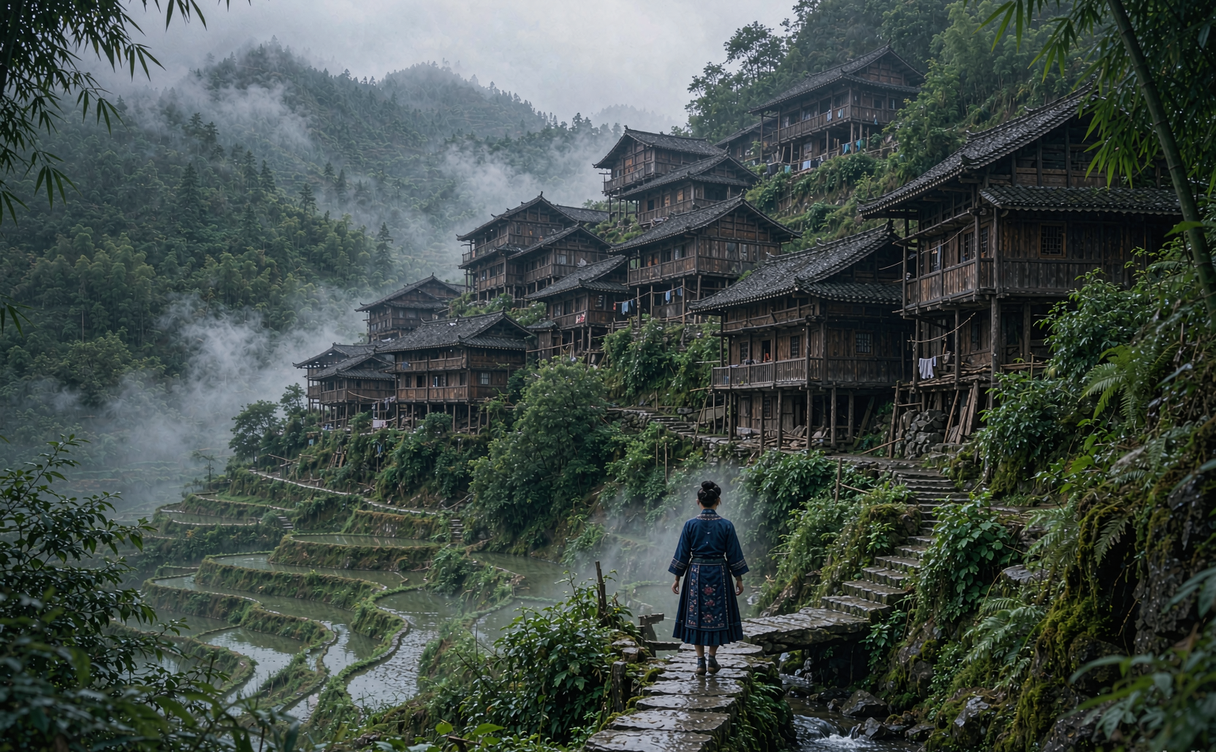
Guizhou is the province that rewards the traveller who came for landscape rather than nightlife. Guiyang is a handy 2 to 2.5 hours from Kunming by rail. From there: Libo for the Xiaoqikong karst water, Xijiang for the largest Miao minority village in China with a working silver workshop culture, and Anshun for the Huangguoshu waterfalls. Guizhou is also the cheapest of the four provinces to eat in, with a sour-fish sour soup you will either love or never order twice.
The karst here is serious enough to be on the world list, and UNESCO’s South China Karst inscription covers sites in Guizhou including Shibing. If you want the national picture of what to prioritise, our best things to do in China guide is a fair second opinion, but in Guizhou I would pick one water destination and one village rather than trying all three.
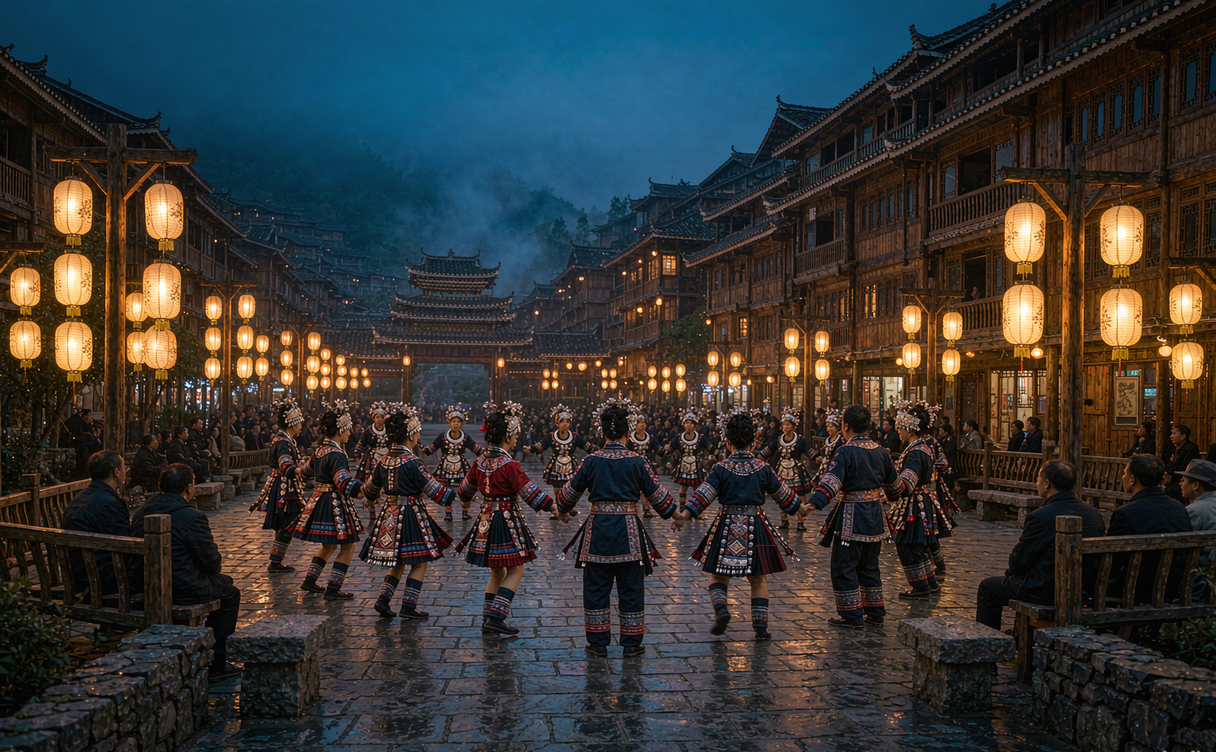
Give Libo a full day and Xijiang two. In Xijiang, walk uphill past the tourism strip to the upper terraces before 8am, when the women are washing and the buses have not arrived, and let someone in the square lace you into a silver bracelet for the price the workshop charges rather than the price the shop window quotes.
Guangxi: the karst you came for
Guilin and Yangshuo are the fourth corner, and the Li River cruise from Guilin to Yangshuo, about four hours, is the cliché that still delivers. Buy the cruise if you want to drift and look; take the bus or the high-speed train instead if you would rather cycle in Yangshuo and climb the limestone crags outside town. The Longji Rice Terraces, about two hours northeast of Guilin, are best in late May when they are flooded and mirror-flat, and again in late September when they turn gold. October is the compromise month when they are full and the weather holds.
A Southwest China itinerary that fits
Here is how to travel Southwest China in a form that survives contact with a real holiday. Twenty-one days, clockwise: three nights Chengdu with a panda morning plus one trip to Jiuzhaigou; two nights Kunming; three nights Dali; two nights Lijiang; two nights Shangri-La with a Napahai day; two nights Guiyang; two nights Xijiang or Libo; one night Guilin; three nights Yangshuo and Longji; out from Guilin. Cut it to fourteen by dropping Jiuzhaigou and Guangxi, which leaves a Yunnan-plus-Guizhou core that still reads as the best of Southwest China.
Where to sleep and what it costs
Inside the loop, stay in the old town or the station-adjacent district, never the industrial fringe. Hostels in Dali and Lijiang run RMB 60 to 110 a bed; mid-range doubles RMB 200 to 350; the plateau lodges in Shangri-La and the timber homestays in Xijiang cost similar. Expect RMB 250 to 400 a day outside the holiday weeks, counting a hotel room, three meals and one intercity leg. Our China travel guide for first timers covers the payment and SIM-card mechanics that catch people out; cash is nearly obsolete here.
Build your own Southwest China itinerary around one province per week. If you can only pick two, take Yunnan and Guizhou: the trains are short, the food is cheap and the landscapes are the least repetitive in China.
Mistakes worth avoiding
Do not book Jiuzhaigou on the same day you fly in. Do not plan a Lijiang-to-Shangri-La night bus after a long flight. Do not judge Guizhou by Guiyang, which is a grey commuter city with no reason to linger. Do not assume the whole region is cold in the evening; the plains of Guangxi are still warm in November while Lijiang needs a fleece. And do not believe a hotel listing that says “near the old town” without checking the distance on the map, which in Lijiang and Dali routinely means fifteen minutes of walking with luggage.
If you want the full Southwest China highlights list and nothing else, this loop is it. The southwest rewards patience more than any other region I have toured in China. Take the slow leg when the train is cancelled, eat the underseasoned broth without complaining, and the trip will give you the karst, the plateau and the best food in the country in roughly the same two weeks.
Start building your Southwest China itinerary now, one province per week, and book the Jiuzhaigou and Xijiang tickets the day they open. The best of Southwest China is very hard to reach on a grey Tuesday in February, which is exactly when nobody competes with you for it.