

Guilin sells the world a picture of karst peaks reflected in a river, and most visitors happily buy it. Ten hours of mountain road further west, the scenery changes completely: green-tiled drum towers standing in villages of timber stilt houses, covered wooden bridges arcing across ravines, and terraced hillsides cut by hand into the flanks of the hills. This Sanjiang Guangxi travel guide is for anyone who has finished the Li River and wants the other Guangxi — the one where the minority villages are still working places rather than restored film sets.
Sanjiang Dong Autonomous County sits in the north of Guangxi, under Liuzhou, and it is the largest home of the Dong people, sometimes written Kam, outside Guizhou. This Sanjiang travel guide is really about the Dong villages in Guangxi and the families who still live in them. The Dong have built wooden architecture without a single iron nail, and they have a tradition of unaccompanied group singing that UNESCO recognised as intangible heritage. Both of those are on display here.
Coming from the east or the coast? Our China travel guide for first-timers sorts out the pass, the payment apps and the train tickets before you commit to a village stay.
What the Dong Built, and Why It Matters
Wind-and-rain bridges (fengyu qiao) are the signature. They are covered passages built over streams and ravines, with tiered pavilion roofs stacked on top of the deck, so a whole village can cross a swollen torrent in a downpour without getting wet. The largest and most photographed is Chengyang Bridge, formally the Chengyang Yongji Bridge, completed in 1924 out of timber and stone by the whole community — no nails, no cement, and a construction method still taught to apprentices in the villages nearby.
Drum towers work differently. They are the assembly hall and the voice of the village: a multi-storey timber tower where the council meets, where funerals are organised and where the lusheng player sleeps during festival season. Villages without a drum tower are considered incomplete, and Sanjiang has dozens. The Chengyang cluster of eight villages holds several, and the long tables of a 合拢宴 — the communal feast where households join their benches into one — are laid in front of them.
Things to Do in Sanjiang
The things to do in Sanjiang all sit within about 30 km of one another, which is what makes a slow, listening pace possible here.
Start early at the Chengyang cluster of eight villages, about 20 km northeast of the county seat. The bridge is roughly a twenty-minute walk from the car park, and it is best in the hour after sunrise when the mist is still in the ravine and the only sound is the water. Walk across it slowly; you will pass villagers on bicycles and women washing at the far end.
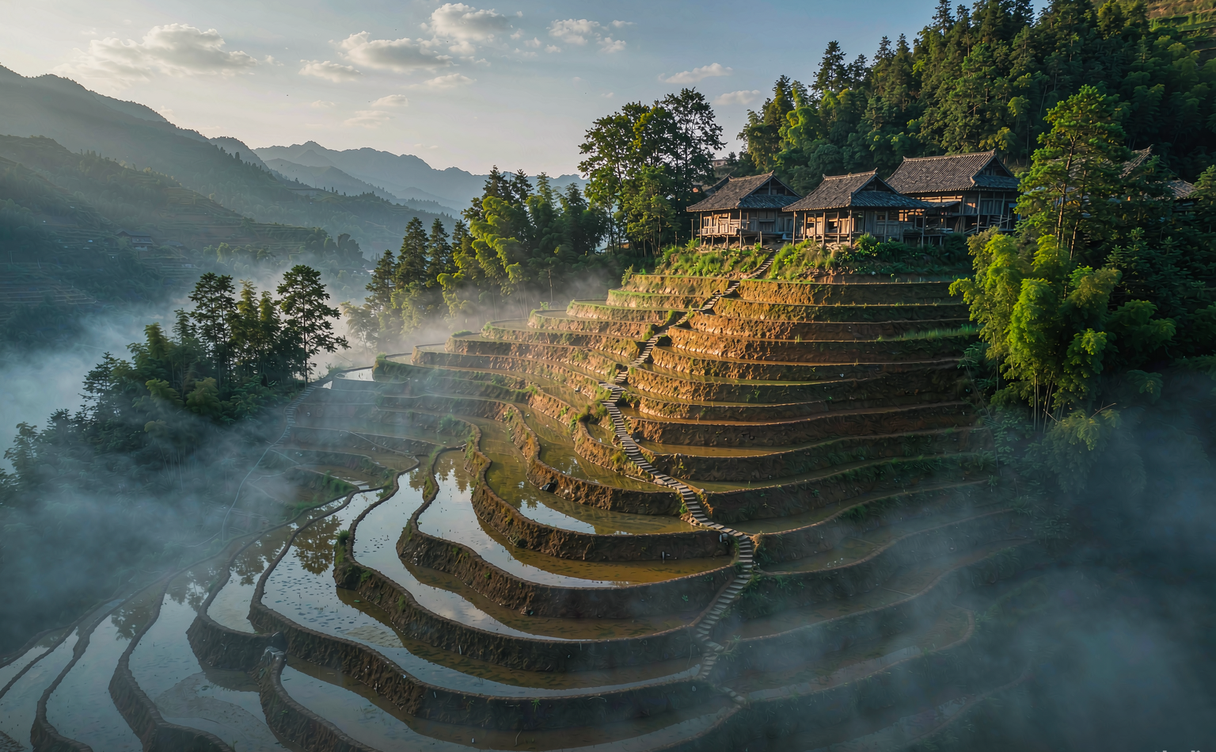
From the bridge, work inland through Ping’an and the neighbouring hamlets of the same cluster. What makes these places different from most restored old towns is that people are still living in the wooden houses — cooking in the front room, drying辣椒 on the balconies, keeping the ground store for pigs. Wooden stilt houses here rise on packed-earth piers, the upper floor of family life, with a covered walkway along the front so the dogs can pass without anyone opening a door.
Go up on the terraces above Ping’an at least once. The Sanjiang hillsides are cut into narrow ledges that hold water through the growing season, and in May they are full of transplanting children and water, in July solid green, in late September gold. If you have seen Longji, this is quieter and less polished.
How to Get to Sanjiang
The honest answer to how to get to Sanjiang is the train. Sanjiang station on the Guiyang–Guilin high-speed line takes you from Guilin North in about 75 minutes (fares around ¥65–95 second class), from Guangzhou South in roughly 2.5 to 3 hours, and it sits about 7 km from the county town — a taxi or ride-hail for ¥20–35, or the cheap local bus if you can read the destination board. If booking a seat is new to you, our guide to riding China’s high-speed covers machine collection with a passport and the tricks for avoiding standing room in holiday weeks.
By road from Liuzhou takes about two hours over the branches to the county seat; from Guilin, allow four to five hours because much of it is winding mountain road. Many visitors fly into Guilin and then train in. Note that Guilin airport transfers may require documents most foreign tourists don’t carry — check our best time to visit China for seasonal closure warnings on the small mountain roads in winter.
Two nights in the villages is the minimum I would suggest. One night gives you a bridge and a dark; two nights gives you the evening where the grand song gets sung and the oil tea gets poured.
Best Time to Visit Sanjiang
The best time to visit Sanjiang is April, May and October. April and May bring the terraces full of water and transplanting activity, warmer rain that fills the ravines and makes the wind-and-rain bridges genuinely useful rather than photogenic. October gives you the golden harvest and comfortable walking weather; it is also the busiest, so book a village room early.
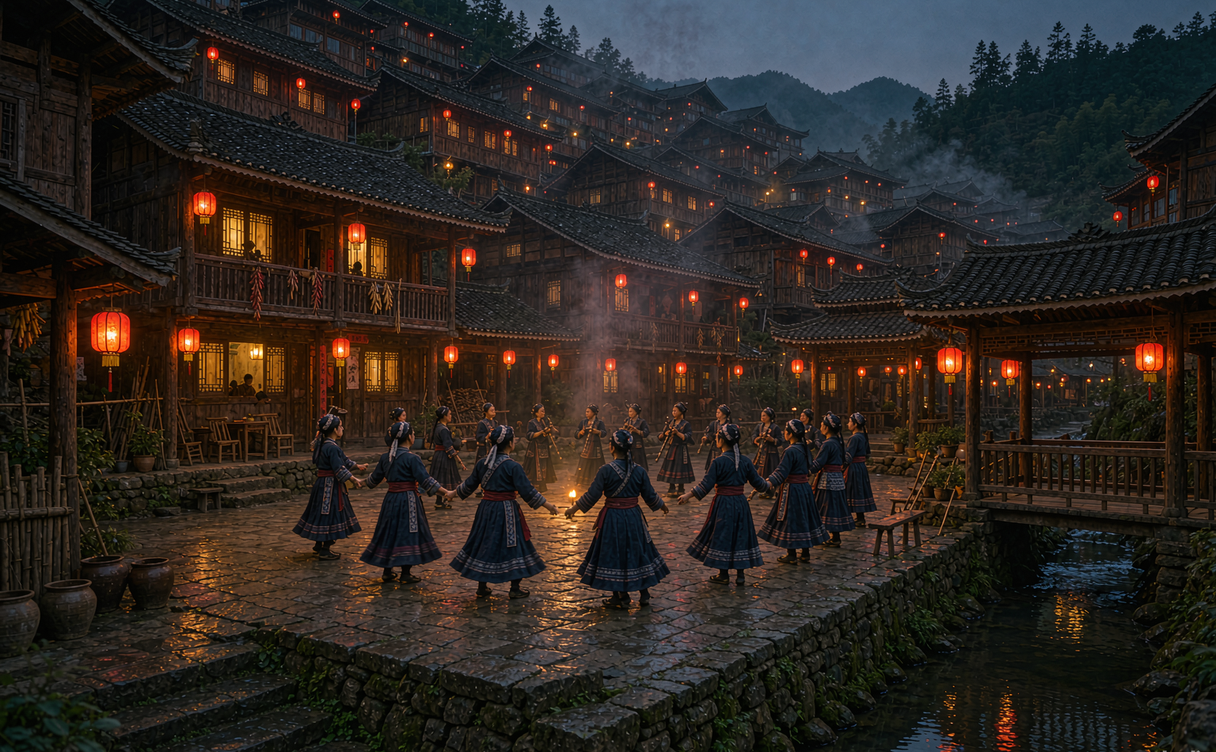
Don’t dismiss the colder months. From December to February the Dong villages thicken with smoke, families gather round the hearths, and the lusheng season begins — the 芦笙节 weeks around the lunar new year bring brass and reed pipes into every square and the whole village dances in a ring. You will be cold and you will have the place almost to yourself.
Festival dates follow the lunar calendar and shift every year, so confirm the exact dates locally before you build a trip around one. The grand song ( Dong dam) is performed at weekends in several villages, and it is absolutely worth arranging through your guesthouse rather than hoping to catch it.
Eating in the Dong Villages
Dong food is unlike the Cantonese food most foreign visitors expect from Guangxi. The centre of the table is often 油茶, a savoury beaten tea — rice, tea leaves and sesame pounded together and poured hot, served with fried pork and puffed grains. It looks like a mistake and it is excellent. Then come the ferments: 侗族腌鱼, rice-wrapped fish buried and aged for months, served steamed with chilli; 腌肉, the sour cured pork; and 糯米饭, sticky rice steamed in bamboo and eaten by hand.
The 合拢宴 is the one to aim for. Several households join their long tables into one long meal, and guests are seated by age and gender with the elders at the head. A spread like this comes to roughly ¥60–120 a head depending on how much fish and how much liquor, and you should drink the rice wine the way your neighbour does or you will be carried to your bed by the fourth round.
Where to Stay
Stay inside the village. Past the bridge at Chengyang and up at Ping’an there are guesthouses converted from the old stilt houses, with timber floors, a tiled roof and rooms from ¥120 to ¥300 in season, cheaper in winter. Ask for a room on the upper floor facing the valley, and expect to hear the rooster and the dogs at dawn.
What you gain is the evening. At dusk the visitor buses leave, the village returns to being a village, and if you are lucky and your host is connected to the right people, the grand song gets sung in the drum tower square — a wall of unaccompanied voices, men’s parts low and interlocking, the high octave brought by the women. UNESCO lists the Dong grand song on its representative list, and it explains why the repertoire was never written down; the UNESCO record for the Dong grand song is the clearest short account.
A Sanjiang Itinerary Worth Copying
The only Sanjiang itinerary worth copying has two nights in a village and nothing in the county town. Day one: train in, taxi out to the Chengyang villages in the late afternoon, walk the bridge, watch the sunset from the terraces, sleep in a stilt house. Day two: dawn on the bridge, terraces after breakfast, drum towers and the market in the county seat in the afternoon, a 合拢宴 at night if one is on. Day three: drive out to the more remote 林溪 drum towers and catch a train from Sanjiang station in the evening.
If you are routing through the north of the region, a Guilin travel guide will help you plan the karst leg, and the food sections in our Guangxi cuisine guide and Guilin food guide will prepare your palate for the fermented and sticky-rice side of this corner of China.
Sanjiang Traps to Avoid
The big one is treating Sanjiang as a day trip from Guilin. It is a long run each way and you will see a bridge and leave unfulfilled. Second: photographing people without asking, which is rude anywhere and genuinely resented in the smaller hamlets. Third, and this catches people out, is the ticket — the Chengyang cluster runs a combined entry around ¥60–90 per person, drum-tower climbs are small extras, and tickets get repriced, so treat my numbers as a guide rather than a promise.
This Sanjiang travel guide will not fix that for you, but it will point you at the Dong villages in Guangxi that still want visitors. Walk the bridge in the early morning, eat oil tea at least once even if the idea repels you, and get up on the terraces before breakfast. Best time to visit Sanjiang if you want the villages quiet rather than the weather perfect is midweek in May or October, and yes, that is also the best time to avoid the coach parties. Sanjiang, Guangxi is not the postcard version of this province, and that is exactly the point.
Book the village room first and build the rest around it — train in from Guilin or Guangzhou, two nights in a stilt house, and one long table at the end of it.