

Most visitors to China eat in Beijing. Then they cross one provincial border — fifty kilometres, a single train ride — and find that the kitchen next door has been quietly better for a century. Hebei wraps around the capital on three sides, and its cooking shares the northern backbone of Beijing food while going its own way. It is heavier on wheat, less precious about oil, and far more relaxed than Sichuan or Hunan about what a long braise can do. This Hebei cuisine guide is what we hand to readers who want the north China flavors that actually feed the capital’s own working days, not the dishes that photograph well for a brochure.
The trouble is that Hebei never advertised. There is no single dish the province claims the way Sichuan claims mapo tofu. Instead you get a scatter of local specialties — a braised chicken in Shijiazhuang, a donkey burger in Cangzhou, a plate of river fish in Baiyangdian — each defended tooth and nail by its own town.
Why Hebei cuisine gets overlooked
Hebei is one of China’s most populous provinces and one of its least photographed. It has mountains, a stretch of coastline on the Bohai Sea, the Baiyangdian lakes Beijing draws from, and the Great Wall at Shanhaiguan. Except for Chengde’s summer palaces, almost none of it reaches foreign itineraries. Foreigners fly into Beijing, see the Forbidden City, and leave.
The food suffers the same fate. Beijing’s restaurants are full of Hebei cooks and the capital’s 涮羊肉 and 卤煮 lineage runs straight through this province’s kitchens — but visitors credit the city, not the source. We have taken groups to Shijiazhuang in November and watched them abandon their hotel meal plan by the second night, purely because a ¥12 griddle bun next to the cabbage seller beat anything on the room-service menu.
What Hebei provincial cuisine actually tastes like
At its centre, Hebei provincial cuisine is a wheat cuisine; rice is the guest, not the host. Flavour runs savoury and slightly sweet rather than fiery, with soy sauce, star anise, and a willingness to deep-fry first and braise second. Where Sichuan builds a dish from chilies, Hebei builds it from texture — soft braised meat against crisp fried bread.
Two techniques define it. 扒 (braise-in-the-pot) produces the glossy banquet plates, above all 金毛狮子鱼 (Golden Lioness Fish, a fried carp in sweet-sour caramel glaze) and 万字扣肉 (Wanzi pork belly, tied with string and steamed until it collapses). The second is 驴肉 (donkey), slow-cooked with heavy spice — not a curiosity but the province’s signature protein.
The encyclopaedia entry on Hebei gives the geography behind the food: loess plains, the Yan and Taihang mountains, and a coastline that puts seafood within reach of almost every town.
Best Hebei dishes to order, and what they cost
If you only eat five things, make them these. We priced them from stalls and mid-range restaurants in 2025 and 2026; the spread is real, because a ¥8 street version and a ¥45 restaurant version of the same dish are genuinely different objects.
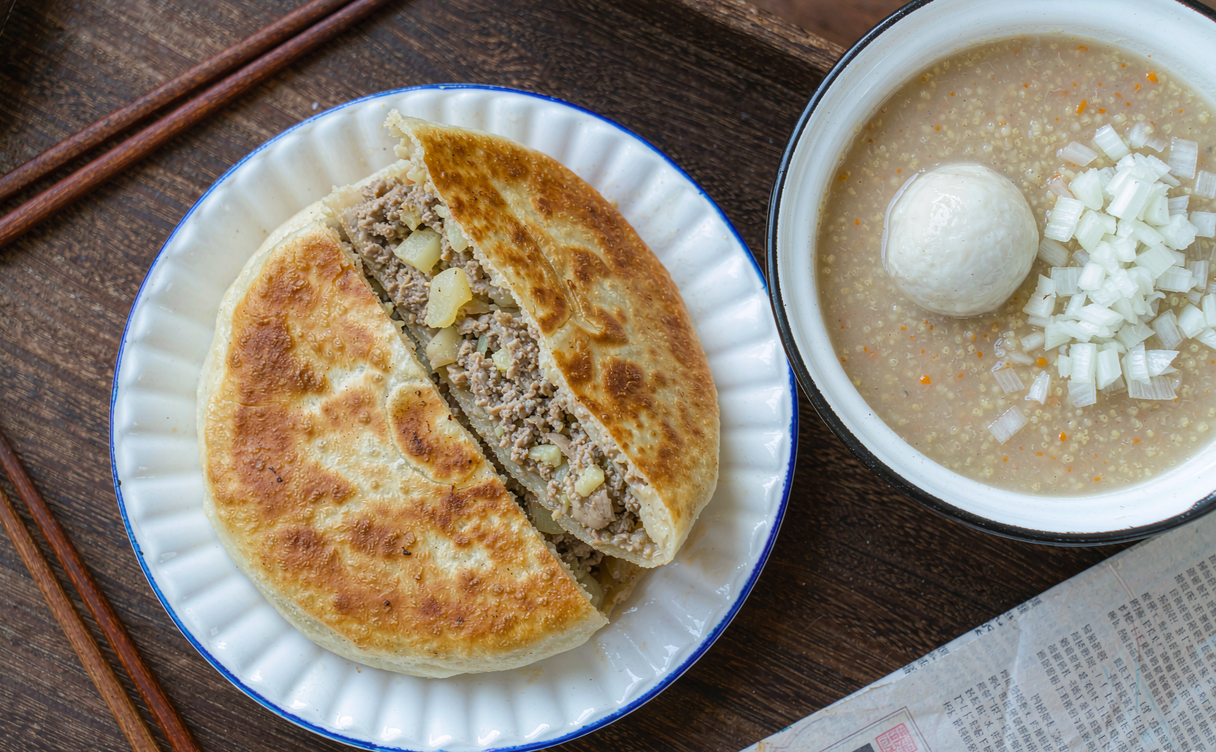
驴肉火烧 (donkey burger, Rùròu huǒshāo). The single best argument for Hebei cooking: shredded donkey meat stewed with star anise and chili, chopped into a round of crisp layered wheat bread baked against the wall of a clay oven. A half costs ¥8–12, a whole ¥12–16. Baoding and Cangzhou both claim it; Cangzhou’s 河间 version is the one we send people to, because the bread is thinner and shatters better.
金凤扒鸡 (Jinfeng braised chicken). Shijiazhuang’s famous dish: a whole chicken brushed with malt sugar, fried, then braised in soy and spice until the meat slides off the bone. Order a half (¥22–30) to share. Eat it cold with pickled mustard root and a beer.
白洋淀炖杂鱼 (Baiyangdian braised mixed fish). From the lake district in the east, a cast-iron pot of whatever freshwater fish the boat brought back, stewed with bean paste, scallion, and a fistful of corn bread crumbled into the sauce. A large pot is ¥90–140 and feeds four.
唐山饹馇 (Tangshan fried cake, Gèzha). A thin batter of mung bean and starch, fried until lacy and served with garlic vinegar sauce. Vegetarian, ¥15–25, and completely unknown outside the region.
承德羊汤 (Chengde lamb soup). River lamb boiled hard with cumin and pepper, served with a spoonful of its own floating fat and dry steamed bread to dip. ¥15–25. Worth the detour if you are already up in the mountains.
Things to eat in Hebei beyond the headline list
Once the famous five are done, readers who come back chase the small stuff. 缸炉烧饼 (crock-oven sesame bun, ¥2–4) is the bread of the north China plain: a thin disc baked on the oven floor, brittle, smelling of toasted sesame before you turn the corner. 藁城宫面 (Goubiao palace noodles) is a fine hand-pulled thread noodle in clear broth with lard and chive oil. In Handan, 二毛烧鸡 is a smoky braised chicken sold by the quarter. In Qinhuangdao the province turns into a seafood town — steamed crabs run ¥60–90 per jin — and the 四条包子 bakery near the old port makes a leavened pork bun that has fed ship crews since the 1890s.
North China runs on breakfast: 小米粥 (millet porridge, ¥4–8), 豆腐脑 (silken tofu custard in broth, ¥6–10), 油条 (fried dough sticks, ¥2–3 a pair), 茶鸡蛋 (tea eggs, ¥2–3). None of it photographs, and all of it is how a province of seventy-five million people starts a day. We eat it standing up and recommend it.
Where to eat in Shijiazhuang: streets, alleys and night markets
Shijiazhuang is the obvious base: an hour from Beijing by train, and a real working city with a real restaurant scene rather than a tourist town pretending to have one.
Start at the 裕华路 night market south of the old city, where griddles run until midnight and a feed for two costs ¥60–90. Then walk the side alleys off 中山路 for 金凤扒鸡 shops, where the oldest keep a counter of cold braised chicken and cut it on the spot. For donkey burgers, head north toward 运河桥 instead of the tourist centre — locals queue at the small shops, and the queue is always the right signal.
Eat one meal where the queue forms, not where the menu has English on it — in Shijiazhuang the queue is a reliable five-minute walk from the best donkey burger in the province, and it costs less than a hotel cocktail.
We also send people to 正定 (Zhengding), thirty minutes north by road, for two reasons: the Ming-dynasty temples on 隆兴寺, and a cluster of old noodle and braised-pot shops that almost nothing in English describes. A bowl of 正定 牛肉面 there is ¥14–20 with a trolley of cold sides.
Ordering in Chinese: our practical cheat sheet
English menus in Hebei are rare outside the top hotels, so our readers need three phrases.
Learn 来半份 (lái bànfèn — “half portion, please”). Hebei portions are large and shared; ordering four full dishes for two is the most common mistake we see. Learn 微辣 (wēi là, “barely spicy”) and 不要香菜 (búyào xiāngcài, “no coriander”); 不辣 (bù là) means no spice at all. Staff will repeat your order back to you, so match their tone and it goes fine.
Tea is free and the water is hot. Sit down, point at what the table opposite is eating, and say 这个 (zhège, “this one”). That one word, aimed at a neighbour’s plate, has rescued many a dinner.
Pairing a Hebei food trip with Beijing
The logic is simple, and we have used it on a dozen trips: one day in Beijing for the history, two or three in Hebei around it, because the rail is fast and the cooking is cheaper. The cleanest loop is Beijing → Shijiazhuang (1h by high-speed rail, ¥55–90) → Baoding for donkey burgers (40 minutes more) → back through Beijing. Add Chengde for the summer palaces and 羊汤 if you want mountains; add Qinhuangdao if you want the sea. Our China high-speed train guide for foreigners covers ticketing and gate checks.
[IMAGE: A lazy Susan of Hebei dishes — braised fish, donkey burger and millet porridge — on a round table | alt=”Hebei dishes table braised fish donkey burger millet porridge”]
If food is the point, our China food tour guide charts the provinces by what they do best, and Hebei sits next to the capital’s own street traditions in it. Our Beijing food guide lets you compare the two kitchens side by side; our honest verdict is that Beijing is more polished and Hebei is more honest.
Getting around, and what a day costs
Trains: Beijing West and Beijing Station both run to Shijiazhuang frequently, ¥55–90 second class. Baoding is faster and closer (about 40 minutes). Handan is two hours south, Chengde two hours north, Qinhuangdao three. We skip the buses except for Zhengding and Cangzhou, where the road trip is short.
Budget per person per day, from our notes: breakfast ¥12–20, street lunch ¥20–35, a shared dinner with one beer ¥70–120 for two, a mid-range room ¥260–450 in Shijiazhuang, ¥180–300 in Baoding. Alipay or WeChat Pay is universal, but we carry a few hundred yuan in notes for the griddle stalls that accept cash only.
Give Hebei three days rather than one — the province is a short train hop from Beijing but the best dishes are scattered across four or five different towns, and trying to fit them into a day means eating in a station.
Practical notes we learned the hard way
Winter is the underrated season. From December to February the north China plain is dry, cold, and full of hot-pot and lamb-soup kitchens doing their best work. Summer is hot and humid with real thunderstorms in July and August, and the national holidays in early October and early May are the worst times to book a table — we have waited forty minutes for a griddle bun on 1 October.
Bring small notes for the market stalls, carry your own bottle (public taps are not for drinking), and learn 打包 (dǎbāo — “wrap it up”); Hebei portions are generous and the box is free. For the wider picture on when to come, our Shijiazhuang travel guide covers the provincial capital in more depth than this Hebei food guide can.
Final thoughts
Hebei is the province neighbouring your postcard. It fed Beijing for six hundred years, it has the best donkey meat in China, and it will charge you ¥12 for a bun a Michelin guide would put on a cover. We keep sending readers here because leaving the capital behind rewards you with a plain, unembarrassed cooking that almost nobody writes about.
Start with a half portion, a bowl of millet porridge, and the shortest train ride in China — Hebei rewards the traveller who treats it as a province rather than a suburb.