

Yuyao sits in the shadow of two famous neighbours and quietly outranks both of them for the first morning of any trip. A county-level city administered by Ningbo, it spreads along the south bank of the Yao River, roughly 30 km upriver from the port and about 130 km down the Hangzhou–Ningbo corridor from the provincial capital. Inside 1,400 square kilometres it holds a Neolithic rice village that rewrote Chinese prehistory, the kilns that dressed the Tang court in celadon, and a rim of hills thick with bayberry trees that ripen inside a three-week window each June. This Yuyao travel guide is built for travellers who want the archaeology and the fruit in one itinerary.
Arriving in Yuyao: Two Stations, One Expressway
Yuyao has two rail heads. Yuyao North (Yuyebei) sits on the Hangzhou–Ningbo high-speed line, open since 2013; the older Yuyao station on the Xiaoyong conventional line sits closer to the old town. From Hangzhou East, the fast train takes a little over an hour and costs around ¥70 second class. From Ningbo it is 20 to 30 minutes and barely ¥20. Both stations are served by county buses and ride-hailing, and the run into the centre runs 20 to 30 minutes either way. If you would rather use Hangzhou as your base city, the Hangzhou travel guide covers the eastern termini and how to chain a day trip off them.
Driving is equally simple. The G92 Hangzhou–Ningbo expressway skirts the eastern edge of town, and the approach from the north comes around the head of Hangzhou Bay rather than across the water on the bridge. Ningbo is 40 minutes away, Hangzhou about 90, Shanghai roughly four with a change at Hangzhou. Long-distance coaches from Ningbo’s south bus station take about an hour for ¥15 and drop you nearer the river than the train does.
Hemudu Ancient Village Yuyao: Seven Thousand Years of Rice
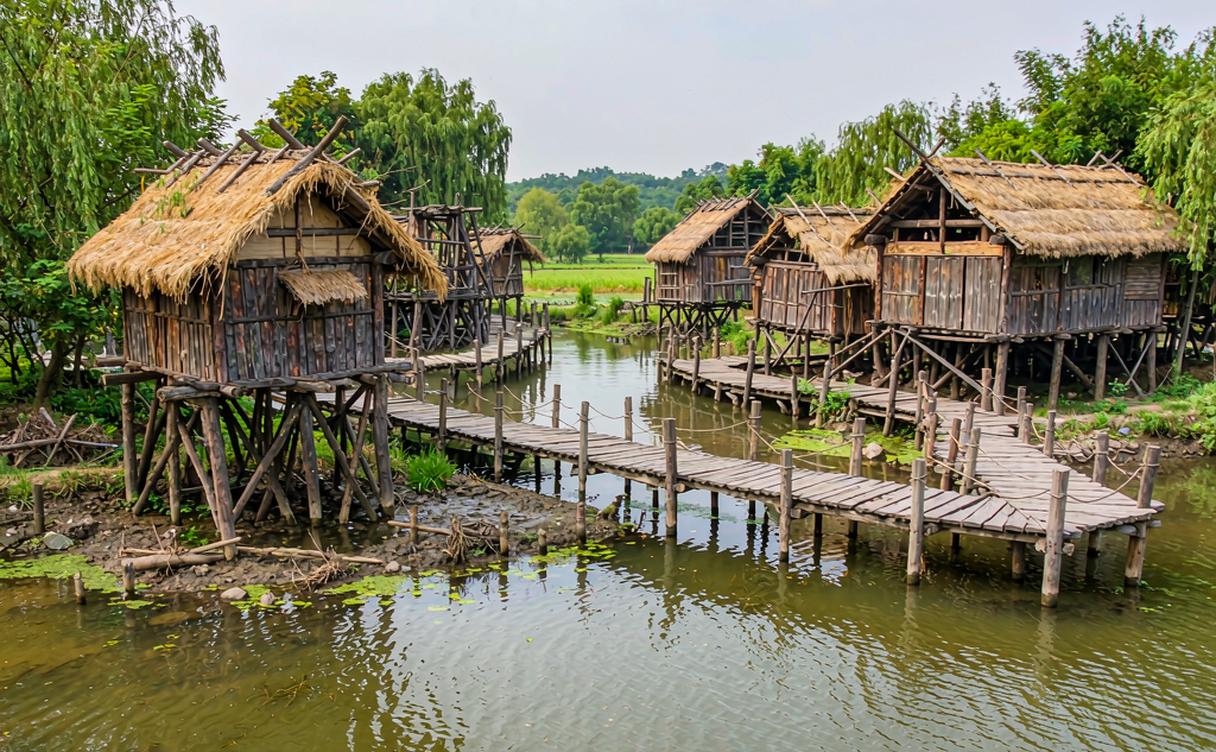
Twenty kilometres southeast of the centre, at Luoshan in Hemudu town, farmers draining a marsh in 1973 struck a deposit that turned out to be one of the richest Neolithic sites in the world. Excavation across four seasons exposed something like 4,000 square metres of a settlement occupied between roughly 5000 and 3300 BC — the Hemudu culture, named for this spot, whose lowest layers are about 7,000 years old.
The finds are unusually tactile. Whole bands of rice chaff and straw, a metre deep, prove wet-rice farming on an industrial scale for the era. Hundreds of polished bone spades, lashed to wooden handles, were the hoes of those harvests. Shark teeth and whale ribs came out beside the hearths, which is how we know the sea was at this village’s door. Two objects draw the crowds: an ivory panel carved with two birds facing a sun, and a wooden bowl coated in raw lacquer, the oldest lacquered wood yet found in China. The timbers carry the earliest mortise-and-tenon joints known here, and the houses stood on stilts over the wetland, the longest beam more than 70 metres. Near the middle sits a log-lined well, arguably China’s earliest.
The Hemudu Site Museum climbs the ridge above the pit — four halls, a ramp down to the standing remains, about an hour’s visit and a fee of roughly ¥25. The whole complex was listed a National Key Cultural Relics Protection Unit in 1982. For the stratigraphy and the full find list in one place, the English reference entry on Hemudu is the most complete public summary.
If the Neolithic is the deep past, Ningbo is the working present, and the two make a natural pair. Begin with the Ningbo travel guide to stake out the museum quarter and the arcade streets, then take the train back west for the hills. Most Yuyao itineraries travel better as one quiet day in the country plus a base in the city — the China off-the-beaten-path guide shows how to split the week.
Yue Ware Celadon Kiln Site Yuyao at Shanglin Lake
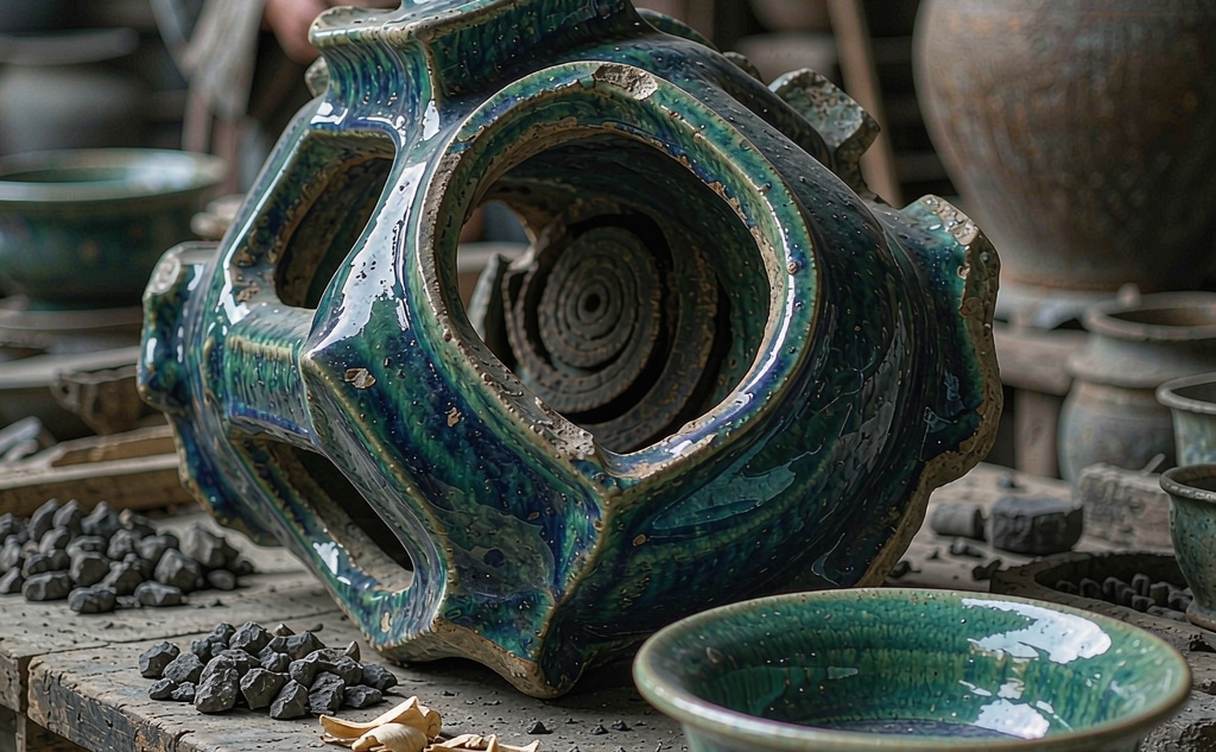
North of the city, where the ground flattens toward neighbouring Cixi, Shanglin Lake banks hold more than a hundred kiln mounds — the Yue ware celadon kiln site Yuyao belongs to the oldest continuous kiln tradition in China, firing from the late Neolithic into the Song and sending tribute porcelain up to the Tang capital. When Lu Yu ranked ceramics, this ware came first. The Tang poet Lu Guimeng caught the colour in two lines: in the ninth month’s wind and dew the Yue kilns open and take away the green of a thousand peaks.
The kiln field received national protection in 2006. The lakeshore now carries a low-built museum, a reconstructed firing chamber and long views across the water; the site is open, cheap, and almost always empty on weekday mornings. Nothing on the protected ground is a workshop, but a handful of potters still fire wood-bodied celadon in the old recipe in the low hills north of the reservation, and the museum desk will point you to the nearest one. Plan half a day, then take the road back south through the 丈亭 market, where the crates on the ground floor are often full of the same clay.
Yuyao Bayberry Season June: Picking Above the Plum Rain
Nothing about Yuyao fixes a date like the fruit. The Yuyao bayberry season June opens around the second week of the month, hits full colour between the 15th and the 28th, and is over by the first week of July. The variety that matters is the 荸荠种, dark as a mulberry and sweet without the sour kick of the red berries sold in city supermarkets; a few hillside growers still graft a pale white fruit.
The trees climb the lower Siming ranges — Dalan and Zhangshui townships between 200 and 700 metres — and the altitude buys two things. Fruit ripens later up the slope, which stretches the season by about a week, and the berries come in thicker-skinned, more aromatic and sweeter. Growers open the slopes to visitors for a picking fee of ¥30 to ¥60, with fruit at ¥15 to ¥30 a jin. Go before 9 am to stay ahead of the coaches and the wasps. Long sleeves, a hat and shoes with grip do more for the day than any umbrella, and rinse the berries rather than soaking them. Whatever you do not eat goes into bayberry wine, which locals drink cold in the afternoon on the terrace.
Two days is the honest minimum here and three is better: Hemudu, Shanglin Lake, a bayberry slope, then the mountains. Break the best things to do in China week into a delta run of Ningbo, Yuyao and the water towns to the west, and the hills stop feeling like a detour. The China off-the-beaten-path guide already routes the quieter half.
The Yao River, Siming Mountains and the Old Town
The Yao River threads the town from west to east and meets the Yong at Ningbo, which is why the old centre grew around its banks rather than behind walls. A riverside greenway now runs for kilometres on the north quay, flat enough to cycle and shaded by old 樟 trees; this is the part of things to do in Yuyao that locals actually use, and it takes an evening. Inland, the old town keeps a cluster of low courtyards that are a scaled-down preview of the traditions mapped in our China classical gardens guide, and the house where the philosopher Wang Yangming was born is maintained near 瑞云楼 in the northern district.
Southwest of town the Siming Mountains rise past 800 metres, with 四明湖 reservoir filling the valley below. The range holds two good days: a forest-park loop of fir and bamboo with mist in the mornings, and 丹山赤水 in Dalan, a gorge with a waterfall and a late-autumn persimmon harvest that sets the hillsides orange in the last weeks of October. Villages here rent rooms at 200 to 500 a night, and the road from the reservoir up to the pass is the best driving in the county.
When to Go: The Best Time to Visit Yuyao
Late June is the reason most people come, but it coincides with the plum rain, so carry a light rain shell and expect two wet afternoons. Late March to early April fills the Siming terraces with rapeseed flower and draws crowds that thin out by the second week. The best time to visit Yuyao for walking is September and October, when the hills cool, the water in 四明湖 drops and the persimmon hangs. Winter is damp and grey but the museum is empty and the bayberry bars are quiet. Skip 1–7 October and Chinese New Year if you want a parking space at Hemudu.
Budget, Miles and Where to Stay
A night in the county seat runs ¥180–320 for a mid-range hotel, ¥300–500 in a Siming mountain room with a view. Plan ¥220–400 a day per person outside peak season: ¥25 for Hemudu, ¥20–30 for the Shanglin Lake museum, ¥50–90 for a picking slot, ¥40–80 for a bowl of river shrimp and 杨梅 at a small restaurant, ¥15–25 for county buses. Distances from the centre: Hemudu 20 km, Shanglin Lake 25 km north, Dalan 60 km southwest, Ningbo 30 km, Hangzhou 130 km. A taxi across town is ¥15–25; the county buses reach every site in the list above for a few yuan, though the Dalan slopes are quicker in a chartered car at ¥250–350 for the day.
Finish the loop in Shaoxing, an hour down the same rail line and a different century of water towns and tea houses. The Shaoxing travel guide pairs cleanly with this one, and Hangzhou closes the circle northward if you are flying out of Xiaoshan.