

In 208, a fleet of chained warships burned on a bend of the Yangtze and the balance of a continent shifted. Chibi is the Hubei town that sells itself on that moment, and it turns out the place earns the claim: a rust-red cliff ridge above a broad river, a working museum, a tea town that supplied the caravans, and almost none of the crowds that hit the imperial capitals. This Chibi travel guide covers how to get here from Wuhan, what the battlefield park is really like, when the Yangtze views are best, and how to fit the brick tea towns into the same trip.
Chibi is a county level city under Xianning, sitting about 130 kilometres southwest of Wuhan on the south bank of the Yangtze. Foreigners rarely list it, which means a mid autumn afternoon on the cliff path can be entirely empty. The practicalities matter more than usual here, because distances, ticket offices and boats all close early in this part of Hubei.
[CTA] If Wuhan is your base, work out the onward train before you leave the city — read our Wuhan travel guide and we will map Chibi onto the days you already have.
Weekend timetables in Hubei thin out sharply on Friday evenings, so check the return too.
[/CTA]
The Red Cliff Ridge and the Ancient Battlefield
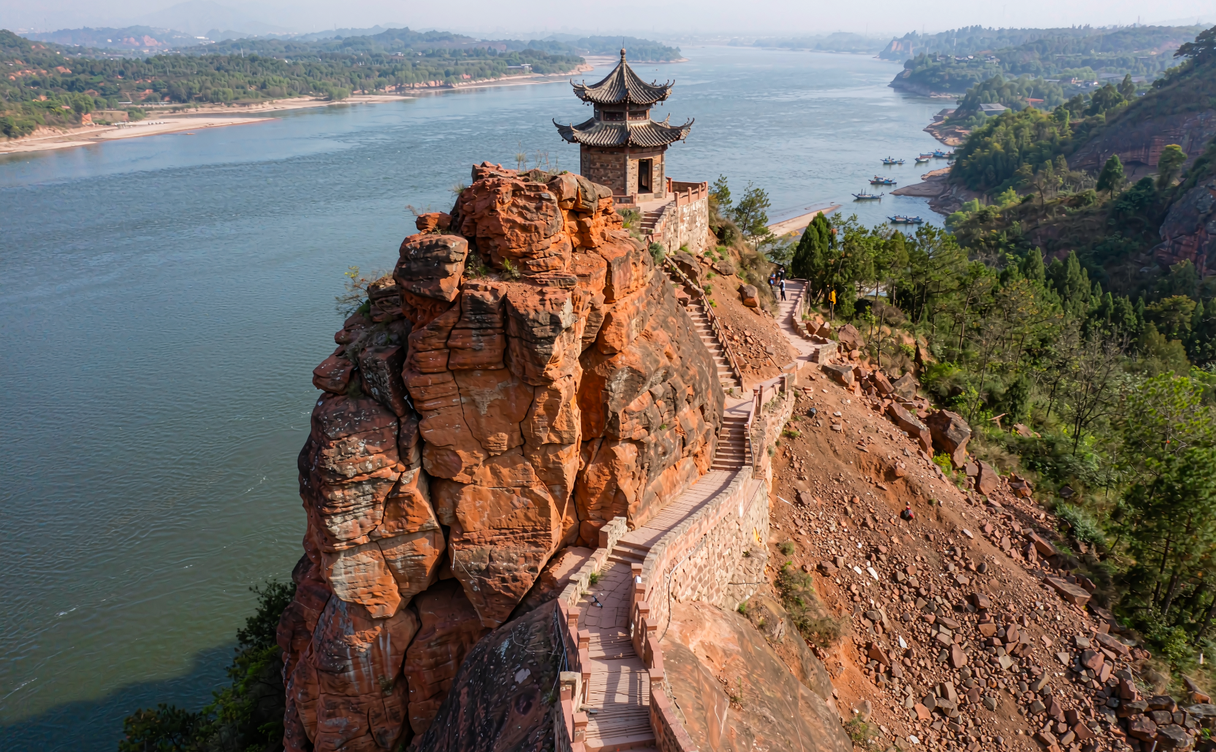
The main scenic area pairs a climb up Red Cliff Hill, the low ridge the town is named for, with a reconstructed camp below it. At the bottom, a stone path leads to the famous two character cliff inscription carved into the rock face; it is smaller and more ordinary than the photographs suggest, and that is the point — you are standing under the same wall the poets described for a thousand years. Above it, the pavilions give you the view that explains the tactics: a wide bend, a hard north wind, and a downriver position that decided the engagement.
Walk the ridge from the south gate to the river viewpoint, then come back down through the camp area with its replica barracks, fleet lines and cannon. Allow two to three hours. The path is stepped and shady in places, mostly paved, and manageable in ordinary shoes.
The Chibi Battle of Red Cliffs Museum, and Why to Do It First
The Chibi Battle of Red Cliffs museum sits near the park entrance and does the job most battlefield sites skip: it tells you who was who. Cao Cao’s side is presented with ambition and logistics rather than the cartoon villainy that later novels added, and the allied command of Sun Quan and Liu Bei gets an honest share of the exhibits.
Go through the museum before you climb. Half an hour to an hour is enough, and the relief model of the river bend is the single best object in the building — it shows why a fire ship attack down the wind worked on the night it did. Without that model the pavilion viewpoints are just nice views.
Yangloudong and the Brick Tea Road
Twenty minutes northeast of the battlefield lies Yangloudong, a market town that grew on tea and is now the quietest interesting place in the district. This is the origin point of the Hubei green brick tea that travelled the caravan road north into the interior, and the old street still has its stone slab paving, the god houses, and the slowly collapsing courtyards where tea was pressed and dried.
The surrounding hills are tea terraces, and in April the rows are sharp and new green against the bare plum trees. Most visitors buy a flat brick of pressed tea at one of the workshops and are shown the steaming, pressing and drying rooms. Ask for the smokier cooked style if you want what the caravans actually carried; the fresher version is milder and easier for someone used to green tea.
[CTA] Two food and one tea stop makes the day. Tell us your month and we will include the tea terrace walk, the Yangloudong street and the cliff climb in a single sensible order.
The tea works open early and close for lunch, so the workshop goes first or not at all.
[/CTA]
Lushui Lake and the Things to Do in Chibi Along the River
Chibi also holds Lushui Lake, a broad reservoir inland with wooded islands and boat taxis. It is the local swimming, fishing and boating water, and it is where the weekend crowd goes, which is a different crowd from the battlefield visitors. A morning on the lake costs around 60 to 150 RMB for a hire boat or an organised cruise, and the islands are close enough to swim stops to make it feel like a bigger lake than it is.
For the river itself, the safest Chibi Yangtze riverside viewpoints are the terrace below the cliff path and the levee walk to the west of town, where the traffic is light and the width of the water is the whole show. Freighters still run the channel on the same line the fleets took.
How to Get to Chibi from Wuhan
How to get to Chibi from Wuhan is straightforward by rail. Trains run roughly hourly from Wuhan station and Wuhan South to Chibi North, about an hour to an hour and twenty on the slower services, with the fare in the region of 40 to 70 RMB. From Wuhan’s south side the trip is shorter; from the city centre allow extra time for the metro leg to the station.
If you are continuing west, the same line connects onward toward Yichang and the Three Gorges Dam, which makes a tidy two stop route. Coming from the east or from Shanghai, the China high speed rail guide for foreigners covers ticket machines, passport gates and how to find your platform in a station this size. The Xianning end of the line has its own useful notes in the Xianning travel guide.
Best Time to Visit Chibi
The best time to visit Chibi is April and May, or the second half of September into November. Spring gives you tea on the terraces and warm evenings on the levee; autumn gives you clear visibility across the river, which is the difference between a hazy grey band of water and a landscape you can photograph.
July and August in this stretch of Hubei are genuinely oppressive, and the cliff path has little shade at the top. Winter brings mist on the Yangtze that is atmospheric to the point of being worth the cold, but the boats run fewer services. If your dates are fixed in summer, start at seven in the morning.
Eating, Sleeping and the Mistakes
Eat river fish — the Yangtze catfish and the lake whitebait are on most menus — plus lotus root soup, Hubei style rice noodles, and the smoked local ham. The tea is worth drinking here rather than buying a brick of it to take home unless you actually want it.
Stay in Chibi proper rather than out at the scenic area; mid range rooms run about 150 to 280 RMB and the town has more consistent food than the park gates. Two nights covers the cliff, the museum, Yangloudong and a lake morning. Three nights lets you add the levee walk, the tea workshop properly, and a train west.
Two practical warnings. Buy your battlefield ticket at the gate with cash or mobile pay as available, and keep your passport with you because Hubei checkpoints on the smaller lines can ask for it. And do not try to fit the cliff, the lake and Yangloudong into one afternoon — the park alone closes early, roughly around five in low season, and the last bus back is earlier than you expect.
[CTA] Chibi rewards a slow day more than a full one. Send us your arrival city and we will build the route from the museum through the ridge to the levee, train times included.
If it does not fit your schedule we will tell you, rather than pad the itinerary out.
[/CTA]
If the Yangtze is the theme of your trip, the Yangtze River cruise guide shows how this stretch reads from the water, and the best things to do in China list is a good sanity check before you cut this stop. For background on the region, the Lonely Planet Hubei province guide is worth an hour with before you leave.