

Most travelers who think about the Liaodong Peninsula head straight for Dalian’s promenades or Dandong’s border views, and they skip the stretch of coast in between. That is a mistake, because Yingkou — a prefecture at the northern lip of the Bohai Sea — pairs long sandy beaches with some of the freshest, cheapest seafood in Northeast China. Our clients who come for a summer beach weekend or a hot-spring reset almost always leave surprised by how relaxed and un tourist-trapped it feels. This Yingkou travel guide covers the beaches, the seafood, the hot springs, and exactly how to fit the city into a Liaoning coastal trip.
Where Yingkou Sits
Yingkou occupies the southwest coast of the Liaodong Peninsula, where the Liao River meets the Bohai Sea. The urban core sits on the river mouth, while the beach action is concentrated in Bayuquan District (鲅鱼圈区) about 50 kilometers south, a separate seaside zone built around a port, a marina, and a sweep of pale sand. The geography matters for planning: you do not really “stay in Yingkou city” for the beach — you base in Bayuquan and treat the old river-front town as a half-day cultural stop.
For the regional picture, the Liaodong Peninsula entry on Wikipedia explains how this finger of land shapes the climate and the coast, and why the Bohai side (where Yingkou sits) tends to be calmer and warmer for swimming than the open Yellow Sea shore further south.
The Beaches: Bayuquan and White Sand Bay
The main draw is the sand. Bayuquan’s Moon Bay (月牙湾) and the adjacent developed waterfront have a long, gently curving beach with pale, fine sand and shallow water that is safe for kids. A few kilometers south, Baisha Bay (白沙湾, “White Sand Bay”) is quieter and more natural, backed by a strip of pine forest that local families love for camping in summer. We once arranged a July weekend for a family from Shenyang fleeing the city heat; they rented a beachfront guesthouse for about 300 RMB a night, walked to the water in sandals, and ate clams they bought off a returning fishing boat for less than the price of a café lunch.
The water is warmest from late July through August, when sea temperatures reach the low 20s°C, but that is also peak crowd season and the time to book ahead. For space and good light, May to June and September are excellent: the sea is cool for swimming but the beaches are empty and the air is clean.
Shanhai Square and the Coastal Promenade
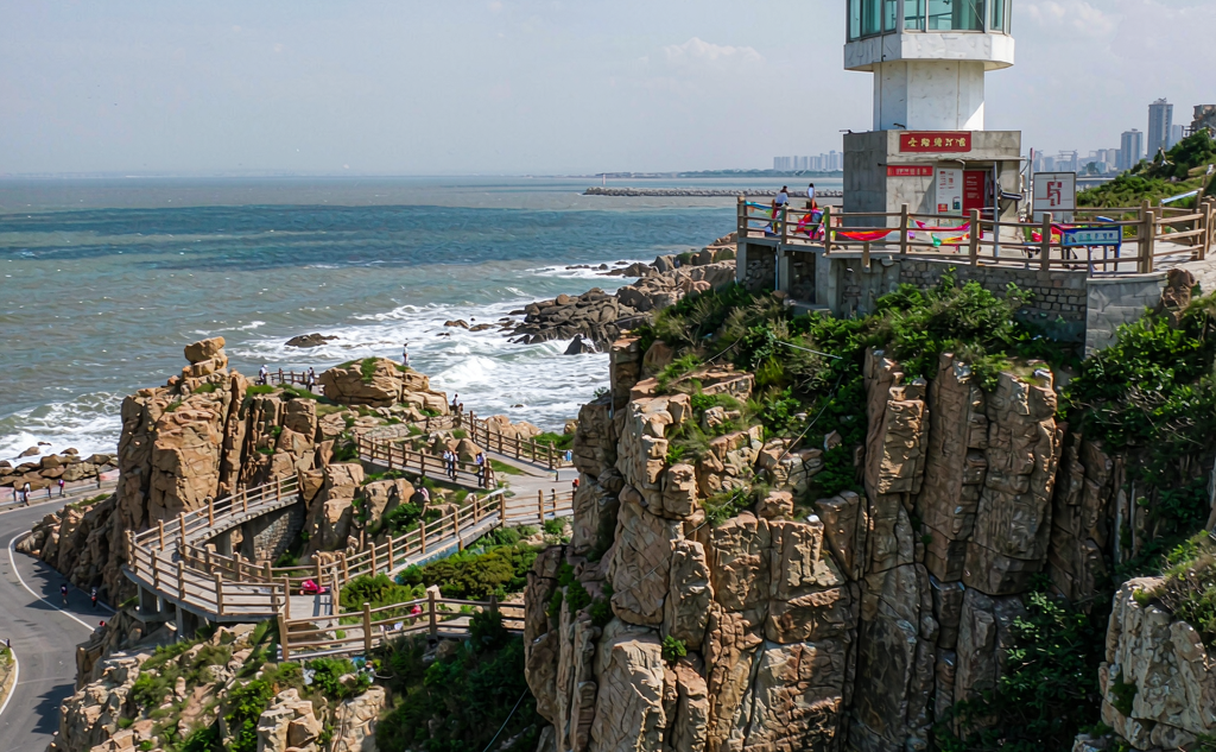
Bayanquan’s Shanhai Square (山海广场) is the social heart of the coast — a broad plaza with a giant shellfish-themed sculpture, a long pier, and a Sea Zen (鲅鱼公主) statue rising from the water on a reef. It is touristy in the benign, local way: evening strollers, ice-cream stalls, and fishermen casting lines off the rocks. The promenade north toward the marina is flat and walkable for kilometers, good for a sunset loop. Come at golden hour; the light over the Bohai is soft and the sculpture photographs well against the water.
Hot Springs at Xiongyue
Inland from the coast, the town of Xiongyue (熊岳) in Gaizhou has been a hot-spring destination for centuries. The Xiongyue hot springs (熊岳温泉) draw mineral-rich water that several hotels and bathhouses pipe into pools; a day-pass to a resort soaking area typically runs 80 to 180 RMB depending on the facility, with hotel guests often included. We recommend it as a half-day recovery after the beach or as an overnight spa stay. The water is hot year-round, which makes winter visits appealing when the coast is shut but the springs are steaming — a nice counterpoint to the summer crowds.
Wang’er Mountain and the Mother-Son Legend
A short drive inland, Wang’er Mountain (望儿山, “Watch-for-Son Mountain”) is less a hike than a cultural stop. The peak resembles a seated woman from a distance, and local legend says a mother climbed daily to watch for her son returning from imperial exams. There is a pagoda, a small park, and a statue telling the story; it is a pleasant hour, especially if you are traveling with family, and the viewpoint gives a rare inland look at the peninsula’s low hills. Entry is usually modest (around 30 to 50 RMB).
The Liaohe River Old Street and the West Fort
Back in the urban core, the Liaohe River Old Street (辽河老街) is a restored strip of early-20th-century merchant buildings where Chinese and Western styles mix — a reminder that Yingkou was an open trading port after the 1861 Treaty of Tianjin. The facades are photogenic and the lane has coffee shops and small museums now. Nearby, the West Fort (西炮台), a Qing-dynasty coastal artillery fort of packed earth and brick, sits where the river meets the sea; climb the ramparts for a sense of how the empire tried to guard this mouth. Both are free or nearly so and make a relaxed half-day walk.
Things to Do in Yingkou: Our Picks
Readers searching things to do in Yingkou usually want a balanced, realistic list. Here is ours:
1. Swim or walk the sand at Moon Bay or Baisha Bay (half to full day).
2. Stroll Shanhai Square and the coastal promenade at sunset.
3. Soak in the Xiongyue hot springs (half day).
4. Visit Wang’er Mountain park and viewpoint (1 hour).
5. Walk the Liaohe River Old Street and the West Fort in the city (half day).
6. Eat seafood at a Bayuquan market restaurant — the real reason to come.
Seafood: The Main Event
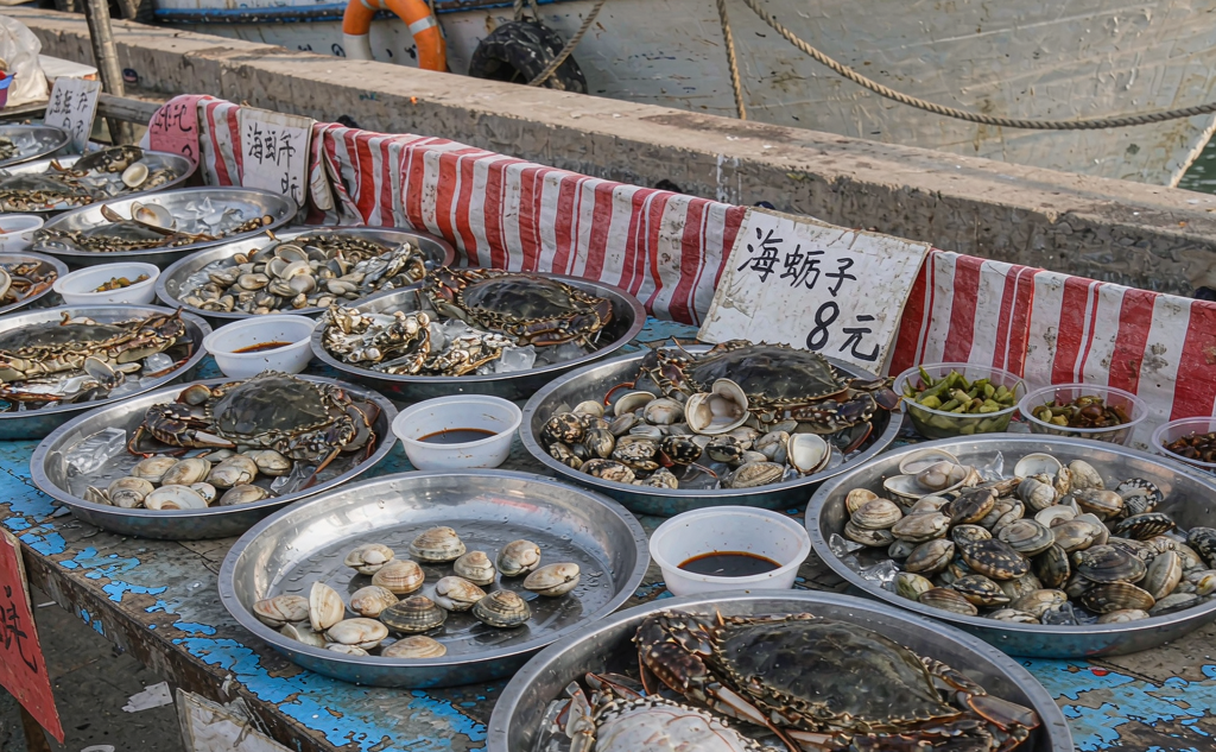
Yingkou’s seafood is the headline, and the smart move is to buy at the source. The Bayuquan seafood market and the docks see daily landings of Spanish mackerel (鲅鱼), prawns (对虾), clams (蚬子), jellyfish (海蜇), and blue crab (螃蟹). Many restaurants will cook your market purchase for a small fee, or you can order straight off the tank. Expect to pay roughly 60 to 120 RMB per person for a generous shared spread of steamed clams, braised mackerel, and cold jellyfish salad in season, with beer extra. The jellyfish salad is a local signature — crisp, garlicky, and nothing like the chewy versions elsewhere.
Season matters: crabs fatten in late summer and autumn, mackerel runs in spring, and clams are dependable most of the warm year. We tell clients to ask the restaurant what came in that morning rather than ordering from a fixed list; the freshest thing on the boat is always the best value.
How to Get to Yingkou
Yingkou is easy by high-speed rail. The Harbin–Dalian line (哈大高铁) calls at Yingkou East Station (营口东站) and Bayuquan Station (鲅鱼圈站). From Shenyang it is about 1 to 1.5 hours; from Dalian roughly 1 to 1.5 hours; from Dandong you usually change at Dalian or Shenyang, totaling around 2.5 to 3.5 hours. For most visitors the logical plan is to base in Shenyang or Dalian and make Yingkou a beach-and-seafood overnight. Our Shenyang travel guide covers the provincial capital as a launch point, and the Dalian travel guide handles the southern peninsula hub.
Train booking and seat classes are explained in our China high-speed train guide for foreigners; the northeast lines use the same apps and rules as the rest of the network. Within Yingkou, a taxi or pre-arranged driver covers the 50 km between the city and Bayuquan; local buses exist but are slow for a short trip.
Best Time to Visit Yingkou
The coast has four clear seasons. Summer (July to August) is beach season — warm, sometimes humid, with seawater at its most swimmable, but also the busiest and priciest. Late May to June and September are the sweet spots for empty beaches, clean air, and lower hotel rates, though the sea is cooler. Autumn (September to October) is also prime seafood season. Winter is cold and the beaches close, but the Xiongyue hot springs make a cozy off-season trip, and room rates drop sharply.
A Suggested Yingkou Itinerary
A tight coastal loop:
- Day 1: High-speed train to Bayuquan. Drop bags, walk Shanhai Square and the promenade at sunset, seafood dinner.
- Day 2: Morning on Baisha Bay or Moon Bay, afternoon Xiongyue hot springs, evening market seafood.
- Day 3 (optional): City half-day — Liaohe River Old Street, West Fort, Wang’er Mountain — then train out via Shenyang or Dalian.
This Yingkou itinerary keeps things slow and beach-first; add the city sights only if you have the third day. The point is to relax, not to tick boxes.
Costs, Food, and Practical Tips
Yingkou is gentle on the wallet. A beachfront guesthouse in Bayuquan runs 250 to 600 RMB in summer, a seafood dinner for two about 150 to 300 RMB, and a hot-spring day pass 80 to 180 RMB. Mobile payment dominates; carry a little cash for market stalls. The coast gets breezy, so pack a light jacket even in summer evenings, and bring reef shoes for the pebbly patches between the sandy stretches.
English is limited, so have your hotel write “鲅鱼圈” (Bayanquan) and key sites in Chinese for taxi drivers. Swim only in flagged areas at the developed beaches, and check jellyfish warnings in late summer — the local sting is mild but annoying, and lifeguards post notices when numbers rise.
Fitting Yingkou into a Liaoning Trip
Yingkou works best between the region’s bigger names. Many travelers pair it with Dalian to the south and Dandong to the southeast, using the high-speed network to hop between coastal cities. Our Dandong travel guide covers the Yalu River border scenery if you want to extend the peninsula loop. For the bigger picture, the best things to do in China list places Liaoning’s coast among the country’s underrated summer options, and first-timers should start with the China travel guide for first-timers before booking trains and beach stays.
We have sent families, couples, and a group of friends here for a low-key seaside break, and the pattern holds: Yingkou delivers more relaxation per yuan than the headline resorts, with seafood that justifies the trip on its own. Come for the sand, stay for the clams, and let the slow Bohai evenings do the rest.