

The First Thing You Notice About Real Yangzhou Fried Rice
Order Yangzhou fried rice in the city it is named after and the bowl that arrives will surprise anyone raised on the brown, soy-slicked pile most of the world calls “Chinese fried rice.” It is pale and glistening, almost the colour of fresh straw, and every grain stands on its own. The secret is a thin film of egg clinging to each separate kernel of rice, so the white looks sheathed in gold. Cooks in Yangzhou call this the jin guo yin (gold-wrapped-silver) standard, and a chef is quietly judged by how cleanly he or she pulls it off. That single detail — colour and separation — is the difference between a forgettable fried rice and the dish that became China’s most copied export.
This is not a dish built for drama. There is no chili oil, no mountain of aromatics, no tableside theatrics. What it asks for instead is restraint, sharp knife work, and a wok hot enough to scare you. Done right, it is the clearest proof that Chinese home cooking values technique over spectacle.
Yangzhou Fried Rice History: From “Broken Gold” to a City’s Signature
The history of Yangzhou fried rice runs longer than most travellers expect. Its earliest ancestor is usually traced to the Sui and Tang dynasties, when a simple “broken gold rice” (sui jin fan) — rice fried with egg so it glittered like scattered gold — was served to travellers along the Grand Canal. Yangzhou sat at the canal’s richest bend, a gathering point for salt merchants, scholars and itinerant cooks, and over centuries the humble egg rice accumulated the city’s surplus: a little shrimp here, some cured meat there, a handful of garden peas.
By the Qing dynasty the dish had been codified by Yangzhou’s banquet kitchens into something closer to what we eat today, and the name stuck because the city’s chefs — famously proud and famously mobile — carried the recipe across China and, later, into overseas Chinatowns. What outsiders received was a simplified, often soy-darkened version. The pale, precise original mostly stayed home. Understanding that gap is the first step to making the genuine thing, because the goal is never “brown rice with stuff in it” — it is a bright, separate, balanced bowl.
If you want to go deeper on the region’s repertoire, our Huaiyang cuisine guide covers the gentle, knife-driven school of cooking that Yangzhou sits at the heart of.
What Does Yangzhou Fried Rice Taste Like?
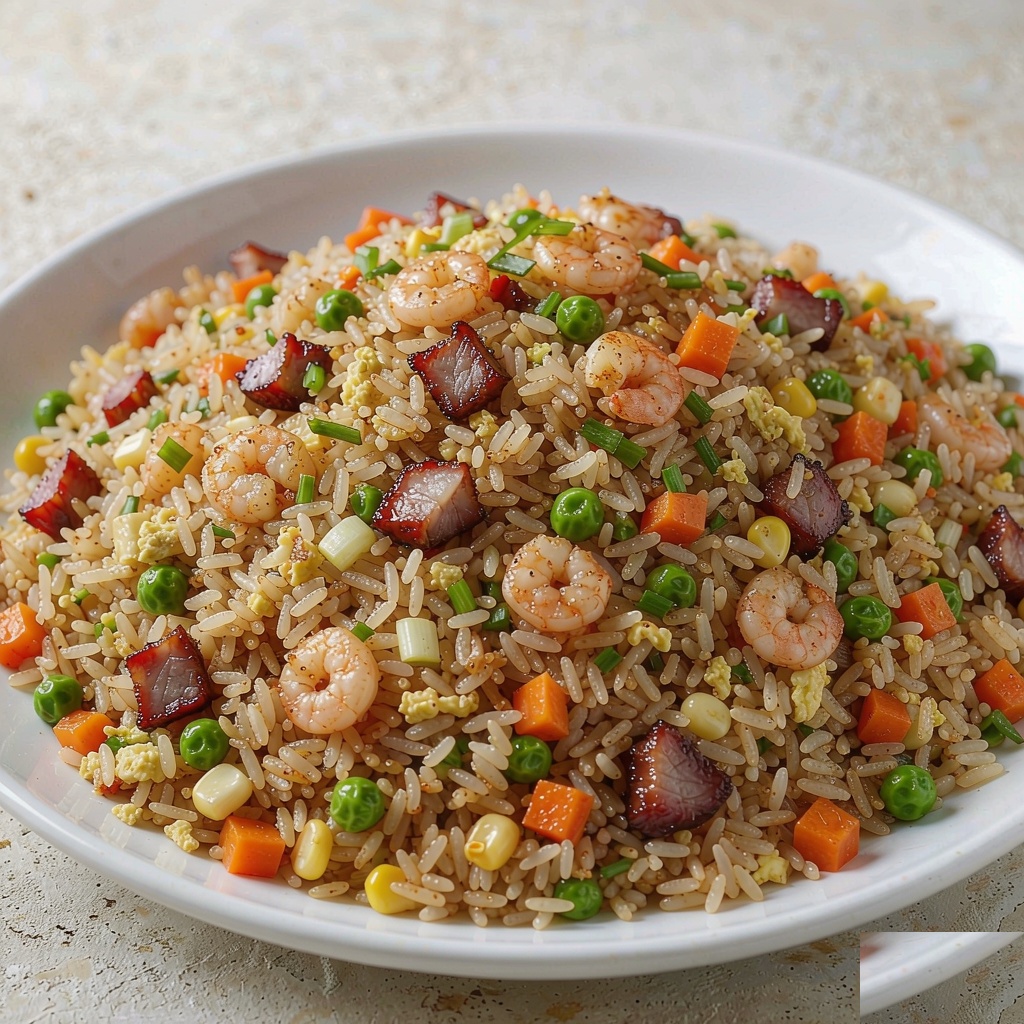
People braced for a salty, heavy fried rice are often caught off guard. Proper Yangzhou fried rice is light, savoury and clean. The dominant note is the toasted sweetness of egg and rice rather than soy; the shrimp and cured pork give it a gentle umami backbone; the peas and scallion lift the finish with a faint vegetal freshness. Texture does most of the work — you want each grain to feel distinct and slightly resilient, never clumped or greasy.
There is also a subtle smokiness if the wok is hot enough, the elusive wok hei that restaurant kitchens chase. At home you may not fully reach it, but you can get close, and the dish is forgiving enough that even a timid version beats almost anything from a foil container.
Yangzhou Fried Rice Ingredients: The “Eight Treasures”
The canonical Yangzhou fried rice ingredients list is sometimes called the eight treasures, though home cooks rarely use all eight. The point is contrast — something soft (egg), something sweet (pea, corn), something savoury (shrimp, cured pork), something aromatic (scallion). Here is a practical shopping list for two hungry people:
- Day-old cooked rice — about 400 g (roughly 2 cups). This is non-negotiable; fresh rice turns to paste.
- Eggs — 2 to 3, beaten. Some cooks use a third egg to coat the rice before frying.
- Small peeled shrimp — 80 g. Fresh or thawed frozen both work.
- Char siu (barbecue pork) or lean ham — 60 g, diced small. This is your savoury anchor.
- Green peas — 50 g, fresh or frozen.
- Carrot — 40 g, finely diced so it cooks in seconds.
- Scallions — 2 stalks, the white and green parts separated and chopped.
- Seasoning — fine salt, white pepper, and a few drops of sesame oil.
- Neutral oil — peanut or rice bran, about 2 tablespoons in total.
A word on the Yangzhou fried rice char siu question: authentic versions use a little roasted or cured pork, and that sweet-savoury cube is part of what makes the dish sing. If you cannot find char siu, diced ham, lap cheong (Chinese sausage), or even a little bacon will do the job. For the Yangzhou fried rice shrimp, small whole peeled shrimp read best; reserve a few dried shrimp (xia mi) if you want an extra hit of ocean umami folded in with the scallion whites.
For travellers, the dish is also one of the best budget meals in China — a filling, protein-rich bowl that costs little and turns up everywhere from train-station counters to hotel breakfast buffets.
Who It’s For — and Who Should Hold Back
This is a genuinely family-friendly dish: quick, customisable, and a brilliant way to use leftover rice and stray vegetables. Children usually love it because it is mild and sweet rather than spicy. It also travels well as a make-ahead component for a China trip food diary.
A few people should pause. Anyone with a shellfish allergy must skip or swap the shrimp. Because char siu and ham are salty, those watching sodium should halve the cured meat and season lightly. Strict vegetarians can make a credible version with egg plus mushrooms and extra peas, but note that the classic recipe is not meat-free, so confirm before ordering it abroad as a “safe” vegetable option. And if you are counting every calorie, see the nutrition note below — it is friendlier than you might think.
How to Make Yangzhou Fried Rice at Home (Step by Step)
The authentic Yangzhou fried rice recipe lives or dies on preparation. Everything is diced to roughly the same tiny size so it cooks evenly in the minute the rice is in the wok. Get your mise en place straight before the first drop of oil hits the pan.
1. Break up and dry the rice
Spread the day-old rice on a tray and, with wet fingers, break every clump. Let it sit uncovered for 20 minutes so the surface dries. Dry, separate grains are what separate this from mush.
2. Prep the treasures
Dice char siu, carrot and scallion white into 5 mm cubes. Blanch peas and carrot for 30 seconds, then shock in cold water and drain. Pat the shrimp dry.
3. Coat the rice in egg (optional but worth it)
For the true gold-wrapped-silver look, mix one beaten egg into the cold rice and stir until every grain is lightly filmed. This is the trick that gives restaurant bowls their even colour.
4. Scramble the remaining egg
Heat a wok until a drop of water dances, add a little oil, pour in the rest of the beaten egg, and stir for ten seconds until just set but still soft. Slide it out.
5. Sear the proteins and aromatics
Re-oil the wok, toss in scallion white, then shrimp and char siu, stirring over high heat for 30 seconds until the shrimp turn pink and the pork releases its fat.
6. Fry the rice
Add the rice and, using a spatula and the wok’s curve, press and toss to separate the grains. Keep it moving for two to three minutes. The rice should sound like gentle rain on the metal.
7. Season and combine
Sprinkle salt and white pepper, fold in peas, carrot and the reserved egg, then the scallion green. Toss once more.
8. Finish off heat
Kill the flame, add a few drops of sesame oil, give it a final toss, and plate immediately. Fried rice waits for no one.
Yangzhou Fried Rice vs Egg Fried Rice — and vs the Western Version
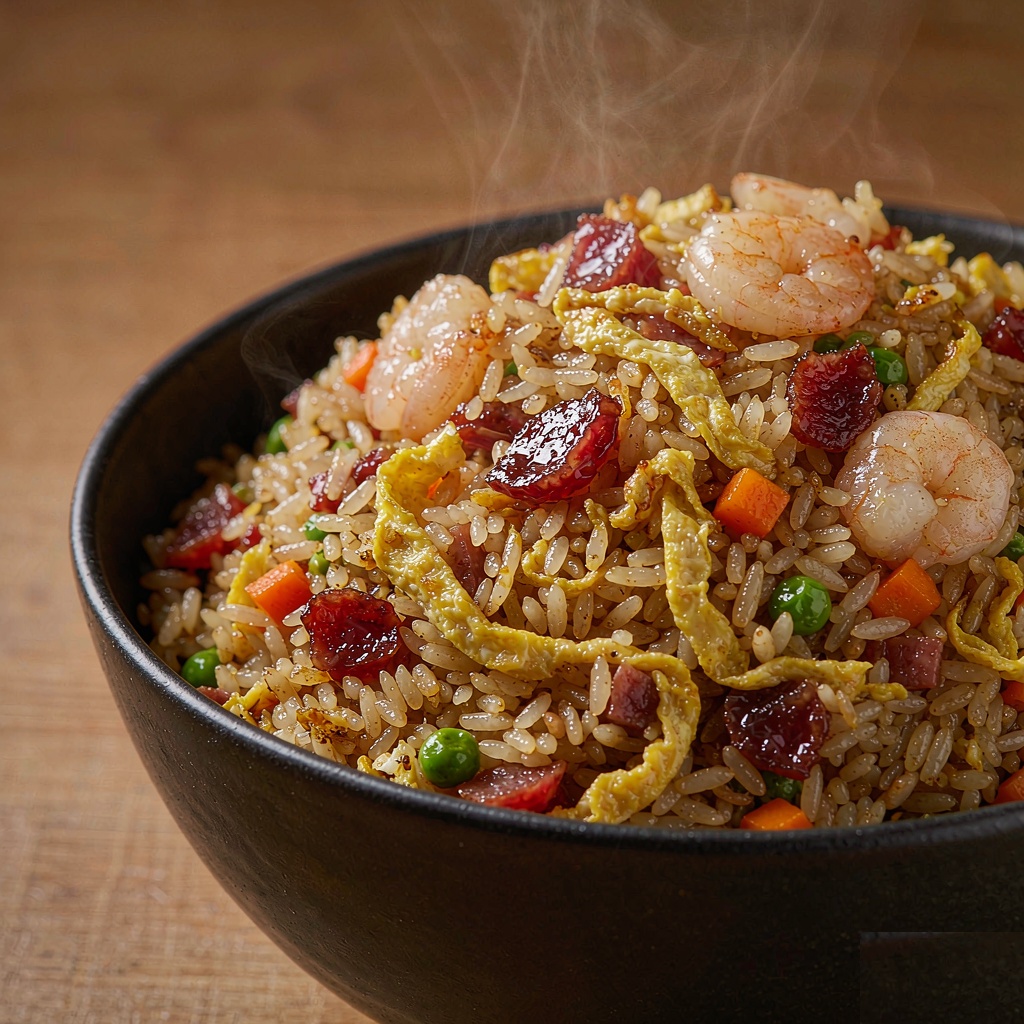
A common question is whether Yangzhou fried rice vs egg fried rice is even a meaningful distinction. It is. Plain egg fried rice is exactly what it says: rice, egg, salt, maybe scallion. Yangzhou fried rice is the dressed-up cousin, carrying shrimp, cured pork and vegetables in a balanced, multicoloured mix. Think of egg fried rice as the canvas and Yangzhou as the finished painting.
The bigger gap is against the “special fried rice” found in many Western Chinese takeaways. That version is typically soy-dark, packed with canned peas and watery carrots, and bound with extra oil. The best Yangzhou fried rice, by contrast, stays pale, dry and separate, letting the ingredients read individually rather than melting into a brown mass. If your bowl comes out brown, you have likely used too much soy or not enough heat — both are easy to fix next time.
Yangzhou Fried Rice Calories and Nutrition
Because it is light on oil and sauce, Yangzhou fried rice calories are reasonable. A 200 g serving of the home version — rice, one egg, a modest amount of shrimp and char siu, and vegetables — lands around 250 to 300 kcal, with a useful hit of protein from the egg and shrimp. That is noticeably leaner than a soy-heavy takeaway portion, which can run 400 kcal or more once you account for the extra oil. Use brown or mixed rice and add more peas and carrot if you want to nudge the fibre up without changing the character.
Tips for Wok Hei on a Home Stove
You will not have a 100,000-BTU restaurant burner, and that is fine. Cook in two smaller batches rather than crowding the wok, preheat the pan until it is almost smoking, and keep the rice moving the entire time. A heavy cast-iron skillet is a decent stand-in for a wok if you do not own one. The single biggest home mistake is adding everything at once and steaming it; high heat and constant motion are the whole game.
Regional twists are welcome. Some Yangzhou families add a few lily bulbs or bamboo shoots for crunch; Cantonese kitchens lean heavier on char siu; banquet versions fold in sea cucumber or dried scallop for luxury. None of these break the rules — they just testify that the dish was always a way to show off what was good in the larder.
If you are planning a trip around the food, our Yangzhou food guide maps where to eat the real thing, including the morning-tea houses where a bowl of this rice is still part of a proper breakfast spread.
Frequently Asked Questions
Is Yangzhou fried rice the same as egg fried rice?
No. Egg fried rice contains only rice, egg and seasoning. Yangzhou fried rice builds on that base with shrimp, cured pork (char siu or ham), peas, carrot and scallion — the “eight treasures” that give it colour, texture and a fuller savoury profile.
What shrimp should I use for Yangzhou fried rice?
Small peeled shrimp are ideal; fresh or thawed frozen both work well. For deeper umami, add a teaspoon of dried shrimp (xia mi) with the scallion whites. Avoid large, heavily sauced shrimp, which throw off the balance.
Can I make Yangzhou fried rice without char siu?
Yes. Substitute diced ham, Chinese sausage (lap cheong), or even a little bacon. For a vegetarian bowl, use mushrooms and extra peas, though purists would call that a different dish.
Why does restaurant fried rice taste better?
Three things: a fiercer burner (wok hei), a well-seasoned wok, and day-old rice. At home, cook in smaller batches over the highest heat you safely can, and never use fresh rice.
How many calories are in Yangzhou fried rice?
A 200 g home portion is roughly 250–300 kcal. It is lighter than soy-heavy takeaway versions, which often exceed 400 kcal once extra oil is counted.
What is the difference between Yangzhou and Yangchow fried rice?
None in the kitchen. “Yangchow” is simply the older postal romanisation of the same city; menus in older or Western-Chinese restaurants often keep the Yangchow spelling. The dish is identical.
A Bowl Worth Getting Right
There is a reason how to make Yangzhou fried rice at home is one of the most searched Chinese recipes in the world: it looks simple and rewards precision. Master the rice, respect the heat, and keep the ingredients small and separate, and you will produce a bowl that tastes less like takeaway and more like the canal-side city it came from. It will not be brown, it will not be greasy, and every grain will tell you the cook paid attention — which, in the end, is the whole point of the dish.