

I first saw the Flaming Mountains in Turpan, Xinjiang, China from the window of a slowly crawling train, and I understood the name immediately. The ridgeline glowed like a coal seam caught at dusk, even though it was ten in the morning. This is one of the hottest, driest, and most visually startling places I have stood in all of China — a wall of bare red sandstone that has baked under a near-vertical sun for millions of years.
If you are building a Silk Road itinerary, the Flaming Mountains Turpan stop is unmissable. It is not a hiking mountain range in the usual sense. It is a long, low escarpment of eroded red rock that runs east–west through the Turpan Depression, the lowest and one of the hottest spots in the country. For a traveler, it is a short, dramatic half-day that pairs perfectly with the green coolness of nearby Grape Valley.
In this guide I will walk you through getting there, what you actually see, the red cliffs themselves, practical tips, and the best time to come. I have been twice — once in July (a mistake I will explain) and once in April (much wiser) — so the advice below comes from standing in that heat myself.
Getting There from Turpan
The Flaming Mountains sit about 30 km east of Turpan city center, right along the old northern Silk Road corridor. Most visitors base themselves in Turpan, which is itself an easy hub to reach.
From Urumqi, the regional capital, you can take a fast train to Turpan North Station in roughly one hour, or a slower conventional train to Turpan Station in about two. I recommend staying a night or two in Turpan and treating the Flaming Mountains as a half-day loop with Grape Valley and the nearby ruins.
Once in Turpan, your options are:
- Taxi or Didi — simplest. A round trip with waiting time costs roughly 150–250 RMB depending on negotiation and season. Agree on the price and waiting time before you get in.
- Local bus — cheaper but slower and less frequent; fine if you are on a tight budget and have time to spare.
- Rented car with driver — best if you are linking several Silk Road sites in one day.
The Flaming Mountains scenic area has a clearly marked entrance, a parking lot, and a long viewing terrace aimed straight at the most photogenic red ridge. There is also a giant thermometer statue at the gate — more on that below.
For broader planning on the region, see our Xinjiang travel guide, which covers transport between Urumqi, Turpan, and Kashgar.
What to See
The main attraction is the landscape itself, but the site has been developed with a few concrete things to look at. Here is what I found worth the stop.
The Giant Thermometer. At the entrance stands a huge red thermometer monument that records the real air temperature. On my July visit it read 47°C in the shade — and there is no shade. It is a gimmick, but it makes the heat tangible and is a fun photo.
The Viewing Platforms. Wooden walkways and terraces let you stand right at the foot of the cliffs. You are not allowed to scramble up the fragile rock, but you get close enough to feel the radiated heat coming off the stone.
The Monkey King and Princess Iron Fan statues. Fans of the classic novel Journey to the West will recognize this place. The Flaming Mountains are the mythical barrier that Sun Wukong must cross, and the site leans into that story with statues and a small exhibition. I am not a mythology buff, but even I enjoyed the connection between folklore and a very real, very hostile landscape.
Grape Valley (just west). A short drive brings you into a shaded, irrigated canyon of vine trellises where the temperature drops by what feels like ten degrees. After the exposed red rock, the sudden green is a relief. The grapes are delicious and cheap in season.
For the Silk Road context that makes this place meaningful, read our Turpan Silk Road guide.
The Red Cliffs
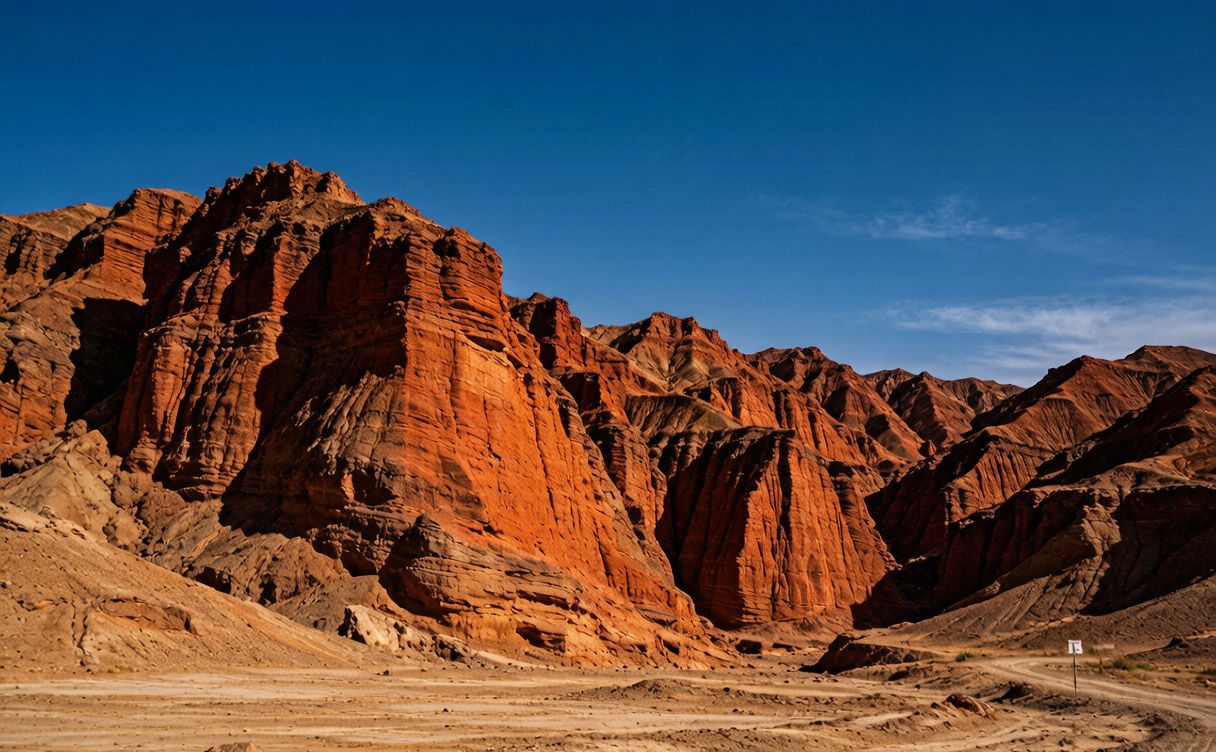
Now to the heart of it. The Flaming Mountains Turpan cliffs are made of red sandstone and conglomerate laid down in the Jurassic period, then folded and eroded into a series of parallel, flame-shaped ridges. The color is not a trick of light alone — the iron-rich rock really is that red, and at sunrise and sunset it looks genuinely on fire.
What struck me most was the silence. There is no vegetation, no birdsong, just heat shimmer rising off the rock. The canyon walls show clear horizontal banding, like layers of a cake baked too long. In places the wind has carved hollows and ribs that catch the light differently as the sun moves.
A practical note: the cliffs are beautiful but genuinely dangerous in heat. The stone radiates heat back at you, and there is almost no shade. I visited at 11 a.m. in July and lasted about forty minutes before retreating to the bus. In April, with a temperature around 25°C, I could linger for over an hour and actually enjoy it.
If you want to extend the red-rock theme, pair this with a trip further east later in your journey; our Xian Huaqing Palace guide covers another historic hot-spring site with a very different feel, useful if you are routing from Xinjiang toward central China.
Tips
These are the things I wish someone had told me before my first visit.
- Bring far more water than you think. I carried two liters in July and finished them in twenty minutes. The dryness means you sweat without noticing.
- Wear a hat, sunglasses, and sun-protective clothing. There is no shade on the viewing terraces. A light long-sleeve shirt kept me cooler than a t-shirt because it blocked the radiated heat.
- Go early or late in the day. The site opens in the morning; arrive at opening or aim for the last two hours before close. Midday in summer is brutal.
- Carry cash. Small entrance stalls and some taxis do not take foreign cards or even every Chinese mobile payment app reliably.
- Combine with Grape Valley. Doing both in one loop balances the heat with shade and a meal.
- Mind the floor. The walkways are solid, but the ground near the cliffs is loose gravel. Closed shoes beat sandals.
- Don’t expect a hike. This is a look-and-photograph destination, not a trek. Manage your time accordingly.
If you are also planning warmer-weather beach time after the desert, our Sanya Yalong Bay guide is a useful contrast — swap radiant rock for radiant sea.
Best Time
The single most important planning decision is when you go. The Turpan Depression is one of the hottest inhabited places on Earth, and the Flaming Mountains earn their name most fiercely from June to August, when daytime highs routinely hit 40–47°C.
My honest recommendation:
- April to early May — ideal. Warm but manageable, the cliffs still glow, and Grape Valley is turning green. Crowds are lighter.
- September to October — also excellent. The worst heat is gone, the grapes are being harvested, and the light is golden.
- June to August — only if you must. Visit at opening or near sunset, drink constantly, and keep expectations realistic. I do not recommend it for first-time visitors with kids or older travelers.
- November to March — very cold and windy, with some facilities reduced. The red rock against snow can be striking, but services are limited.
For a region-wide calendar, our Best time to visit Xinjiang article breaks down every season across the whole province, not just Turpan.
Good to know
The Flaming Mountains in Turpan, Xinjiang, China sit within the Turpan Depression, which at about 155 meters below sea level is one of the lowest points in the country. The area’s extreme heat, sparse rain, and historical oasis towns made it a defining landmark on the northern Silk Road for more than a thousand years. Entrance fees are modest and change by season; check the official regional tourism board for current prices, opening hours, and any weather closures: Xinjiang Tourism.
I came away convinced that the Flaming Mountains are best understood as an experience of heat and color rather than a checklist sight. Stand at the base, feel the rock radiating warmth, watch the bands of red shift as the light moves, then retreat to the grapes and shade of the valley. That rhythm — fire and fruit, desert and oasis — is the real Turpan.