

The Xia Dynasty occupies a strange and fascinating place in Chinese history. It is remembered as the first dynasty to rule over a unified Chinese realm, yet for most of recorded history its existence rested on legend rather than physical proof. Modern archaeology has begun to close that gap, but the line between myth and history remains deliberately thin. For travelers who want to understand where the idea of “China” begins, the story of the xia dynasty is where the narrative opens. You can read a broader overview of the topic on the Xia dynasty page at Wikipedia, but this guide focuses on what visitors can actually see and understand today.
A Semi-Legendary Beginning
Unlike the Han, Tang, or Ming, the Xia is not anchored by surviving royal archives or contemporary inscriptions. Our earliest written mentions come centuries later, in the Oracle Bone and bronze texts of the Shang and Zhou dynasties, and in compiled histories such as the later Records of the Grand Historian. These sources describe the Xia as a real polity, but they were written long after the fact and blended genealogy with moral tale.
This is what makes the xia dynasty so compelling for visitors. It is the origin point of the Chinese concept of legitimate rule, the “Mandate of Heaven,” long before that phrase was coined. The Xia rulers were portrayed as having earned the right to govern through service to the people, a theme that would echo through every later dynasty. Because the evidence is partial, archaeologists and historians treat the Xia as “semi-legendary”: plausible as a real early state, but impossible to map with the precision we apply to later periods.
Yu the Great and the Control of the Floods
The central founding story of the Xia is the legend of Yu the Great. According to tradition, Yu’s father was assigned to stop a cataclysmic flood that had ravaged the early Chinese heartland for generations. His father failed and was executed. Yu took up the task and, rather than building dams to block the water, he dug channels to guide it toward the sea. The effort consumed years, and the story holds that he passed his own home three times without entering, so devoted was he to the work.
When the waters were tamed, Yu was granted kingship, and upon his death the throne passed to his son rather than reverting to a worthy commoner. That moment, the shift from chosen merit to hereditary rule, is traditionally marked as the birth of the xia dynasty. Whether Yu was a single historical figure or a composite of many flood engineers, the tale captures something real about early Chinese civilization: survival depended on large-scale water management across the Yellow River basin, and the leaders who organized it became the first kings.
The Erlitou Site in Henan
The single most important place to connect the legend with the ground is Erlitou, in Yanshi, Henan province. Excavations here, beginning in the 1950s and intensifying through the late 20th century, revealed a large urban settlement dating roughly from 1900 to 1500 BCE. That window lines up closely with the traditional chronology assigned to the Xia by later historians.
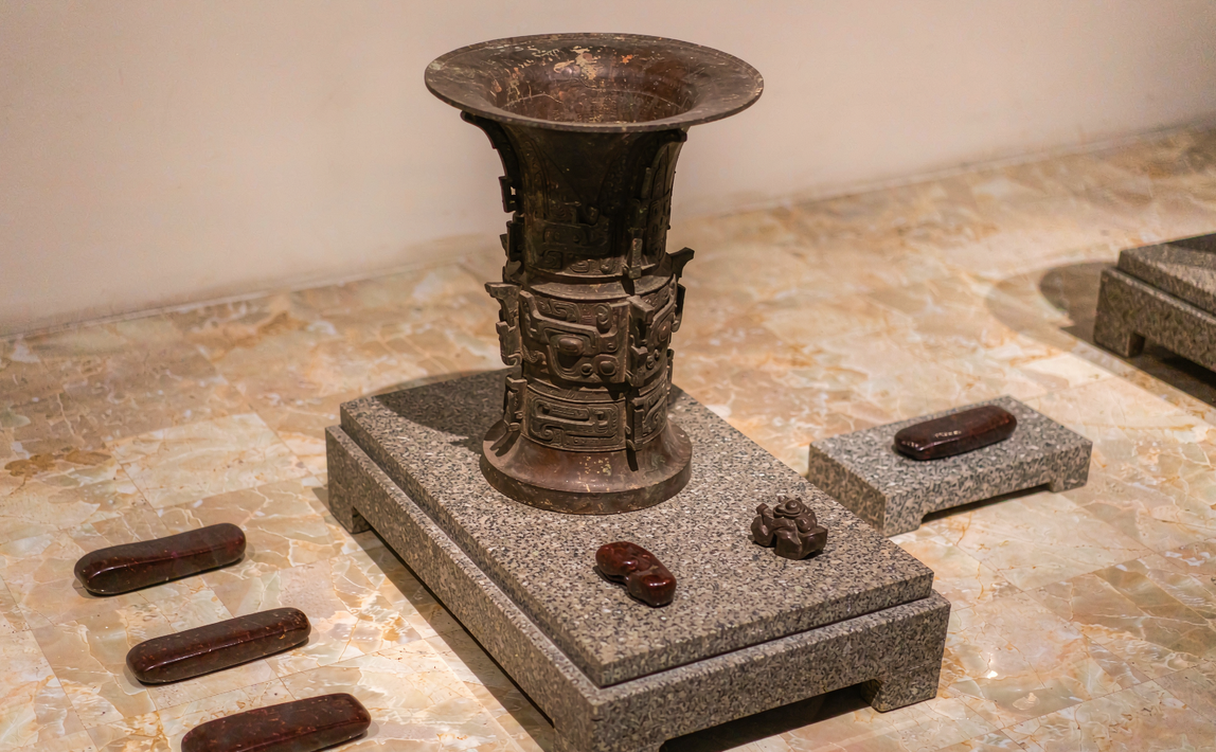
What archaeologists found at Erlitou is striking. There is a planned palace complex with rammed-earth foundations, a grid-like layout, and clear signs of social hierarchy. The site shows early bronze casting on an organized scale, including ritual vessels that foreshadow the elaborate bronze culture of the Shang. For many scholars, Erlitou represents either the capital of the late Xia or the transitional phase between the Xia and Shang. Either way, it is the strongest material candidate for the xia dynasty yet discovered.
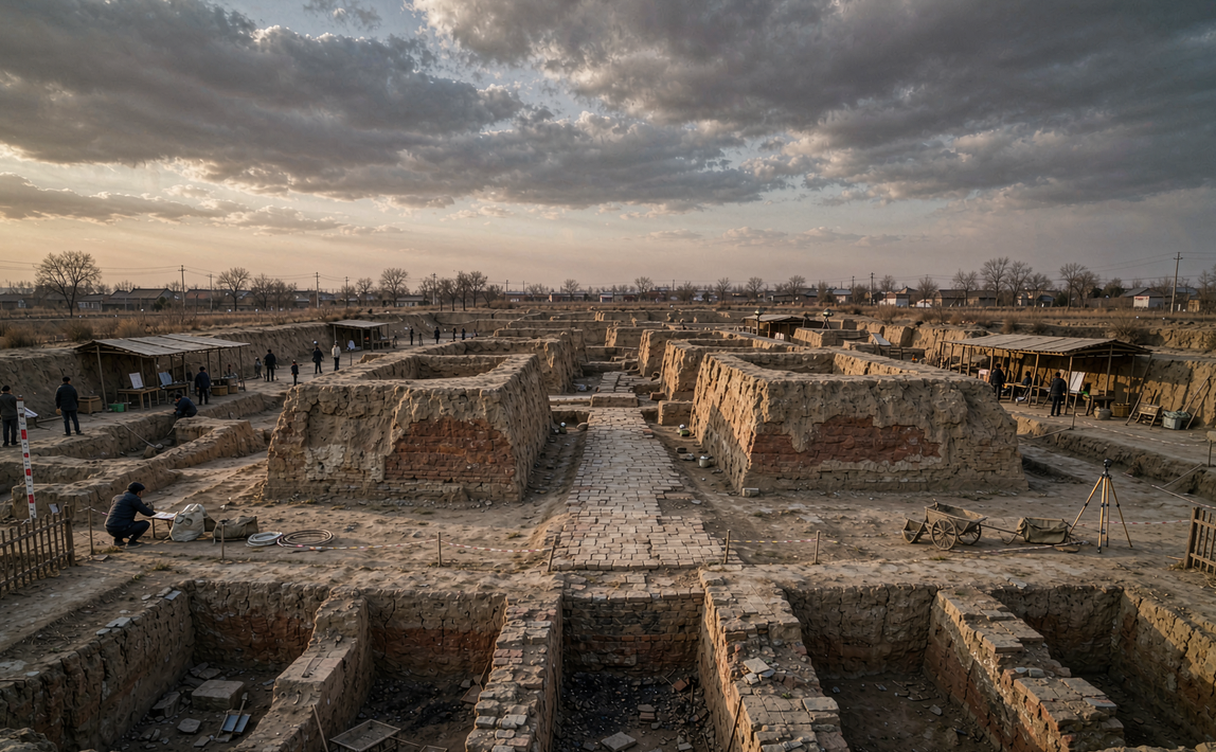
The on-site museum displays bronze vessels, jade objects, pottery, and reconstructions of the early urban plan. Visiting Erlitou does not give you a dynasty with a name carved in stone, but it gives you the texture of a society that matches the scale the legends imply. It is the closest you can come to standing inside the xia dynasty, even if the label remains a scholarly conclusion rather than a signed document.
Bronze Age Context of Early China
To appreciate Erlitou, it helps to place the Xia within the wider Bronze Age of East Asia. The dynasty is believed to sit at the threshold of China’s Bronze Age, a period when metalworking moved from small ornaments to state-controlled production of weapons and ritual vessels. The famous bronze cultures that followed, the Shang with their oracle bones and towering cast vessels, and the Zhou with their feudal network, built directly on foundations laid during this earlier horizon.
The xia dynasty, if we accept Erlitou as its material expression, marks the moment when localized Neolithic cultures along the Yellow and Yangtze rivers consolidated into something approaching a territorial state. This was not yet the China of walls and empires, but it was the prototype: centralized workshop production, elite burial goods, and a political story that later rulers would eagerly claim as their own ancestry. Understanding this context is what turns a pile of broken pottery into a chapter of world history.
How to Visit Xia Dynasty Related Sites
Travelers chasing the Xia will find that the experience is less about a single ticketed monument and more about following a thread through central China. The essential stop is Erlitou, reachable from Luoyang in Henan by road in roughly an hour. Pair it with the wider Henan circuit, which also includes the Shaolin Temple and the ancient capital sites around Luoyang and Anyang, the latter famous for its Shang oracle bone pits.
For artifacts that have been lifted from the ground and placed behind glass, the Shaanxi History Museum in Xi’an holds bronzes and jades from the broader early-dynasty period and helps contextualize what came before the Qin and Han. In Beijing, the Forbidden City tickets grant access to a later imperial complex that, however distant in time, was built to embody the same mandate-first ideology the Xia legends established.
If your route also includes northern defenses and later imperial spectacle, the Great Wall of China sits at the opposite end of the dynastic timeline from the Xia, a useful counterpoint for seeing how the idea of a unified realm evolved. For a full planning framework covering transport, seasons, and regional routes, our xia dynasty primer for first-time visitors lays out the practical basics. And if you want to build a broader itinerary around early China, see our list of the best things to do in China.
Travel logistics are straightforward but regional. Henan is served by high-speed rail from Beijing, Xi’an, and Shanghai, and Luoyang Longmen station is the usual gateway. Spring and autumn offer the most comfortable weather for walking open archaeological sites. Allow at least half a day for Erlitou itself, plus travel time, and consider a guide who can explain the stratigraphy, because the site’s significance is easy to miss without interpretation.
Is the Xia Xia Dynasty the Same as the Xia Dynasty?
A common search variation is the phrase “xia xia dynasty,” and the answer is simple: it refers to the same polity. The doubled form usually appears as a transcription or indexing artifact rather than a distinct historical entity. When you see “xia xia dynasty” in a list of keywords or search results, treat it as a redundant repetition of the xia dynasty, China’s semi-legendary first ruling house. There was only one Xia in the traditional sequence of dynasties, and it preceded the Shang.
This matters for travelers because the doubling can cause confusion when planning reading or tours. If a museum label, map, or article uses the longer phrasing, you are still looking at the Erlitou-era culture and the Yu the Great flood tradition described above. The xia xia dynasty and the xia dynasty are one and the same subject, and both point back to the Henan heartland where the earliest Chinese state is thought to have formed.
Why the Xia Still Matters to Travelers
The Xia may be the least visible dynasty on any tourist map, but it is the most foundational. Every later achievement, from the bronze rituals of the Shang to the walls of the Ming, traces a lineage back to the claim that China’s first king earned his throne by controlling the waters and serving the people. Visiting the sites and museums that hold this early material lets you stand at the source of a civilization that has remained continuous for more than three thousand years.
You do not need to be an archaeologist to feel the weight of Erlitou’s rammed-earth foundations or the craftsmanship of its bronzes. You only need the willingness to look past the legends and ask what they were built upon. The xia dynasty invites exactly that question, and central China provides the answers.
[CTA]Discover China’s ancient history with our expert guides and curated itineraries.[/CTA]
[CTA]Plan your Henan and Xi’an route with tailored advice from travelers who know the sites.[/CTA]
[CTA]Start building your early-China itinerary with our handpicked tours and museum guides.[/CTA]