

I pressed my face to the glass until a guard coughed politely, and I still couldn’t see the bottom of the gold bowl. I had read that the Shaanxi History Museum holds more Tang-dynasty gold and silver than any other collection on earth, but reading is one thing and standing in front of a 1,100-year-old silver pitcher shaped like a dancing horse is another. Xi’an was the capital of thirteen dynasties, and this one building — the shaanxi history museum xian locals quietly call “the treasury of China” — packs more royal wealth into its halls than most countries see in a century. If you only do one museum in China, make it this one.
Why the Shaanxi History Museum Outshines Most of Beijing
The Forbidden City gets the postcards, but this museum gets the artifacts. Beijing’s palaces are gorgeous empty rooms; Xi’an’s museum is stuffed with the actual stuff those rooms were built to flaunt. The building itself is a deliberately understated piece of 1980s architecture — a low, dark-tiled complex modelled on the Tang ceremonial style, with none of the imperial swagger of its Beijing rival, which is exactly the point. Shaanxi sat at the political heart of China for over a thousand years — the Zhou, Qin, Han, and Tang all planted their capitals here — so when archaeologists dug up the region they hit layer after layer of royal treasure. Most visitors just call it the shaanxi museum, but don’t let the plain name fool you: this is a top-tier national collection wearing a modest provincial badge.
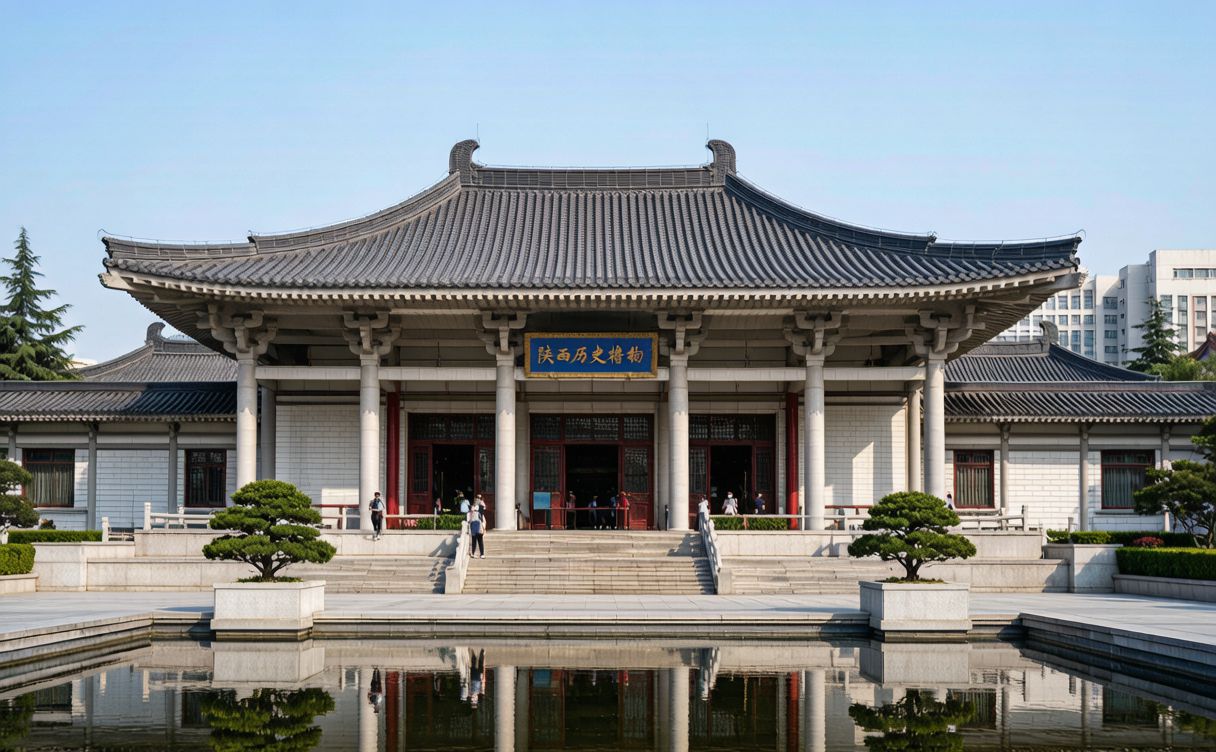
The permanent collection runs past 1.7 million objects, of which only a sliver ever reaches a display case. You’ll walk past Neolithic painted pottery, Han-dynasty jade burial suits, and Buddhist sculpture that survived the centuries more by accident than by design. The genius of the place is sequencing: the galleries march you through time, so by the time you hit the Tang rooms your eyes are primed for the gold.
Don’t sleep on the early galleries, either. The bronze-age section holds ritual vessels cast three thousand years ago, their surfaces still stamped with the clan markings of kings who ruled the Wei River valley long before Xi’an had a name. I spent a guilty ten minutes ignoring the gold entirely, mesmerised by a Zhou-dynasty you vessel whose patina had turned the colour of a storm cloud. The museum’s layout rewards the patient: start at the top of the dynasty ladder and work down, and the Tang rooms will hit like a finale rather than a footnote.
Getting In — The Free-Ticket Hustle
Here’s the part nobody warns you about: general admission to the xian museum is free, but tickets are released in timed online slots and they vanish faster than hot dumplings. When I visited last spring, I opened the booking page at 7:55 a.m. for the 8:00 release and still watched the 9 a.m. slot sell out before I finished typing my passport number. A woman next to me in the lobby laughed and said she’d been refreshing for three days.
The trick is to book the instant a slot opens — they drop new reservations several times a day, often at 8, 11, 18, and 19 o’clock Beijing time — and to have your passport details copied and pasted, ready to go. If you miss the free tickets, there’s a separately ticketed exhibition hall (the Tang murals gallery and the rotating special shows) that you can usually walk straight into. Bring your passport; they check it against the booking, no exceptions and no paper printouts accepted in place of ID.
What Not to Miss Inside
The Tang Gold and Silver That Stopped My Heart
This is the headline act. The Tang dynasty (618–907) loved its bling, and the museum inherited the hoard from the Hejia Village cellar — hundreds of gold and silver vessels buried by a court official who, presumably, planned to come back for them. He never did. It was only unearthed in 1970 during a well-digging project, and the discovery rewrote what historians thought they knew about Tang metalwork. You get a silver pitcher with a horse that appears to dance when you rotate it, a gold bowl chased with Mandarin ducks, and a set of cups so thin the light passes clean through.
When I faced the gold chariot pulled by tiny galloping horses, I forgot to take a photo. A guard nearby noticed my gaping and explained, in careful English, that the piece was “a toy for a Tang princess” — then grinned and admitted he tells that story to everyone. I believed him for a solid minute.
Terracotta Army Artifacts, Up Close
Most people sprint to the pits east of the city (and you should — our guide to the Terracotta Warriors visit covers how to dodge the crowds). But the Xi’an museum holds terracotta artifacts you can study without a stadium of tour groups breathing on your neck: kneeling archers, a bronze chariot, and the famous warrior heads with individually modelled faces. Where the open pits show you the army en masse, these cases show you the craft — the fingerprint of the artisan still pressed into a clay heel.
The Tomb Murals You Almost Can’t See
The mural gallery is separately ticketed and separately climate-controlled for good reason: these paintings, peeled from the walls of Tang noble tombs, are fragile enough to fade if the humidity so much as blinks. A guard explained that only a few dozen visitors are let in per hour and the lights stay low to slow the decay. Stand in that dim room with a 1,300-year-old lady in a green gown staring calmly back at you, and “museum” stops feeling like the right word.
How to Get to the Shaanxi History Museum
The museum sits just northwest of the Big Wild Goose Pagoda, in the Yanta district. Take Metro Line 2 or 3 to Xiaozhai and walk ten minutes, or Line 4 to Dayanta and walk west. Taxis and DiDi will drop you at the north gate, but the surrounding roads clog at midday, so the metro is the sane choice. Give yourself a buffer: the security line at the entrance can snake around the block on weekends, and there’s no skipping it.
Best Time to Go
Go on a weekday, arrive at opening, and you’ll have the Tang gold nearly to yourself. I once made the mistake of a Saturday and spent twenty minutes simply shuffling toward the silver pitcher. When a guard explained that Mondays mean school groups and Saturdays mean everyone else, I switched to Wednesday and suddenly had room to breathe. Avoid China’s public holidays entirely — Golden Week in early October and the Spring Festival turn the free tickets into a lottery and the halls into a scrum. Late March to May and September to early November are the sweet spots: mild weather, thinner crowds, and good light for the photos you’ll actually keep.
One more timing tip from someone who learned it the hard way: book the first slot of the day and treat the museum like a sprint, not a stroll. The free-ticket halls get noticeably busier after 11 a.m. as the tour buses unload, so if you’re through the Tang gold by then you’ve won. Plan two to three hours for the main collection plus another hour if you add the murals gallery. And wear comfortable shoes — the building is larger than it looks from the street, and the walk from the metro alone is a workout in summer heat.
Don’t Leave Hungry
The museum café is overpriced and underwhelming; the Muslim Quarter is a twenty-minute DiDi away and worth every minute. Our Xi’an Muslim Quarter food guide maps the roughened lamb skewers, persimmon cakes, and cold noodles you’ll crave after three hours of gold-gazing. Come for the dynasties, stay for the snacks — and book that free ticket the night before, not the morning of.
For official hours, ticketing, and the current exhibition list, check the museum’s own site: Shaanxi History Museum.