

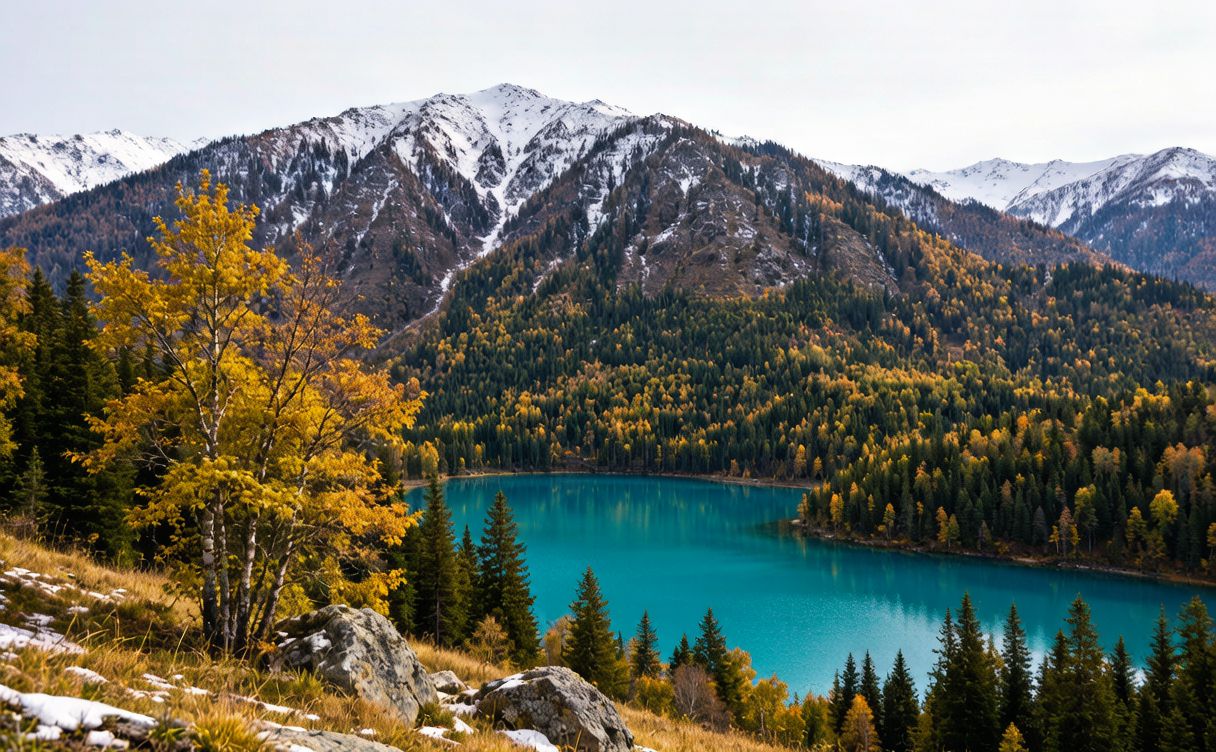
I was still rubbing sleep from my eyes at 6:40 a.m. when the wooden boardwalk at Kanas Lake, Xinjiang, China, went quiet. Then the mist peeled back like a curtain and the water turned from cold steel-grey to an impossible emerald, then turquoise, then a blue I can only describe as “please-stop-taking-photos-and-just-look.” I had seen the postcards. They lie. The real place is louder, stranger, and far more beautiful than any edited JPEG. If you are a foreign traveler building a China wish list, put this glacial alpine lake in northern Xinjiang, China at the very top — and read on before you book, because the logistics matter as much as the view.
What and Where Is Kanas Lake?
Kanas Lake (the name comes from Mongolian, roughly “beautiful, rich and mysterious”) sits in the Altai Mountains of northern Xinjiang, China, near the border with Kazakhstan, Russia, and Mongolia. It is a glacier-fed lake cradled in a U-shaped valley carved by ice during the last glacial period. The water is so clear and mineral-tinted that it shifts color through the day depending on light and depth — locals will tell you it has moods, and after a few mornings there, I stopped arguing.
The lake belongs to Kanas National Geopark, a protected area that also covers the surrounding cedar and larch forest, alpine meadows, and the rivers that drain the snowfields above. Altitude is the first thing to respect here: the lake surface sits at about 1,374 meters (4,508 feet), while the surrounding peaks and passes climb well above 2,000–3,000 meters. Most visitors feel fine, but if you are arriving straight from a long-haul flight into Urumqi (about 800 meters), give your body a day or two to adjust before you start hiking the higher trails.
The “Lake Monster” Folklore (Yes, Really)
No trip to Kanas Lake is complete without hearing about the “water monster.” For decades, local Tuva herders and park rangers have reported large, dark shapes gliding beneath the surface — sometimes a single hump, sometimes a slow wake with no boat in sight. The legend is old enough that it appears in regional folklore, and modern explanations usually point to giant lenok trout (a sizable local salmonid) or larger-than-usual fish moving in schools.
A Tuva host told me one night over milk tea that his grandfather once saw “something the length of three horses” roll near the far shore. He said it with a completely straight face and then laughed. Whether you believe in the monster or not, the story is part of the atmosphere: standing on the viewing platform at dusk, with the wind off the water and the forest going dark, you understand why people invent (or witness) mysteries here.
The Autumn Birch Forest: Why September–October Wins
If you ask me the single best time to visit, I will not hesitate: late September to mid-October. That is when the birch and poplar forests around the lake turn gold, the larches go amber, and the whole valley looks like it has been set on fire by a friendly god. The air is crisp, the skies are usually clear, and the early-morning light on the water is the stuff of postcards you will actually be proud to send.
I timed my own trip for the first week of October. On the third morning, the boardwalk was nearly empty and the birch leaves were falling in slow spirals onto the still water. A photographer from Guangzhou beside me whispered, “This is the only place in China where I forgot to check my phone for three hours.” He was not wrong. Summer (July–August) is green and pleasant but busy with domestic tourists and occasional afternoon rain; winter is brutally cold and mostly closed to casual visitors. Shoulder season in autumn, briefly, is magic.
Tuva Villages and Hemu: The Human Side
The lake is not just scenery — it is home. The Tuva people, a small Turkic-speaking group with deep roots in the Altai, live in wooden log cabins scattered through the valleys. The best-known nearby settlement is Hemu Village, about 30 km from the main Kanas scenic area, famous for its honey-colored houses, horse pastures, and sunrises that spill over the ridge like melted butter.
When I stayed overnight in a Tuva guesthouse, my host — a soft-spoken man named Baatar — poured me salted milk tea and insisted I try the homemade cheese. “Visitors come for the lake,” he said, “but they remember the quiet.” He was right again. In Hemu I watched an old woman braid a horse’s mane at sunrise while thin smoke rose from a dozen chimneys; it felt less like a tourist stop and more like a privilege to witness.
If you want the full cultural arc, pair your lakeside days with the wider region: our Xinjiang travel guide covers the province’s other highlights, and the Xinjiang 7-day itinerary shows how to string Kanas together with the Silk Road south.
How to Reach Kanas Lake (Urumqi → Burqin → Kanas)
Getting to Kanas Lake is half the adventure, and the standard chain is simple to remember: fly or train to Urumqi, then bus or flight to Burqin, then a scenic transfer up into the geopark.
- Urumqi to Burqin. Most foreign travelers fly into Urumqi, the capital of Xinjiang, China. From there you can take a long-distance bus to Burqin County (roughly 9–11 hours by road) or, in season, a shorter flight to nearby Kanas Airport (near Burqin), which dramatically cuts travel time. Buses leave Urumqi’s southern bus station; book ahead in autumn, when seats sell out.
- Burqin to Kanas. From Burqin it is about 2.5–3 hours by shuttle or private car up into the mountains to the Jiadengyu entrance of Kanas National Geopark. The road climbs through canyon and forest, and the last stretch is genuinely beautiful.
- Inside the park. Private cars cannot freely roam the scenic area; you ride the park’s shuttle buses between Kanas Lake, the viewing platforms, and the nearby villages. Buy your tickets and shuttle pass at the entrance.
For things to do on either end of the trip, our Urumqi things to do guide is a handy pre- or post-Kanas stop, and if your route swings south, the Kashgar old town travel guide is the other Xinjiang, China highlight worth the detour.
Permits, Logistics, and Practical Tips
A few things I wish someone had pinned to my forehead before I left:
- Permits. Foreign travelers generally need to register with the local Public Security Bureau (PSB) within 24 hours of arriving in China, and many parts of Xinjiang, China require a Border Defense Permit (边境证) because of the proximity to international borders. Kanas itself is usually accessible on a standard tourist visit, but rules shift, so confirm with your hotel or a licensed Xinjiang travel agency before you go. A registered tour often smooths the paperwork.
- Cash and cards. Burqin and the park take mobile payments (Alipay/WeChat) and cards at bigger hotels, but small Tuva guesthouses and roadside stalls may prefer cash. Carry some RMB.
- Altitude and weather. Even in October, nights near the lake drop near freezing. Pack a warm layer, a real rain shell, and sturdy shoes for the boardwalk and village trails. Sunscreen matters at this altitude.
- Connectivity. Mobile data works in Burqin and major viewpoints, but coverage thins in the deep valleys. Download offline maps.
- Crowds. Autumn weekends are peak. Arrive at the lake platform before 8 a.m. for the famous “morning mist” view without a hundred selfie sticks.
The most reliable background reading I found was the official regional tourism information, which lays out seasonal access and protected-area rules for Xinjiang, China (see Travel China Guide’s Xinjiang section for current logistics). Treat government and park notices as the final word — mountain weather and policy both change fast.
A Few Words on the Place Itself
I want to be honest about why Kanas Lake stuck with me more than almost anywhere else in China. It is not just the color of the water or the gold of the birches. It is the combination: a glacial lake in northern Xinjiang, China, ringed by snow peaks, watched over by people whose way of life predates tourism by centuries, and still wild enough that a “monster” feels plausible. You can stand on the same platform where a Tuva herder’s grandfather saw something impossible and feel the story settle into your bones.
When the mist lifted on my last morning, the lake went from grey to jade in about twenty seconds, and a pair of geese cut a clean line across the surface. Nobody spoke. That, I think, is the whole point of traveling this far: to find a place that earns your silence.
Should You Go?
If you have even a little adventure in you, yes — go. Kanas Lake rewards the effort that reaching it demands. Build your trip around late September or early October, budget time for both the lake and a night in Hemu, and let the slower rhythm of the Altai reset you. Pair it with the rest of the province using our Xinjiang 7-day itinerary so the journey north is just one chapter of a much bigger, stranger, more beautiful story across Xinjiang, China.